Why Line Boring Machinery Repair Deserves Your Attention Before the Next Breakdown
Line boring machinery repair is the process of restoring worn, misaligned, or out-of-round bores in heavy industrial equipment back to their original specifications, without replacing the entire housing or component.
If you’re trying to figure out your options fast, here’s the short version:
What line boring machinery repair involves:
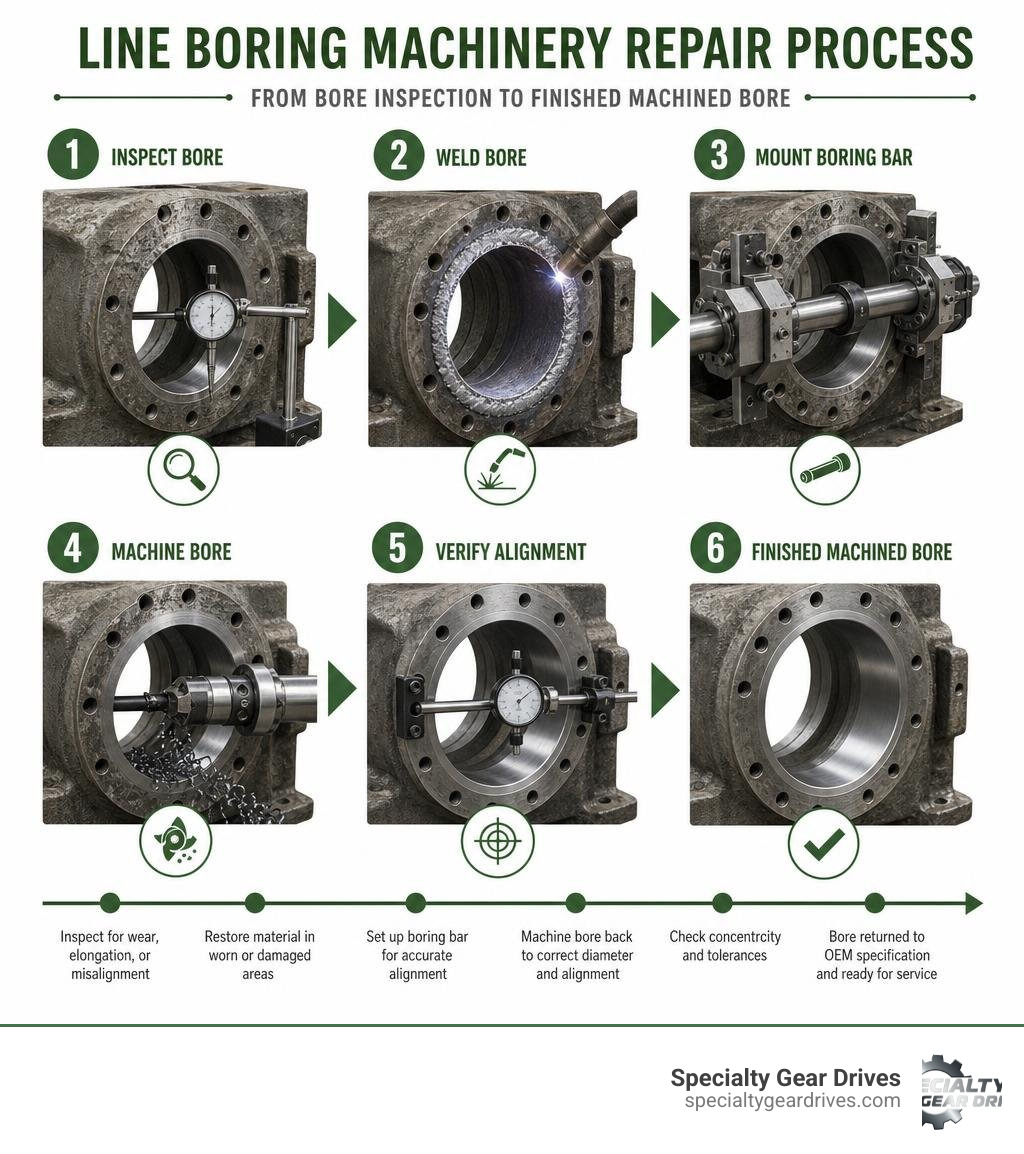
- Inspect the damaged bore for wear, elongation, or misalignment
- Weld material back into the bore if metal has been lost (bore welding)
- Mount a boring bar through the bore using centering cones and bearing brackets
- Machine the bore back to the correct diameter and alignment
- Verify concentricity and tolerances with a dial indicator or laser alignment tool
- Install a repair sleeve if needed, or return the bore to OEM spec directly
This applies to gearbox housings, bearing bores, pivot pins, engine bedplates, and virtually any heavy industrial component where aligned holes are critical to function.
Bore wear is one of the most common and most underestimated failure modes in heavy industrial equipment. A bore that starts slightly out of round puts uneven load on bearings and shafts. That uneven load creates vibration. The vibration accelerates wear on surrounding components. Left alone, what starts as a loose fit becomes a catastrophic failure.
The good news: in most cases, line boring repairs the bore without replacing the entire housing. That matters a lot when you’re looking at a large gearbox casting or a piece of mining equipment that can’t simply be swapped out overnight.
Quick line boring machinery repair terms:
What is Line Boring and How Does It Work?
Line boring is a highly precise machining process designed to enlarge, refine, and perfectly align existing holes in heavy-duty machinery. Unlike drilling, which is meant to create a brand new hole from solid material, line boring focuses on correcting the geometry and dimensions of bores that already exist but have suffered wear.
The primary mechanical objective of this process is to establish perfect collinearity. When a piece of machinery contains multiple bores along a single shaft line, every single one of those bores must share the exact same centerline. If even one bore is out of alignment by a fraction of a millimeter, the shaft will bind, bearings will overheat, and gears will experience uneven tooth contact.
During a typical line boring operation, we pass a rigid, ground steel boring bar through the center of the worn holes. This bar holds one or more single-point cutting tools. As the bar rotates and moves slowly along the axis of the bore, the cutting tools shave away thin layers of metal. This gradual material removal restores the bore to a perfect circle and aligns it precisely with the rest of the machinery frame. To understand more about the underlying mechanics of this precision work, you can read Everything You Need to Know About Line Boring Machining.
Key Equipment Requiring Line Boring Machinery Repair
Heavy industrial machinery relies on perfectly round and aligned bores to handle extreme torque and structural loads. When these bores wear down, the entire machine suffers.

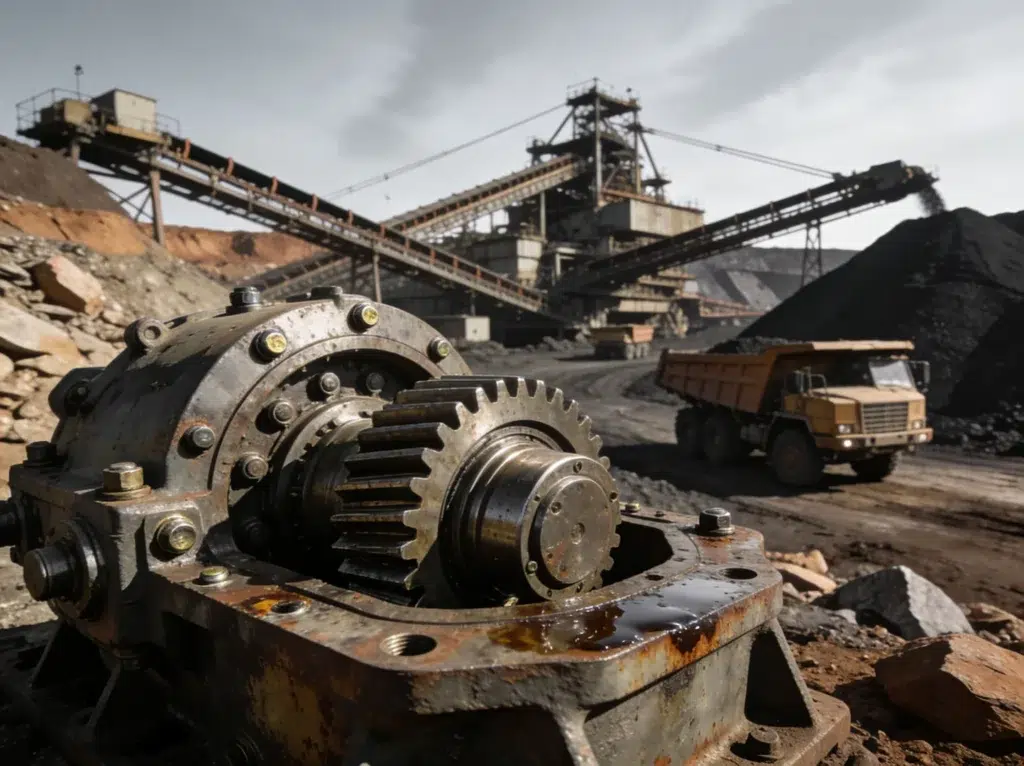
Large industrial gearbox housings are among the most common components that require this specialized repair. When a high-torque speed reducer in a Florida phosphate plant or an Alabama pulp mill experiences a bearing failure, the bearing outer race can spin inside the housing. This spinning action quickly eats away the cast iron or steel housing, leaving an oversized, out-of-round bore that cannot support a new bearing. Instead of scrapping a multi-ton casting, we perform a precision repair on the housing. You can find more detail on this specific service by checking out Line Boring Gearbox Housing Find Professional Services.
Other critical industrial assets that frequently require line boring include:
- Heavy diesel engine bedplates: Restoring the alignment of main bearing pockets and upper and lower cylinder liner landings.
- Steam, gas, and hydro turbines: Re-machining casing joints, blade grooves, and coupling bolt holes.
- Mining and earthmoving equipment: Restoring worn hinge pin bores on large excavator buckets, booms, and chassis joints.
- Marine propulsion systems: Boring out stern tubes, rudder stocks, and pintle bores on coastal cargo vessels and tugboats.
- Industrial manufacturing presses: Re-aligning massive guide bushings and shaft bores in steel fabrication plants.
Causes of Bore Wear and Misalignment in Heavy Machinery
Bore wear is rarely a sudden event. It is almost always the result of prolonged mechanical stress, environmental factors, or maintenance oversights.
Friction is the most obvious culprit. Even with proper lubrication, heavy machinery joints operate under immense pressure. Over time, micro-movements between shafts, bushings, and bores wear away the parent metal. This is especially true in reciprocating machinery or systems subject to heavy shock loads, such as aggregate crushers or wood chippers.
Vibration accelerates this wear cycle. When a shaft suffers from minor imbalance or misalignment, it creates cyclic forces that hammer against the bearing bores. This constant pounding can cause the bearing races to loosen and spin within their seats, destroying the precise press-fit tolerances. If you want to catch these issues before they ruin your housings, implementing a predictive maintenance strategy is key. Read about how this works in How Gearbox Condition Monitoring Saves Your Machinery and Your Sanity.
Environmental conditions across the Southeast also play a major role. High humidity, salt air along the Gulf Coast, and chemical exposure in Louisiana petrochemical plants cause micro-corrosion inside the bores. This corrosion weakens the metal surface, making it far more susceptible to galling and rapid wear when the machine is under load.
Stationary vs. Portable Line Boring Machinery Repair
When faced with a worn bore, plant managers must choose between shipping the component to a machine shop or performing the repair on-site. Both approaches have distinct mechanical advantages depending on the size and location of the damaged equipment.
Stationary line boring relies on massive workshop boring mills. This method is highly precise and ideal for smaller, easily transportable gearboxes or components that require extensive structural rebuilding. In a controlled shop environment, we can set up complex setups and utilize heavy machinery to achieve near-perfect tolerances. You can read a thorough breakdown of these workshop practices in The Complete Guide to Line Boring Housing Machining.
Portable line boring, on the other hand, brings the machine shop directly to your facility. Using compact, high-torque portable boring bars, technicians mount the machining equipment directly to the damaged machine frame. This eliminates the massive logistical headaches, transport costs, and extended downtime associated with rigging and shipping multi-ton equipment.
| Parameter | Stationary Line Boring (Workshop) | Portable Line Boring (On-Site) |
|---|---|---|
| Equipment Size Limit | Limited by workshop crane and machine bed capacity | Virtually unlimited; machine mounts directly to the workpiece |
| Downtime | Longer; requires complete disassembly, rigging, and transport | Shorter; repairs are performed in-situ with minimal teardown |
| Setup Complexity | Lower; machine tool is already level and calibrated | Higher; requires custom mounting brackets and on-site alignment |
| Environmental Control | High; temperature and dust-controlled shop environment | Variable; subject to outdoor or active plant floor conditions |
| Cost Profile | Higher transport and rigging costs; lower machining rates | Zero transport costs; specialized field labor rates apply |
On-Site Setup and Execution of Portable Line Boring
Setting up a portable line boring machine on-site is a highly skilled mechanical procedure where precision is everything. A single mistake during the initial alignment phase will result in a scrap component.
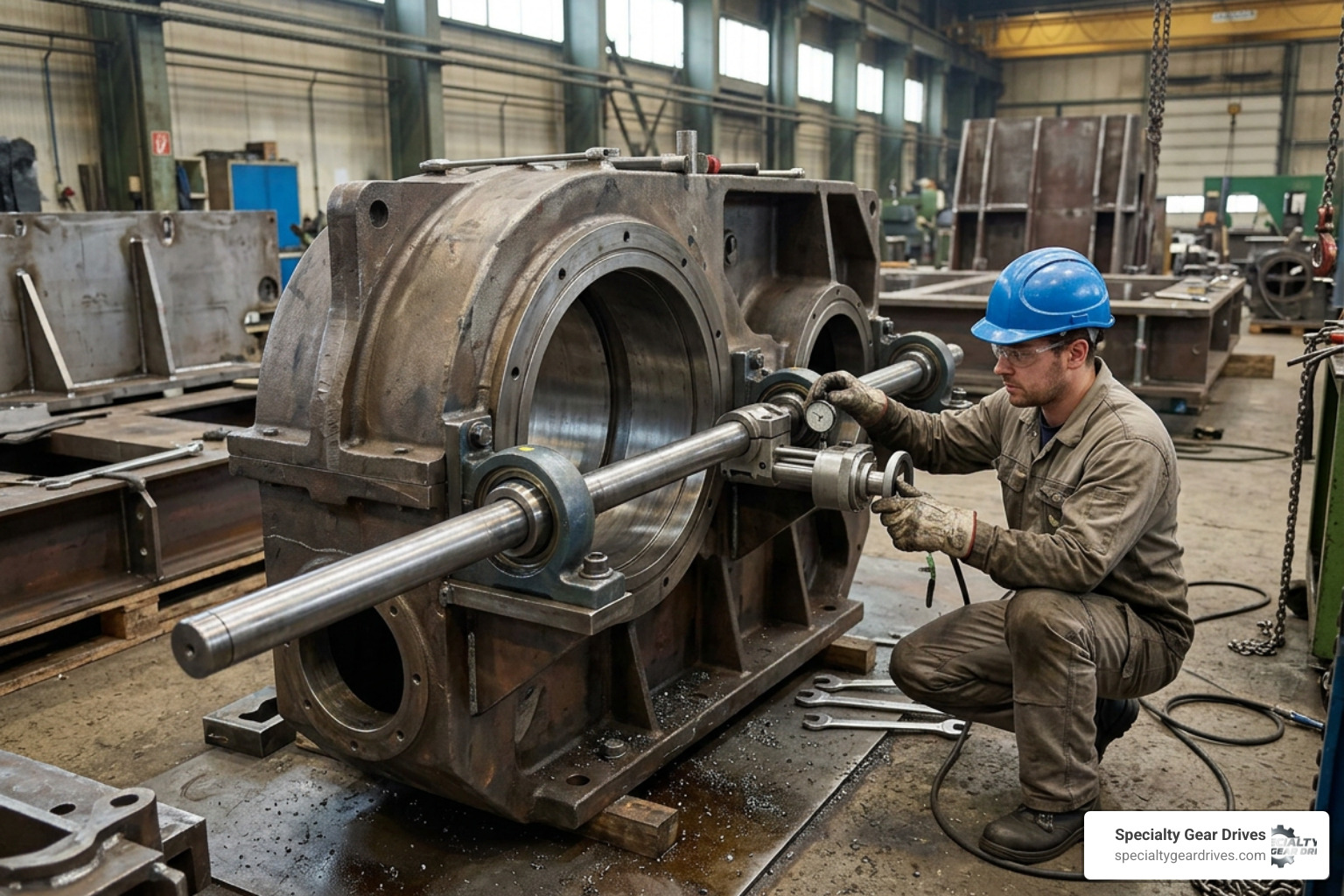
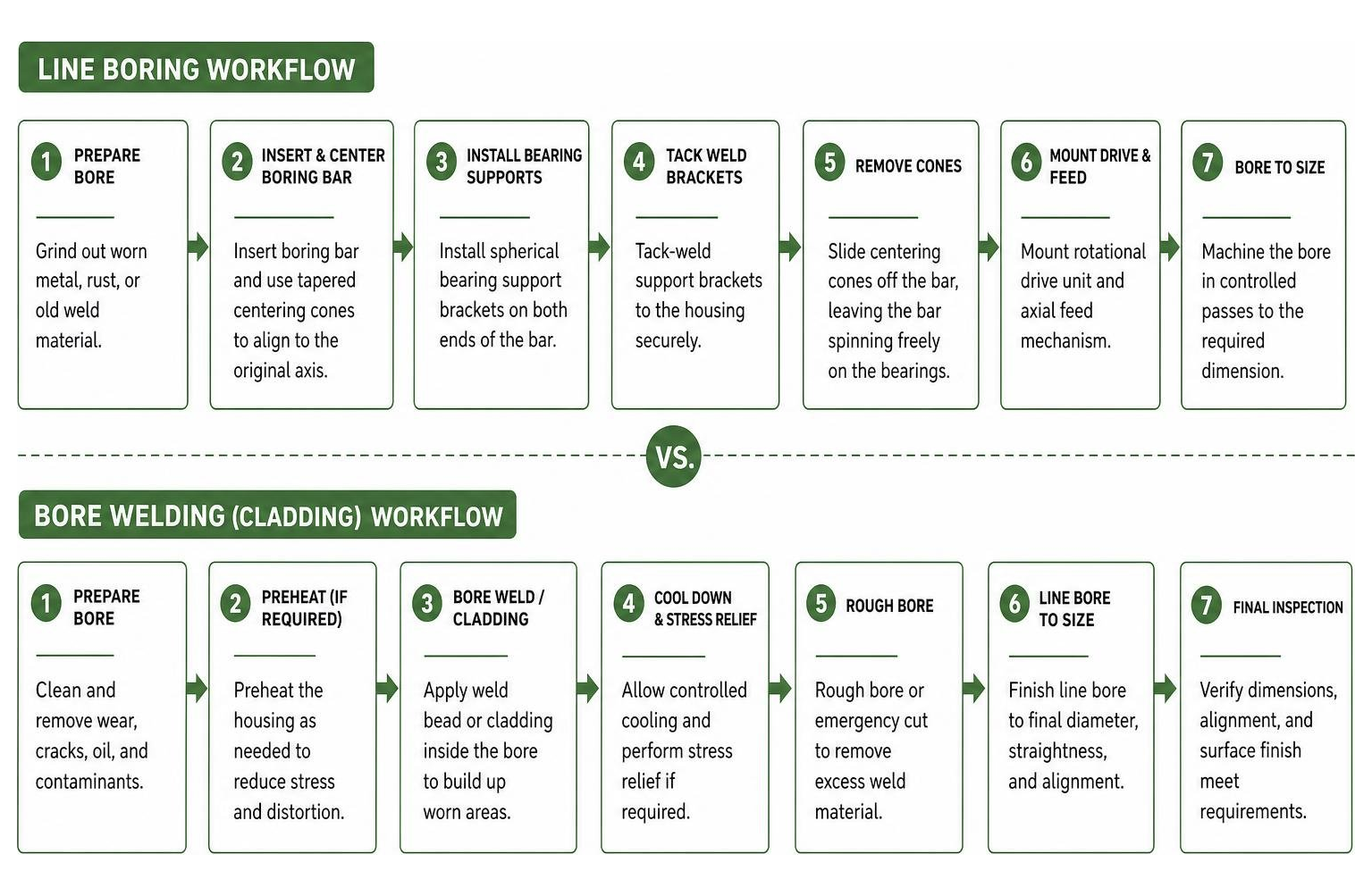
The first step is thorough preparation. We grind out any galled metal, rust, or old weld material from the damaged bore using carbide grinding tools. Once the bore is clean, we slide the boring bar through the opening. To center the bar relative to the original, undamaged bore axis, we slip tapered centering cones onto the bar and push them firmly into the bores. These cones mechanically force the bar into the exact geometric center of the original hole.
Next, we install spherical bearing support brackets over the ends of the boring bar. These specialized bearings are critical because they allow for multi-directional self-alignment, preventing the bar from binding if the mounting brackets are welded at a slight angle. We securely tack-weld these brackets directly to the equipment housing. Once the brackets are secured, we slide the centering cones out of the way, leaving the boring bar spinning freely on the aligned bearings. Finally, we mount the rotational drive unit and the axial feed mechanism to the bar. For a closer look at similar shaft and bore restoration techniques, see our Step by Step Guide to Shaft Rebuild Services.
Essential Tools for a Line Boring Kit
A professional line boring kit must be stocked with high-precision measuring and cutting tools to ensure workshop-level accuracy in field conditions.
The foundation of the kit is the boring bar itself. We use bars made from 100,000 PSI high-tensile alloy steel that are hard chrome-plated. The chrome plating is essential because it prevents weld splatter from sticking to the bar during bore welding operations and resists scratches from locking set screws. The cutter mounting holes must be spaced at least five inches apart to preserve the structural stiffness of the bar under heavy cutting loads.
For measurement, we rely on specialized instruments that allow us to check our work without constantly dismantling the setup. These include:
- Precision dial indicators: Used to measure runout and verify that the boring bar is concentric to the original bore.
- Telescoping bore gauges and inside micrometers: Essential for measuring the exact diameter of the hole as we make successive cutting passes.
- Cutter positioners: Micrometer-style clamps that attach to the boring bar, allowing us to adjust the cutting tool depth by precise thousandths of an inch.
- Boring bar mounted snap gauges: Specialized gauges that measure the bore diameter directly over the bar, saving valuable time.
To see how these tools come together to solve severe wear issues in heavy industrial setups, you can read Bore No More How Housing Line Boring Repairs Heavy Equipment.
Measuring and Ensuring Bore Alignment Accuracy
Achieving perfect alignment requires continuous verification throughout the machining process. We measure twice and cut once, verifying our setup at every stage to ensure we meet strict OEM tolerances.
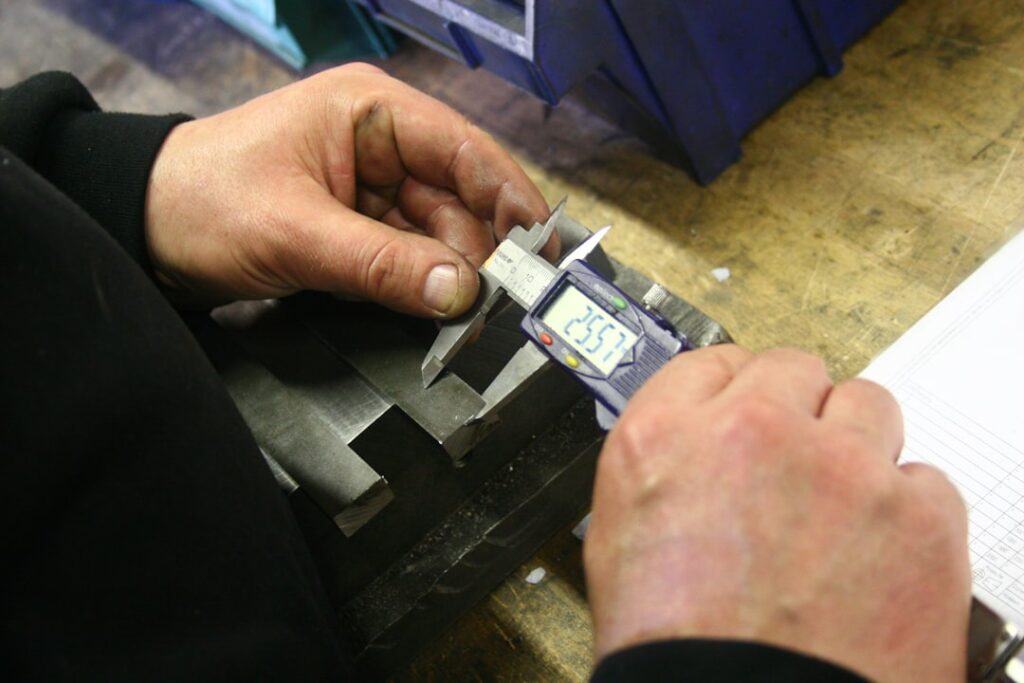
We measure alignment accuracy using Total Indicator Runout (TIR). By mounting a dial indicator to the rotating boring bar and sweeping it around the circumference of an undamaged reference bore or a machined face, we can detect any axial or radial misalignment. Our target for high-precision industrial gearboxes is a TIR of near zero, typically within hundredths of a millimeter (or less than 0.001 inches).
When dealing with long, multi-bore setups, such as the main bearing line of a large reciprocating compressor or a stern tube, mechanical dial indicators can be difficult to use over long distances. In these scenarios, we integrate laser alignment systems. A laser transmitter projects a perfectly straight beam through the bores, and a digital receiver mounted on the boring bar measures any deviation down to the micron. This ensures that even over spans of several meters, the finished bores will be perfectly collinear. To understand how these high-accuracy rebuilds are managed from start to finish, refer to The Ultimate Guide to Line Boring Rebuild Services.
How Bore Welding and Cladding Complement Line Boring
Line boring alone can only remove metal. If a bore has worn past its maximum allowable limit, simply boring it out larger would require using an oversized, non-standard bearing or bushing, which weakens the surrounding housing structure. This is where bore welding and cladding become essential parts of the repair process.
Bore welding is the process of depositing layers of new metal onto the worn inner surface of the bore to rebuild its thickness. We use automatic spiral welding systems that attach directly to the same mounting brackets as our line boring machine. The welding torch rotates and advances automatically, laying down a highly uniform, continuous bead of weld metal around the inside of the bore.
Once the bore is welded back to an undersized diameter, we swap the welding torch for the boring bar. We then machine the newly deposited weld metal back down to the exact OEM standard diameter. This combination of spiral welding and line boring allows us to restore even severely damaged or “wrecked” bores back to like-new condition, preserving the structural integrity of the original casting. To learn more about how advanced welding services are used to save damaged castings, read How Gearbox Housing Welding Services Restore Damaged Castings.
Frequently Asked Questions About Line Boring
What are the safety considerations during line boring machinery repair?
Safety during field machining requires strict adherence to industrial protocols, especially since we are combining heavy rotating machinery with high-temperature welding on-site.
Because bore welding involves open arcs and high heat, a comprehensive hot work permit is always required. Technicians must ensure that the surrounding area is completely clear of flammable materials, which is particularly critical in chemical processing plants or wood yards. Proper ventilation and flash shielding are also necessary to protect nearby plant personnel.
The line boring machine itself utilizes high-torque electric or hydraulic motors. Operators must keep loose clothing, hair, and hands well away from the rotating boring bar and drive gears. Additionally, portable magnetic drill presses or drive units must be secured with safety chains or heavy-duty mechanical clamps. This prevents the equipment from falling and causing injury or severe machine damage if a sudden power failure occurs. For more insights on managing emergency repairs safely, read Emergency Gearbox Repair How to Never Worry About It Again.
How does line boring extend the life of heavy industrial equipment?
Line boring directly extends equipment life by correcting the root causes of mechanical wear: vibration and uneven load distribution.
When a bearing bore becomes elongated or misaligned, the shaft inside it begins to deflect under load. This deflection forces the gears out of their proper alignment, causing rapid tooth wear and localized pitting. It also forces the bearings to run hot, breaking down the lubrication film and leading to premature bearing failure. By restoring the bores to original OEM specifications, we eliminate this shaft deflection and ensure that gears mesh exactly as designed.
This precision repair significantly reduces the total cost of ownership. Instead of purchasing an expensive new gearbox housing and waiting months for delivery, line boring allows you to rebuild the existing asset for a fraction of the cost. This typically results in savings of up to 60% compared to buying new. To see how these boring techniques fit into a comprehensive rebuild strategy, check out The Ultimate Guide to Gearbox Rebuild.
Which Southeast industries benefit most from line boring services?
Facilities throughout the Southeast operate under demanding conditions, where high humidity, heat, and heavy continuous loads accelerate machinery wear.
Pulp and paper mills throughout Alabama and Mississippi rely heavily on line boring to maintain their massive dryer rolls, press sections, and wood yard debarking drums. Phosphate mining and citrus processing plants in Florida use these services to rebuild the heavy-duty gear reducers and slurry pumps that keep their operations running.
In Louisiana, petrochemical plants and busy marine ports utilize in-situ line boring to repair large compressor casings, turbine housings, and shipboard drive systems without the immense expense of moving them off-site. By keeping these critical bores aligned, facilities across the region minimize unplanned downtime and keep production lines moving. For a deeper look at the mechanical benefits of professional machinery repairs, see Everything You Need to Know About Gearbox Repair.
Conclusion
When a critical industrial gearbox or heavy machine housing suffers from bore wear, you do not have to accept weeks of downtime or the massive expense of purchasing a replacement. Precision line boring machinery repair restores your worn, out-of-round bores back to exact OEM specifications right where they sit, saving you time and money.
At Specialty Gear Drives, we specialize in the complete repair, rebuilding, and manufacturing of industrial gearboxes for heavy industries across the Southeast, including oil and gas, mining, pulp and paper, and chemical processing. Based in Largo, Florida, we proudly serve plants and facilities throughout Florida, Georgia, Alabama, South Carolina, Mississippi, and Louisiana.
We understand that every hour of downtime costs your facility money. That is why we offer 24–48 hour emergency repair services, free pickup and delivery, and an industry-leading 24-month warranty on our work. When you partner with us, you can achieve up to 60% savings compared to the cost of buying a new gearbox, all while receiving workshop-grade precision delivered by experienced technicians.
If you are dealing with a worn bearing bore, a misaligned housing, or a gearbox that needs immediate attention, do not wait for a catastrophic failure. Contact us today to schedule your precision repair and get your machinery back running at peak efficiency. Learn more about our comprehensive capabilities by visiting our Industrial Gearbox Repair service page.