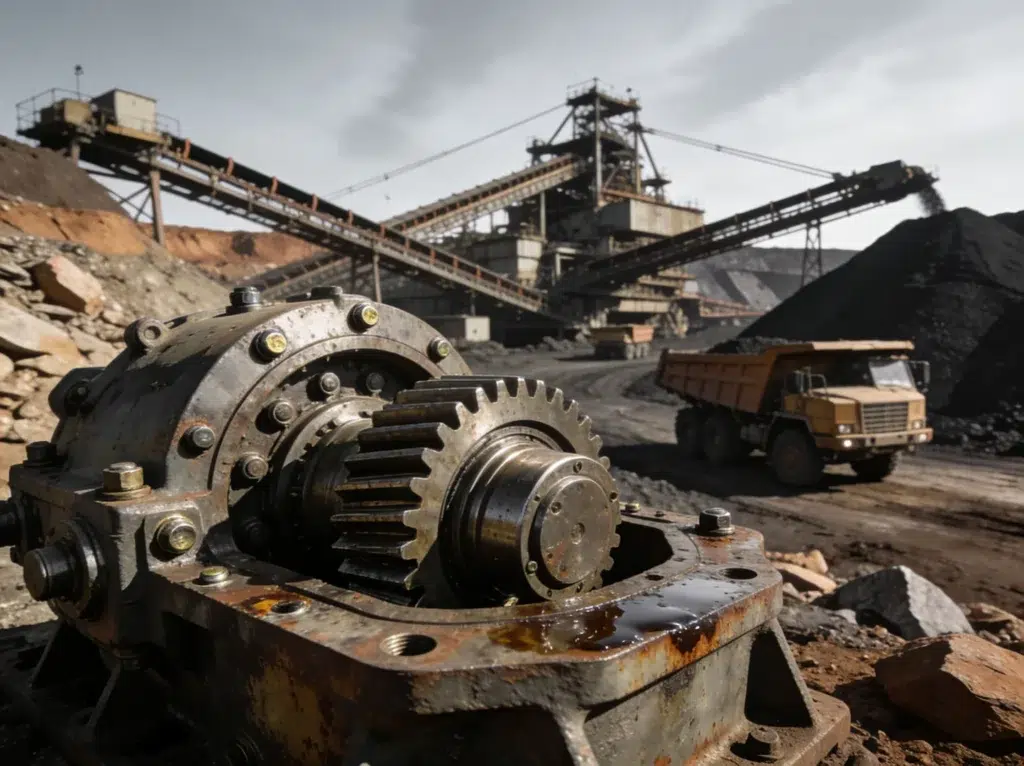
A gearbox housing welding service is a specialized repair process that restores cracked, broken, or structurally compromised gearbox casings to full working condition, without the cost or lead time of a full replacement. If your facility is dealing with a failed housing right now, here is what you need to know:
What a professional gearbox housing welding service typically covers:
- Cracks in cast iron, cast aluminum, or cast steel housings
- Broken mounting lugs and flanges
- Damaged bearing seats and bores
- Cracked or eroded oil passages
- Broken brackets and thrust bearing guides
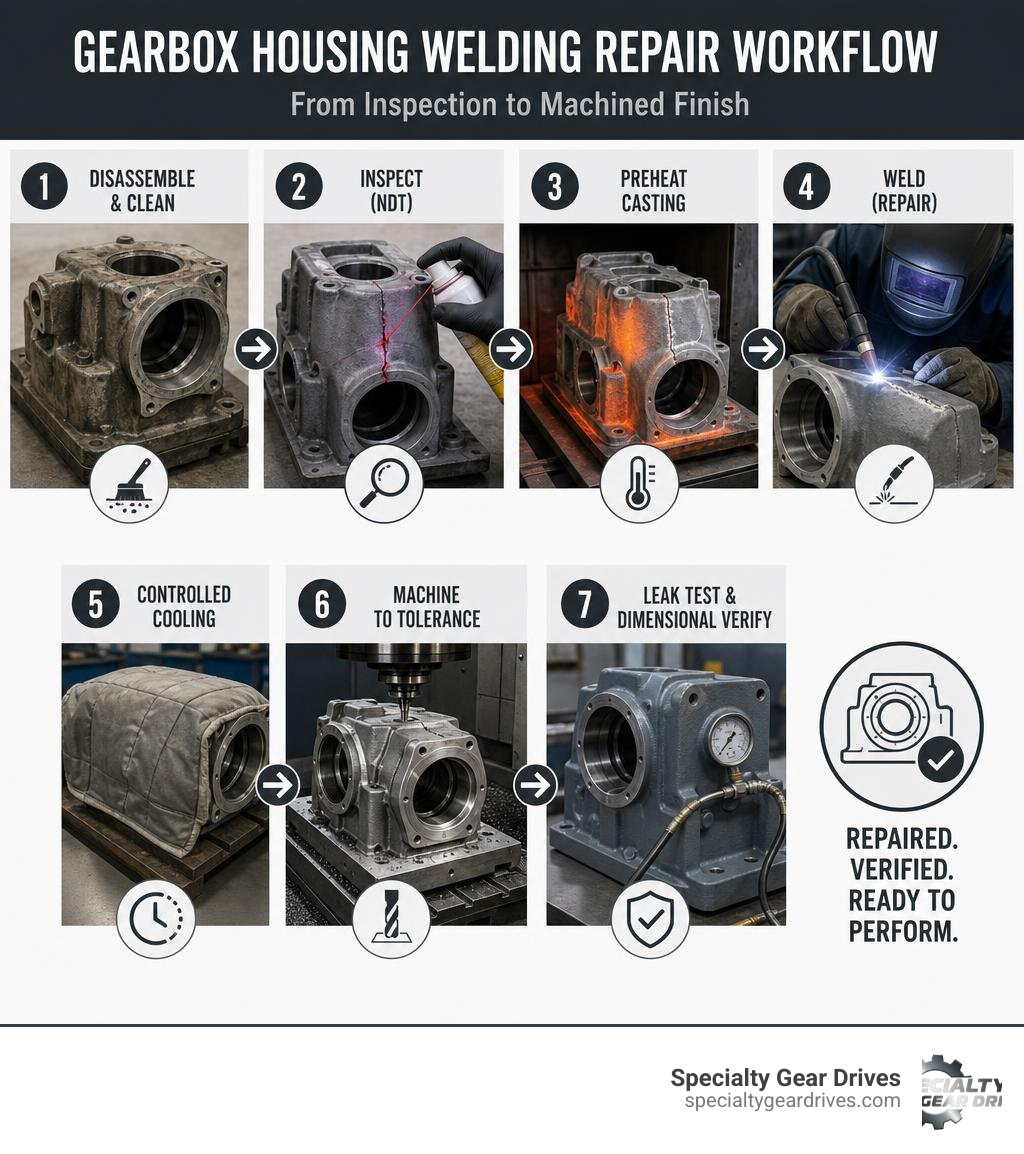
How the repair process works (simplified):
- Disassemble and clean the housing, including removing oil-saturated material
- Inspect the damage using NDT methods (dye penetrant, X-ray, or magnaflux)
- Preheat the casting to the correct temperature for the material
- Weld using the appropriate process (TIG, MIG, or laser welding)
- Allow controlled slow cooling to prevent new cracks
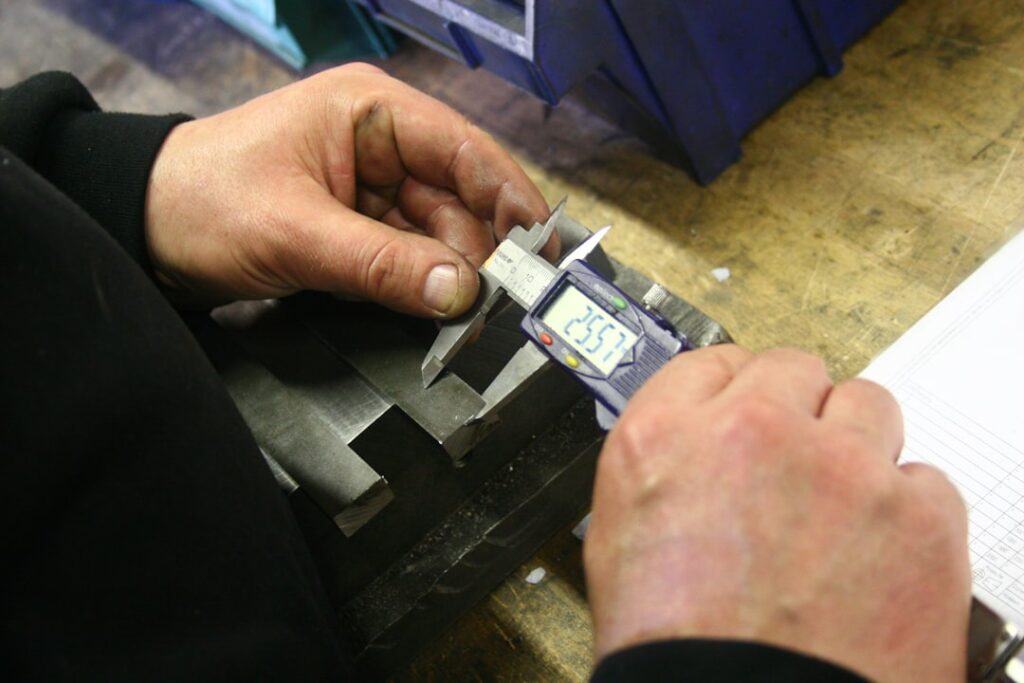
- Machine repaired surfaces back to original tolerances
- Leak test and dimensional verify before reassembly
A single failed gearbox housing on a conveyor line or processing plant can halt an entire production shift. Replacement castings for industrial gear reducers often carry lead times measured in weeks, not days. For maintenance engineers weighing repair against replacement, welding is frequently the faster and more practical path, provided the repair is done correctly and by someone who understands the material.
The challenge is finding a service provider with the right combination of welding expertise, post-weld machining capability, and quality verification. This guide walks you through exactly what to look for.
Common Types of Industrial Gearbox Housing Damage
Industrial gearboxes endure extreme operational stresses, including high torque loads, constant vibration, and environmental temperature swings. Over time, these forces can cause structural failures in the metal casing that require immediate professional attention.

Cracked Castings and Structural Fractures
Cracks often develop around high-stress areas like corners, structural ribs, and near-input or output shafts. These cracks can start as microscopic stress fractures before spreading across the housing wall. If left unaddressed, a minor hairline crack will eventually expand, leading to catastrophic structural failure and massive oil loss that destroys the internal gears.
Broken Mounting Lugs and Flanges
The mounting lugs secure the gearbox to the machine base or foundation. High-torque start-ups, sudden shock loads, or structural misalignment can snap these mounting ears completely off the housing. When a mounting lug breaks, the gearbox shifts, causing immediate shaft misalignment, severe vibration, and rapid wear on the internal bearings and gear teeth.
For more details on diagnosing alignment issues, you can read our guide on how to Don’t Grind Your Gears and Find the Best Gearbox Repairing Near Me.
Damaged Bearing Seats and Bores
Bearing bores hold the rotating shafts in precise alignment. If a bearing fails or spins inside the housing, it can gouge, gall, or wear down the bore diameter. This wear leaves the bearing loose, throwing off the gear mesh and causing rapid gear wear. A professional welding service can build up the worn bore with weld metal so it can be machined back to its original dimensions.
Cracked Oil Passages and Internal Guides
Many large industrial gearboxes use internal oil passages cast directly into the housing walls to route lubricant to critical bearings. Cracks in these internal passages can cause pressure drops in the lubrication system, starving bearings of oil. Similarly, thrust bearing guides and internal retaining shoulders can wear down or break under heavy thrust loads, requiring precision weld build-up and machining.
Welding Processes and Material Challenges for Industrial Castings
Welding a gearbox housing is not the same as welding structural steel. Most industrial gearboxes are made from cast metals, which require highly specialized thermal controls and filler materials to prevent cracking during the welding process.
| Material Type | Common Applications | Key Welding Challenges | Preferred Welding Process |
|---|---|---|---|
| Gray Cast Iron (e.g., ASTM A48) | Heavy speed reducers, pump housings, industrial mixers | High carbon content makes it extremely brittle and prone to cracking | Oxy-acetylene brazing or TIG/Stick with high-nickel filler rods |
| Ductile Iron (e.g., ASTM A536) | High-impact gearboxes, mining equipment, paper mill drives | Requires precise preheat and post-weld heat treatment to maintain ductility | TIG or MIG with specialized nickel-iron wire |
| Cast Aluminum (e.g., A356) | Lightweight industrial gearboxes, chemical processing drives | Absorbs oils and contaminants, prone to severe porosity | TIG welding with 4043 or 5356 filler alloy |
| Cast Steel (e.g., ASTM A216) | Heavy-duty industrial gear drives, marine propulsion | High thermal mass requires preheat to prevent hydrogen cracking | MIG or TIG with low-hydrogen mild steel or alloy filler |
Cast Iron Welding Challenges
Cast iron is notoriously difficult to weld because of its high carbon content. When cast iron is heated rapidly by a welding arc and then cooled quickly, it forms a hard, brittle microstructure called martensite. This brittle zone is highly susceptible to cracking under the thermal stress of the weld. To prevent this, we must use specialized nickel-based filler rods. Nickel remains ductile as it cools, absorbing the shrinkage stresses and preventing the cast iron from cracking along the weld boundary.
Cast Aluminum and Oil Absorption
Cast aluminum is a highly porous material that acts like a sponge when submerged in industrial gear oil for years. When you strike a welding arc on oil-saturated aluminum, the heat vaporizes the trapped oil, creating hydrogen gas bubbles. These bubbles become trapped in the solidifying weld pool, resulting in severe porosity that weakens the repair. Eliminating this oil before welding requires chemical degreasing, baking, and mechanical grinding.
Choosing the Right Welding Process
The choice of welding process depends on the material, the location of the damage, and the level of precision required:
- TIG (Tungsten Inert Gas) Welding: TIG welding is the preferred choice for precise build-up on bearing seats, thin-walled aluminum housings, and complex geometries. It allows the operator to control the heat input and filler metal deposition independently, minimizing thermal distortion. For a deeper look at build-up techniques, see our article on The Art of the Weld: How to Build Up and Repair Worn Shafts.
- MIG (Metal Inert Gas) Welding: MIG welding is highly efficient for structural repairs on cast steel housings or when fabricating heavy steel reinforcement plates. It provides fast deposition rates for large repairs.
- Laser Precision Welding: Laser welding uses an extremely concentrated, low-heat light beam to melt the metal. This process is highly specialized and is used for precision repairs where thermal distortion must be kept to an absolute minimum to protect adjacent machined surfaces.
Critical Pre-Weld and Post-Weld Restoration Steps
A successful gearbox housing repair is decided long before the welding torch is lit and long after the weld has cooled. Skipping the critical preparation or finishing steps will almost guarantee a failed repair.

Deep Cleaning and Degreasing
Before any metal is joined, the housing must be completely stripped of paint, rust, and gear oil. For oil-saturated castings, we use a multi-step cleaning process. This involves solvent degreasing, steam cleaning, and baking the casting in a controlled industrial oven. Baking heats the metal to a temperature that draws the deeply embedded oil out of the pores so it can be wiped away and ground clean.
Preheating and Thermal Control
Preheating the entire housing is essential for cast iron and thick cast steel components. We heat the housing to between 400 degrees and 500 degrees Fahrenheit before welding. This preheating reduces the temperature difference between the weld pool and the surrounding casting, slowing down the cooling rate. Slower cooling prevents the formation of brittle microstructures and minimizes the residual stresses that cause cracking.
Stress Relieving and Controlled Cooling
Once the welding is complete, the housing must not be allowed to cool quickly in open air. We wrap the welded housing in heavy insulation blankets or bury it in dry sand. This traps the heat and allows the housing to cool down slowly over several hours, or even overnight. For critical industrial applications, we perform a formal post-weld heat treatment in an oven to fully relieve any residual stresses locked inside the metal.
Post-Weld Machining and Line Boring
Welding heat always causes microscopic movement in the metal. Even with perfect preheating and slow cooling, bearing bores and mounting faces can warp slightly out of alignment. Once the housing has cooled completely, we mount it on a horizontal boring mill or CNC machining center. We then machine all critical mating surfaces, flange faces, and bearing bores back to their original factory tolerances, often holding alignments within thousandths of an inch.
To understand how we restore these critical bearing alignments, you can read our detailed article on Bore No More: How Housing Line Boring Repairs Heavy Equipment.
Choosing a Professional Gearbox Housing Welding Service
When your plant is down, you need a repair partner who can perform a reliable, engineered repair that stands up to continuous industrial duty.
When to Choose a Gearbox Housing Welding Service Over Replacement
Repairing an industrial gearbox housing is almost always more cost-effective and faster than buying a new one. Original equipment manufacturers often charge high prices for replacement castings, and lead times can stretch from weeks to months, especially for older or imported machinery.
Choosing a professional repair service can save up to 60% compared to the cost of a new housing. More importantly, a welded repair can be completed in a fraction of the time, getting your production line back up and running quickly. If the housing is completely obsolete and cannot be sourced, welding is often the only viable way to save the machine.
What to Look for in a Local Gearbox Housing Welding Service
Not every local weld shop is equipped to handle industrial gear cases. When evaluating a service provider, look for these capabilities:
- In-House Machining: The shop must have large-format milling and line boring capabilities to machine the housing back to specification after welding. If they have to outsource the machining, it will delay your repair and increase the risk of alignment errors.
- Non-Destructive Testing (NDT): A professional shop will verify their work using dye penetrant testing, magnetic particle inspection, or ultrasonic testing to ensure there are no hidden cracks or voids in the weld.
- Leak Testing Equipment: The shop should perform pressure decay leak testing on the completed housing to guarantee that it will not leak oil when returned to service.
- Warranty Protection: A reputable industrial repair specialist will back their work with a solid warranty, giving you confidence that the repaired housing will perform reliably under load.
For comprehensive support on all aspects of your drivetrain, you can learn more about our full range of Industrial Gearbox Repair services.
Frequently Asked Questions about Gearbox Housing Repairs
Can a cracked cast iron gearbox housing be welded?
Yes, cast iron can be welded successfully, but it requires strict adherence to specialized procedures. The process involves thoroughly cleaning the casting, grinding a bevel along the crack, stop-drilling the ends of the crack to prevent it from spreading, preheating the housing to around 400 to 500 degrees Fahrenheit, and using high-nickel filler rods. After welding, the housing must be cooled very slowly under insulating blankets to prevent cracking.
How do you prevent oil leaks after welding a gearbox casing?
Preventing oil leaks requires eliminating weld porosity and ensuring a flat mating surface. We achieve this by baking out trapped oil from the casting pores before welding, using clean shielding gas, and applying precise welding techniques. After welding, we machine the gasket surfaces flat and perform a pressure decay leak test, where the housing is sealed, pressurized with air, and monitored to ensure there is zero pressure drop over time.
Is a welded gearbox housing as strong as a new casting?
A properly welded, stress-relieved, and machined housing is structurally equivalent to a new casting. In high-stress areas, we often reinforce the repair by building up the metal thickness or welding external steel reinforcement straps across the repaired zone. When combined with proper post-weld heat treatment to relieve internal stresses, the repaired housing can easily match the original tensile strength and service life of the machine.
Conclusion
A cracked or broken gearbox housing does not have to mean a costly replacement and weeks of lost production. With a professional gearbox housing welding service, you can restore your critical industrial equipment to factory specifications quickly and reliably.
At Specialty Gear Drives, we specialize in the repair, rebuilding, and manufacturing of heavy industrial gearboxes for demanding sectors like oil and gas, mining, pulp and paper, food processing, and chemical manufacturing. Based in Largo, Florida, we provide rapid-response services across Florida, Georgia, Alabama, Mississippi, South Carolina, and Louisiana.
Our key advantages include:
- 24 to 48-Hour Emergency Service to minimize your facility’s downtime
- Free Pickup and Delivery across our entire southeastern service area
- Up to 60% Savings compared to the cost of buying a new OEM gearbox
- 24-Month Warranty on all parts, labor, and structural repairs
If you have a damaged gearbox housing that needs immediate professional attention, contact us today to schedule a pickup or request an emergency repair quote. Let us help you get your operations back on track. For more information on how we can help, visit our Industrial Gearbox Repair page.