When a Gearbox Fails, Every Minute Counts
Emergency gearbox repair is the rapid diagnosis, rebuilding, and restoration of a failed industrial gearbox to get critical equipment back online as fast as possible, typically within 24 to 48 hours for qualifying jobs.
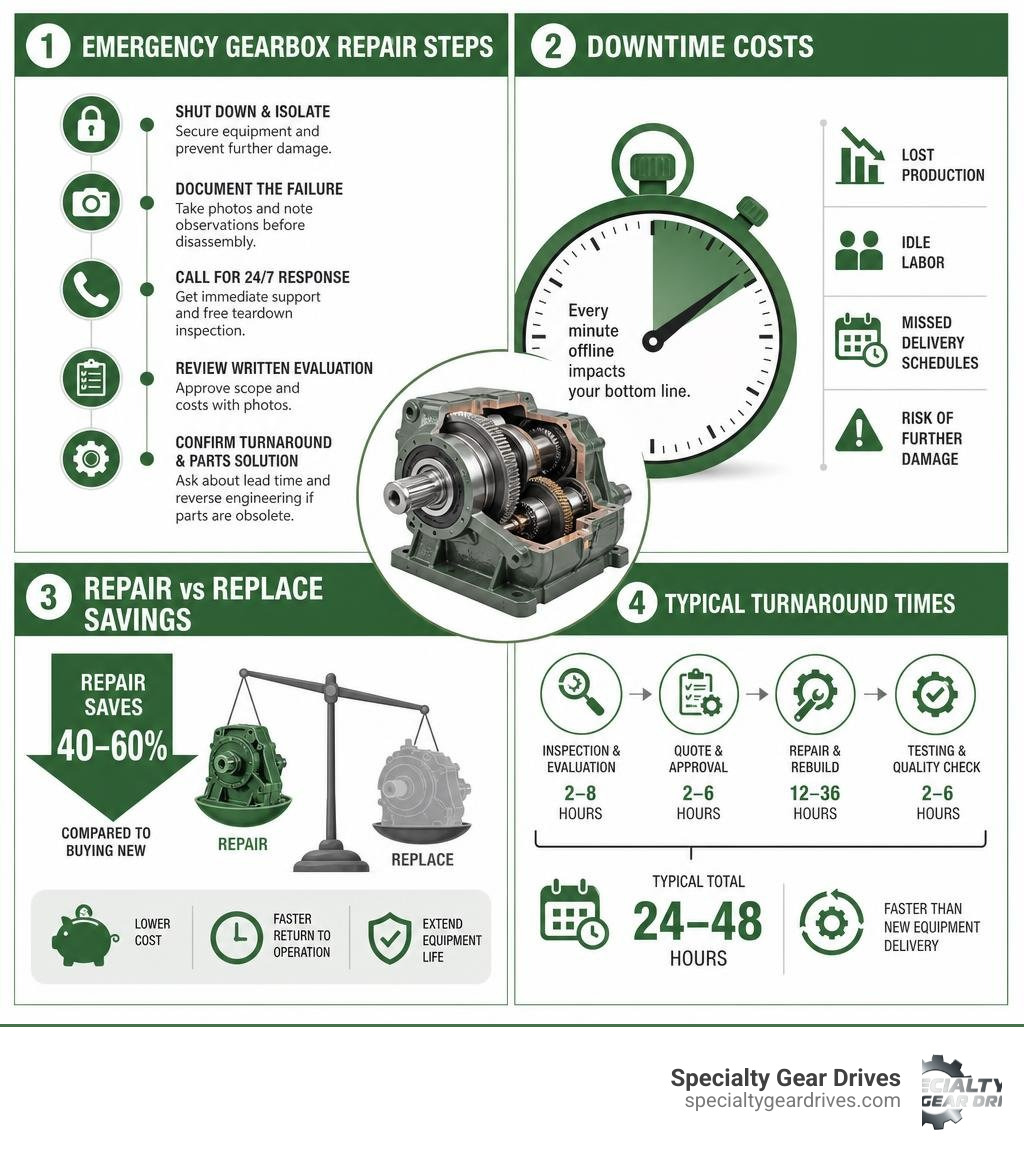
If your gearbox just failed and you need to know what to do right now:
- Shut down and isolate the affected equipment to prevent further damage
- Document the failure with photos before any disassembly
- Call an emergency repair service that offers 24/7 response and free teardown inspection
- Request a written evaluation with photos before approving any repair work
- Ask about turnaround time and whether reverse engineering is available if parts are obsolete
A single failed gearbox on a conveyor line, a cement mill drive, or a paper machine can shut down an entire production shift. In heavy industry, unplanned downtime rarely costs just the price of the part. It compounds: lost output, idle labor, missed delivery schedules, and in some cases, cascading damage to connected equipment.
The good news is that most industrial gearboxes, even severely damaged ones, can be repaired to OEM specifications at a fraction of the cost of buying new. Repairing instead of replacing typically saves 40% to 60% compared to a new unit, and a qualified emergency repair service can often turn a unit around faster than a new gearbox can even be sourced.
This guide covers everything a plant manager or maintenance engineer needs to know: warning signs, the repair process, how to evaluate vendors, and how to handle the first critical moments after a failure.
What is Emergency Gearbox Repair and When is it Needed?
Emergency gearbox repair is an expedited restoration service designed to address sudden, catastrophic failures or severe wear in heavy-duty gear drives. It is required when a failure stops production, creates unsafe operating conditions, or threatens to cause cascading mechanical damage to associated machinery. Unlike standard planned maintenance, emergency repairs bypass the usual scheduling queues to restore your plant’s operations immediately.
When an industrial gearbox operates under heavy loads, its internal components are subjected to immense physical stress. Every gear ratio, torque rating, and shaft alignment is engineered to operate within precise tolerances. In high-demand applications like mining conveyors, chemical mixers, and paper mill rollers, a minor deviation can quickly escalate into a complete system shutdown.
While routine maintenance can catch many issues, sudden operational changes or extreme environmental conditions can trigger unexpected failures. Tracking the operational health of your machinery through regular diagnostic protocols is the best way to prevent these emergencies, as detailed in our guide on How Gearbox Condition Monitoring Saves Your Machinery and Your Sanity.
When to Call for Emergency Gearbox Repair
Call for emergency repair when a gearbox experiences a sudden impact, severe shaft misalignment, major lubrication breakdown, or structural housing damage. These issues require immediate professional intervention to prevent permanent damage to the gears and internal assemblies.
Sudden impacts often occur when foreign material enters the driven machinery, causing an abrupt halt that shocks the gear teeth. This extreme stress can chip or shear teeth instantly, rendering the unit inoperable. Lubrication breakdown is another major catalyst, where a failed seal leads to oil loss, resulting in rapid friction, heat buildup, and eventual component seizure.
If your machinery exhibits these severe symptoms, continuing to run the equipment will destroy the internal components entirely. Seeking immediate assistance through a dedicated Industrial Gearbox Repair service is the most effective way to limit the damage and salvage the core components of your unit.
Critical Warning Signs of Industrial Gearbox Failure
The most common warning signs of industrial gearbox failure are abnormal noises, elevated vibration levels, high operating temperatures, and visible fluid leaks. Tracking these indicators allows maintenance teams to schedule repairs before a catastrophic failure occurs.
Vibration analysis is one of the most reliable methods for detecting early-stage internal wear. When bearings begin to pit or gear teeth experience fatigue, the smooth rotation of the shafts is disrupted. This creates distinct vibration patterns that can be measured with diagnostic sensors. If a gearbox begins to shake or produce a deep, rumbling noise, it indicates that the internal geometry has shifted, requiring immediate inspection.
Fluid leaks and oil contamination are equally critical warning signs. A damaged seal not only lets vital lubricants escape but also allows moisture, dust, and metal particulates to enter the housing. This abrasive mixture accelerates wear on the gear teeth and bearings, leading to excessive backlash and endplay.
Identifying Gearbox Overheating and Wear
Overheating in an industrial gearbox can be identified by discolored housing paint, melted plastic components, or the boiling water test where water droplets instantly sizzle on the casing surface. These signs indicate that the internal temperature has exceeded safe operating limits, usually due to friction or lack of lubrication.
When internal friction rises, the heat transfers to the external housing. If you notice the paint on the gearbox casing blistering or darkening, the unit is operating far too hot. You can perform a simple check by spraying a small mist of water onto the housing. If the water boils off immediately, the internal components are at risk of thermal distortion and rapid failure.
This extreme heat degrades the lubricating oil, leading to metal-on-metal contact. The resulting wear can destroy gear profiles and ruin bearing races. To understand how to address these early signs of wear before they turn into a full-scale plant emergency, read our advice on how to Don’t Grind Your Gears and Find the Best Gearbox Repairing Near Me.
The Step-by-Step Emergency Gearbox Repair Process

The emergency gearbox repair process follows a structured sequence of rapid disassembly, cleaning, non-destructive testing, precision machining, rebuilding, and load testing. This systematic approach ensures that the rebuilt unit meets or exceeds original equipment manufacturer specifications.
When an emergency unit arrives at a specialized repair facility, the engineering team works around the clock to diagnose and resolve the issue. The standard workflow includes:
- Receiving and Documentation: The unit is photographed, assigned a unique tracking number, and visually inspected for external damage.
- Rapid Teardown: Technicians carefully disassemble the gearbox, cataloging every gear, bearing, shaft, and shim to identify the root cause of the failure.
- Ultrasonic Cleaning and NDT: All components are thoroughly cleaned to remove oil and debris, followed by non-destructive testing to locate microscopic cracks or structural flaws.
- Engineering Evaluation: A detailed report with photos is generated to outline the exact scope of work required.
- Precision Machining and Manufacturing: Worn shafts are built up, housings are bored, and damaged gears are reverse-engineered and manufactured in-house.
- Reassembly and Alignment: The gearbox is rebuilt using premium bearings and seals, with precise adjustments made to backlash and shaft endplay.
- Load Testing: The completed unit undergoes a rigorous test run to monitor operating temperatures, vibration levels, and seal integrity before shipment.
Restoring Damaged Housings and Shafts
Damaged gearbox housings and worn shafts are restored using precision line boring, thermal spray buildup, and specialized structural welding. These techniques allow repair facilities to salvage heavy castings and shafts rather than waiting months for new replacements.
Housings often suffer from spun bearings, which wear out the internal bores and cause shaft misalignment. Instead of scrapping the entire casting, technicians use line boring to restore the bores to their original dimensions. This process is explained in detail in our article, Bore No More: How Housing Line Boring Repairs Heavy Equipment.
Similarly, worn or damaged shafts can be repaired rather than replaced. Specialized welding and thermal spray techniques allow engineers to deposit new metal onto the worn areas of a shaft, which is then machined back to its precise original tolerances. You can learn more about this restoration method in The Art of the Weld: How to Build Up and Repair Worn Shafts.
If the housing casting itself is cracked or broken due to structural stress, advanced welding procedures can repair the metal without compromising its strength. Discover how this is achieved by reading How Gearbox Housing Welding Services Restore Damaged Castings.
Repair vs. Replace: Cost Benefits and Turnaround Times
Repairing an industrial gearbox typically saves 40% to 60% of the cost of a new replacement unit while reducing turnaround times from several months to just a few days. This makes repair the most cost-effective and fastest route to restoring production.
| Factor | Repair / Rebuild | Purchasing New |
|---|---|---|
| Average Cost | 40% to 60% savings compared to new | Full retail OEM pricing |
| Typical Lead Time | 24 to 48 hours (Emergency) | 8 to 24+ weeks |
| Obsolete Models | Fully supported via reverse engineering | Not available from OEM |
| Warranty | Matching or exceeding OEM terms | Standard manufacturer warranty |
| Upgrades | Modern materials and heat treatments | Standard factory specifications |
For heavy industrial operations, the lead time for a new gearbox is often the biggest obstacle. Many large-scale gear reducers are built to order, meaning a replacement could take months to arrive from the manufacturer. In contrast, an emergency repair facility can manufacture replacement gears, rebuild the internals, and return the unit to service in a matter of days.
Additionally, choosing a local or regional repair partner can significantly reduce logistical delays. Shipping heavy machinery across the country is expensive and time-consuming. Understanding how to manage these logistics is key, as discussed in Industrial Gearbox Repair – Don’t Let Shipping Costs Grind Your Gears.
How to Choose a Partner for Emergency Gearbox Repair
When selecting an emergency gearbox repair partner, look for a provider that offers 24/7 rapid response, has certified technicians, performs full load testing, and provides a warranty that activates only upon installation.
A reliable repair partner must have the in-house capability to manufacture replacement parts. If a repair shop has to outsource gear cutting or shaft machining, your downtime will extend significantly. Choosing a company with comprehensive machining, welding, and heat-treating capabilities under one roof ensures the fastest possible turnaround.
Ensure the provider offers a clear, written warranty on both parts and labor. The best partners offer warranties that begin when the gearbox is put back into active service, rather than when it leaves the repair shop floor, protecting your investment during storage or scheduled shutdowns.
Frequently Asked Questions about Emergency Gearbox Repair
How quickly can emergency gearbox repair services respond and complete repairs?
Emergency gearbox repair services typically offer a 24- to 48-hour rush turnaround for qualifying jobs, while standard non-emergency repairs take 7 to 10 business days.
The exact turnaround time depends on the extent of the damage and the availability of replacement parts. When a gearbox is received under emergency status, the repair facility schedules technicians to work in continuous shifts until the rebuild is complete. Rapid transit and regional pickup services help minimize the time spent in transport.
How do repair companies handle obsolete or hard-to-find parts?
Repair companies handle obsolete or hard-to-find parts by using reverse engineering, precision gear manufacturing, and archived OEM blueprints to recreate components to original or superior specifications.
If the original equipment manufacturer no longer supports the gearbox model, engineers can measure the worn parts using advanced coordinate measuring machines. They can then manufacture new gears, shafts, and pinions in-house. This process also allows the repair team to upgrade the components using modern alloy steels and advanced heat-treating methods like carburizing or induction hardening, making the rebuilt gearbox stronger than the original.
What should facility managers do immediately when a gearbox failure occurs?
When a gearbox failure occurs, facility managers must immediately isolate the equipment to prevent further damage, document the failure scene with photographs, and contact an emergency repair provider to arrange rapid transit.
Do not attempt to restart the machinery if you suspect an internal mechanical failure, as this can destroy the housing casting and make the unit impossible to rebuild. Once the equipment is safely locked out, take photos of the gearbox, the surrounding drive system, and any visible leaks or damage. This information is highly valuable to the engineering team during the initial diagnostic phase.
For immediate assistance with a failed unit, please Contact Us to coordinate a rapid response.
Conclusion
Industrial gearbox failures can disrupt your production schedules and impact your bottom line, but they do not have to result in weeks of costly downtime. By understanding the critical warning signs of wear and partnering with an experienced emergency repair provider, you can restore your operations quickly and safely.
At Specialty Gear Drives, based in Largo, Florida, we specialize in rapid, high-quality industrial gearbox repair and rebuilding services. We support heavy industries across Florida, Georgia, Alabama, South Carolina, Mississippi, and Louisiana. Our team is equipped to handle emergency repairs for oil and gas, mining, pulp and paper, plastics, and nuclear power generation facilities.
We offer 24- to 48-hour emergency service, free pickup and delivery within our service area, up to 60% savings compared to purchasing a new unit, and an industry-leading 24-month warranty on our rebuilds. Contact us today to learn more about our Industrial Gearbox Repair solutions and keep your plant moving forward.