When a Bore Wears Out, the Whole Machine Pays for It
Line boring housing machining is the process of restoring or creating precision cylindrical bores in industrial housings, using a rotating cutting bar supported at both ends to maintain exact alignment across the full bore length. It is used to repair worn, damaged, or misaligned bores in gearbox housings, bearing housings, marine drive components, hydraulic valve bodies, and actuator housings, bringing them back to OEM specifications without replacing the entire component.
If you are comparing housing machining services, here is what matters most:
| Factor | What to Look For |
|---|---|
| Tolerances | ±0.001 inch or tighter over multi-foot spans |
| Concentricity | Within ±0.005 mm for rotating bore features |
| Surface finish | 125 RMS or better for bearing and seal surfaces |
| On-site capability | Portable boring machines for equipment that cannot be moved |
| Bore welding | Material buildup option for oversized or damaged bores |
| Emergency response | 24/7 availability for unplanned failures |
| Quality verification | CMM inspection and laser alignment confirmation |
A single worn bore in a gearbox housing can throw bearing seats out of alignment, accelerate gear wear, and eventually take down an entire production line. The fix is not always a new housing. In most cases, line boring restores the damaged component to full working specification at a fraction of the replacement cost and in far less time than waiting on OEM parts.
The challenge is that not all machining shops have the equipment, experience, or portable capability to handle large industrial housings, especially ones that are bolted into a plant floor or installed inside a vessel. That gap between what a job requires and what most shops can deliver is exactly why understanding your options matters before a failure forces your hand.
What is Line Boring Housing Machining?
Line boring is a specialized machining process used to enlarge, true up, or restore cylindrical holes that are already cast or drilled into a workpiece. Unlike drilling a new hole from solid metal, line boring corrects the geometry of an existing bore. It ensures that the bore is perfectly round, straight, and aligned with other co-axial bores across a shared centerline.
The process is vital when performing an Industrial Gearbox Repair. Over thousands of hours of operation, heavy vibration and high torque loads cause bearing outer races to spin inside their housing seats. This wear creates an egg-shaped or oversized bore, which ruins shaft alignment and destroys the gear teeth. Line boring allows us to machine away the damaged material, build the surface back up, and cut a new, perfectly concentric bore.
Key Differences Between Line Boring and Standard Boring
The main difference between line boring and standard boring lies in how the cutting tool is supported. Standard boring typically uses a cantilevered boring bar held at only one end, which is fine for shallow holes but prone to deflection and chatter on deep cuts. Line boring uses a long bar supported by bearings on both ends, and often in the middle for long spans, which eliminates tool sag and ensures a straight cut over several feet.
Align boring is a closely related term, often used when multiple inline bores must share a single centerline, such as the main bearing tunnels in a multi-stage compressor frame or a large industrial engine block.
| Feature | Standard Boring | Align Boring | Line Boring |
|---|---|---|---|
| Tool Support | Single-ended (cantilevered) | Double-ended with guide bushings | Double-ended with adjustable bearings |
| Maximum Depth | Limited by bar deflection | Long spans across multiple bores | Long spans up to 10 feet or more |
| Best Application | Shallow bearing caps, blind holes | Inline shaft tunnels, cam tunnels | Heavy gearbox housings, marine stern tubes |
| Alignment Control | Moderate | High | Extremely High |
By utilizing double-ended support, line boring prevents the cutting tool from drifting, even when encountering interrupted cuts or varying material hardness. This setup is the only reliable way to guarantee that two distant bores remain perfectly parallel and concentric to one another.
Industrial Applications of Housing Line Boring
Heavy industrial sectors rely on large-scale rotating machinery. When a housing bore goes out of tolerance, shipping the entire machine to a shop is not always practical or cost-effective. Line boring solves this challenge by restoring critical fits either in a controlled shop environment or directly in the field.
Precision Line Boring Housing Machining for Gearboxes
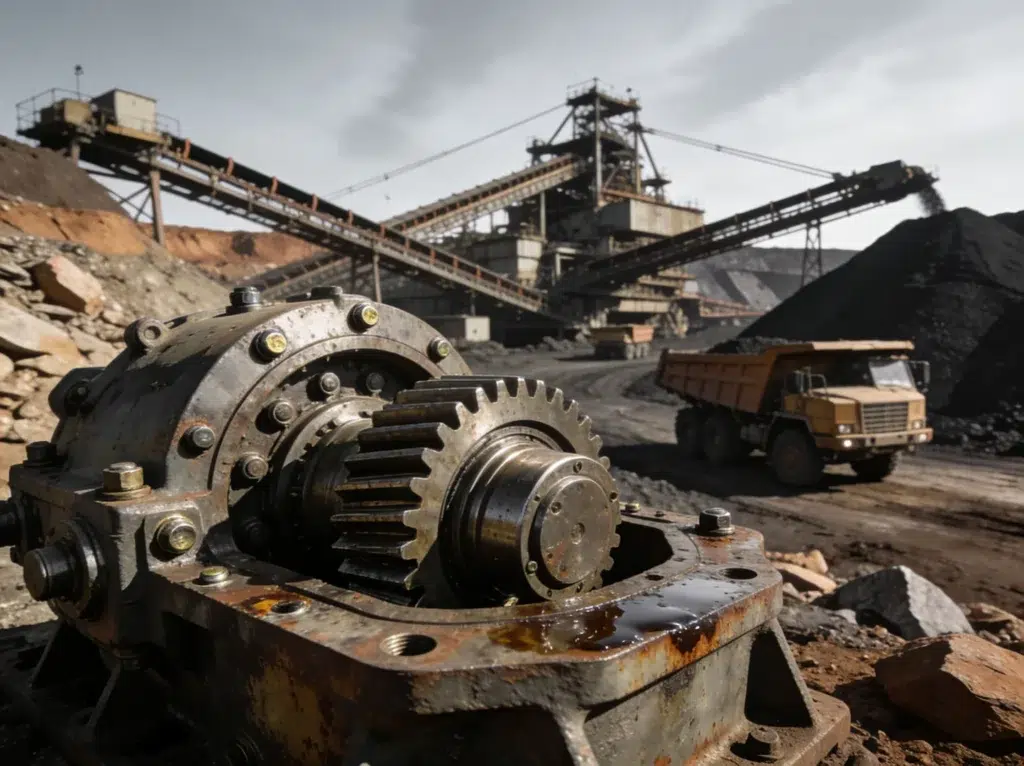
Industrial gearboxes are the mechanical workhorses of mining operations, paper mills, and chemical processing plants. Inside these units, shafts must run perfectly parallel or at precise right angles. If a bearing seat wears out by even a few thousandths of an inch, the gears will misalign, leading to accelerated tooth wear, localized heat buildup, and catastrophic gear teeth failure.
To prevent this outcome, we use specialized line boring setups to restore bearing pocket dimensions. If you are experiencing unusual vibration or gear noise, it is critical to address the issue early. You can read more about identifying these warnings in our guide on how to Don’t Grind Your Gears and Find the Best Gearbox Repairing Near Me.
Our machining process restores the gear centerlines back to their original design positions. We mount the boring bar, align it to the undamaged reference datums, and machine the worn bores back to a uniform, clean diameter. This process prepares the housing for a custom sleeve or weld buildup, ensuring your gears mesh perfectly without binding.
Line Boring Housing Machining for Marine and Hydraulic Systems
In marine applications, line boring is essential for maintaining Z-drive propulsion systems, rudder housings, and stern tubes. A Z-drive bearing fit that has gone out of tolerance causes severe vibration throughout the vessel, threatening the integrity of the seals and the drive shaft itself. Because removing these components from a ship is incredibly expensive, portable line boring equipment is used to machine the sleeve inner diameters directly inside the hull, often handling diameters up to 38 inches over significant lengths.
For hydraulic systems, manufacturing and repairing valve housings is an incredibly precise discipline. Spool bores and compensator bores feature heavily interrupted cuts and thin walls. These bores require narrow tolerances for roundness, cylindrical form, and straightness to prevent high-pressure hydraulic oil from leaking past the valve spools. Line boring tools equipped with guide pads and multiple cutting edges ensure the tool does not drift as it passes through the internal ports of the valve casting.
Technical Challenges and Step-by-Step Process
Machining a large housing bore is a highly technical task with zero margin for error. If the machinist cuts too much material or misaligns the boring bar, the housing can be permanently ruined.
The primary technical challenges include:
- Interrupted Cuts: Bores with internal keyways, oil ports, or split lines cause the cutting tool to repeatedly impact the metal, which can cause chatter and tool wear.
- Thin Walls: Lightweight actuator or motor housings can easily deform under clamping pressure, leading to an out-of-round bore once the clamps are released.
- Thermal Expansion: Machining generates heat. Because metals expand when hot, a bore measured immediately after a heavy cut may shrink out of tolerance once the housing cools down.
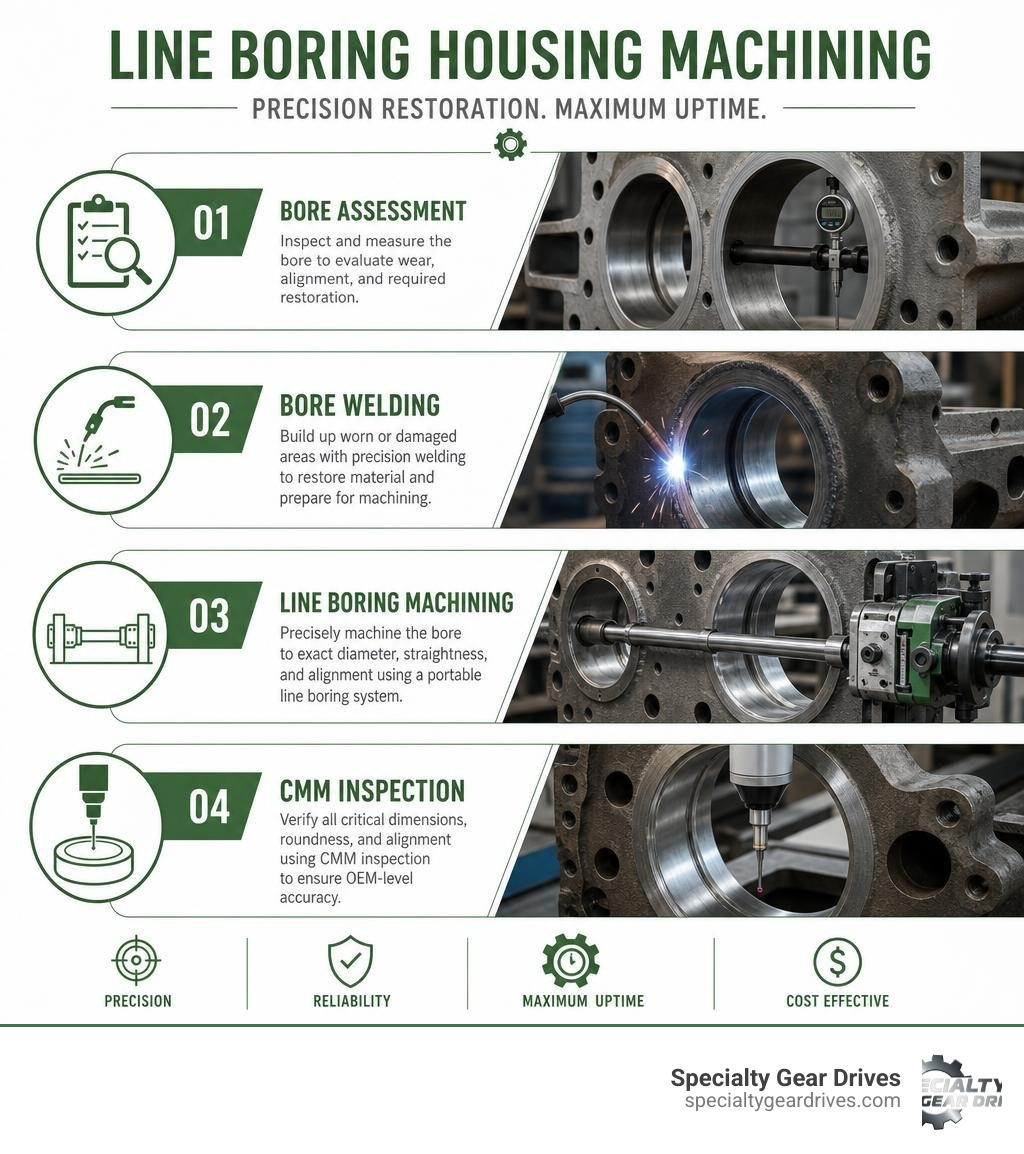
To overcome these challenges, we follow a strict, multi-step process for every line boring job:
- Inspection and Metrology: We measure the existing bore wear, check for cracks, and establish the original centerline using undamaged reference surfaces or laser alignment systems.
- Setup and Alignment: We mount the boring bar using adjustable mounting brackets and centering cones. For long spans, we use laser alignment tools to verify that the bar is straight within microns.
- Bore Welding: If the bore is oversized, we use an automatic bore welder to deposit a uniform layer of new metal. This process is detailed in our article on How Gearbox Housing Welding Services Restore Damaged Castings.
- Rough Machining: We make initial heavy passes to remove the irregular weld bead and bring the bore close to its final size.
- Stress Relief and Stabilization: For thin-walled parts, we release clamping pressure or allow the material to cool to prevent residual stress from warping the bore.
- Finish Machining: We perform light, high-speed passes using precision carbide or cubic boron nitride cutters to achieve the final size and surface finish.
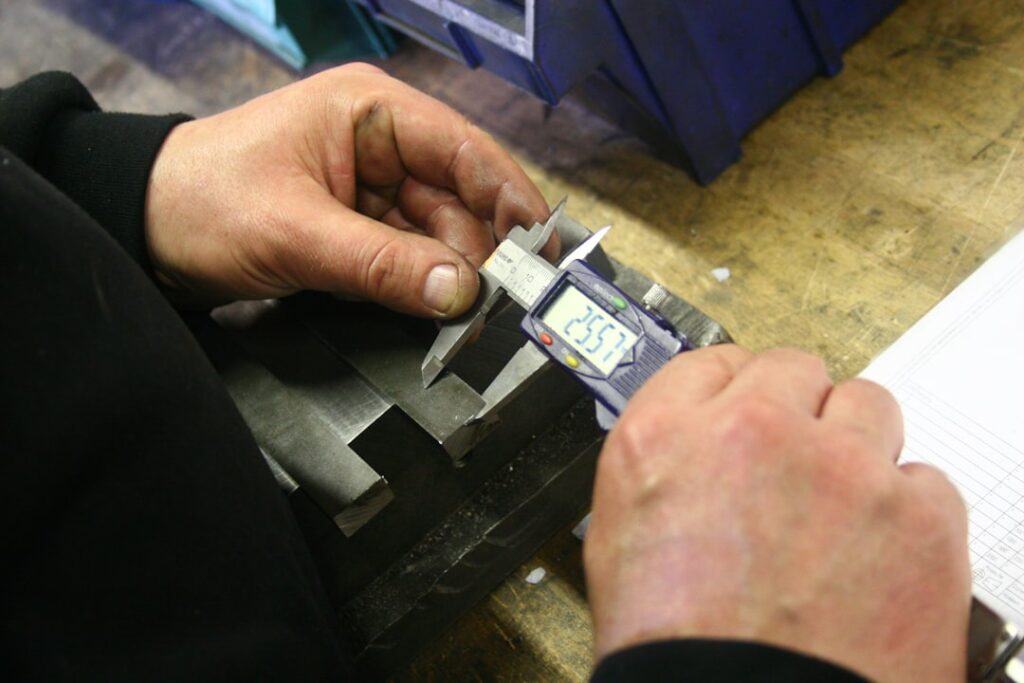
- Final Quality Control: We verify the dimensions using inside micrometers, dial bore gauges, or portable coordinate measuring machines.
Managing Tolerances and GD&T in Housing Bores
Geometric Dimensioning and Tolerancing (GD&T) is critical for high-performance rotating equipment. A bore is not just a simple circle; it is a three-dimensional cylinder that must be straight, round, and oriented correctly relative to other features. For bearing seats, we typically target an H7 tolerance class, which allows only a tiny window of dimensional variance.
Concentricity and runout are equally important. If the front and rear bearing bores of a gearbox or actuator housing are not concentric within ±0.005 mm, the shaft will bind, creating heat and destroying the bearings. To maintain these tight limits, we control the thermal environment during the final cuts and use rigid, induction-hardened boring bars that resist bending under load.
For more information on how weld buildup and machining work together to save worn components, you can explore The Art of the Weld: How to Build Up and Repair Worn Shafts.
Frequently Asked Questions about Housing Line Boring
What is the difference between line boring and line honing?
Line boring uses a single-point cutting tool mounted on a rotating bar to remove bulk material, correct alignment, and establish a new bore centerline. Line honing uses abrasive stones mounted on a flexible mandrel to polish the bore. Honing removes very little material, usually less than 0.003 inches, and is used strictly to achieve an ultra-smooth surface finish or to make micro-adjustments to the final bore size.
Can worn gearbox housings be repaired on-site?
Yes, they can. Using portable line boring rigs, we can perform the entire machining and bore welding process directly at your facility. This eliminates the need to rig, transport, and reinstall massive gearbox housings, which drastically reduces your operational downtime and transport costs.
What tolerances can portable line boring achieve?
Modern portable line boring machines can achieve tolerances as tight as ±0.001 inches over spans up to 10 feet. By using precision-ground boring bars, rigid mounting systems, and laser alignment tools, field technicians can match the accuracy of a traditional machine shop.
Conclusion
When a critical housing bore wears out, replacement is rarely your only option. Precision line boring housing machining offers a reliable, cost-effective way to restore your heavy machinery back to original OEM specifications.
At Specialty Gear Drives, we specialize in the repair and rebuilding of industrial gearboxes for demanding sectors like mining, pulp and paper, marine, and chemical processing. Based in Largo, Florida, we proudly serve plant operators across Florida, Georgia, Alabama, South Carolina, Mississippi, and Louisiana.
We understand that downtime costs you money. That is why we offer 24-48 hour emergency services, free pickup and delivery, and up to 60% savings compared to buying a new gearbox. Every repair we perform is backed by our industry-leading 24-month warranty.
To learn more about how we can restore your worn equipment, check out our guide on how Bore No More: How Housing Line Boring Repairs Heavy Equipment or contact us directly to discuss our Industrial Gearbox Repair services.