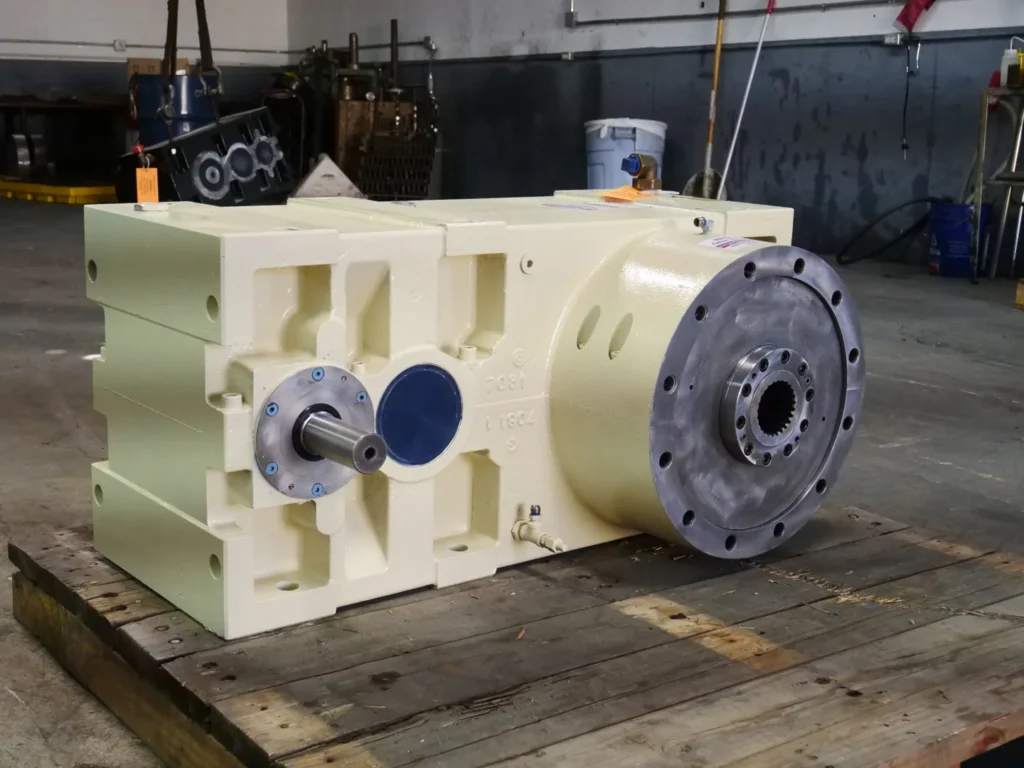
When a Gearbox Goes Down in Mississippi, Every Hour Counts
Overloaded gearbox repair in Mississippi is a critical service for the state’s heavy industries, where a single failed gear reducer can shut down an entire production line for days. If you need the short version, here’s what you need to know:
Quick answer: How to address an overloaded gearbox in Mississippi
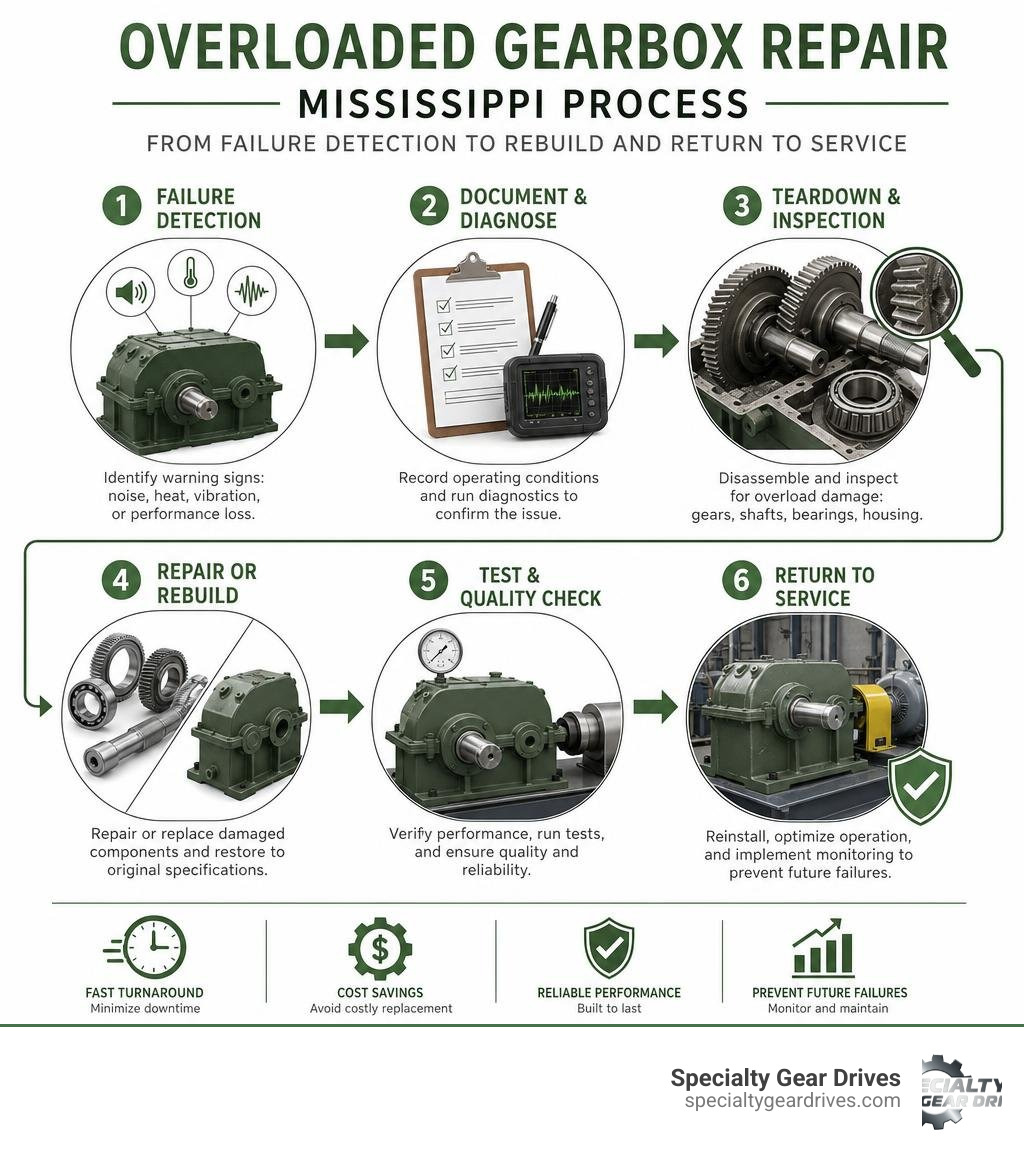
- Stop the equipment immediately if you notice unusual noise, heat, vibration, or performance loss.
- Document the failure by noting operating conditions, load history, and any recent changes to the process.
- Contact a qualified industrial gearbox repair specialist with diagnostic capabilities (vibration analysis, non-destructive testing).
- Get a full teardown inspection to identify overload damage: gear pitting, shaft deflection, spalled bearings, or cracked housings.
- Choose repair or rebuild based on the scope of damage, part availability, and your production timeline.
- Implement preventive measures before returning the unit to service, including load management and condition monitoring.
Gearbox failures account for roughly 15% of all unplanned downtime in industrial facilities, and overloading is one of the leading causes. Across Mississippi’s pulp mills, petrochemical plants, food processing operations, and port facilities, gear reducers run under demanding, continuous loads. When a process jams, a torque spike hits, or lubrication degrades in summer heat, the gearbox absorbs the damage first.
Over 60% of gearbox repairs in heavy-duty applications trace back to overload or misalignment. The good news: most overloaded gearboxes can be fully rebuilt to original specifications at a fraction of the cost of a new unit, often saving 50 to 60% compared to OEM replacement, and experienced repair specialists can turn around emergency rebuilds in as little as 24 to 48 hours.
This guide covers exactly how that repair process works, what to look for in a Mississippi gearbox repair partner, and how to prevent the next failure before it happens.
Why Mississippi Heavy Industries Face Gearbox Overload
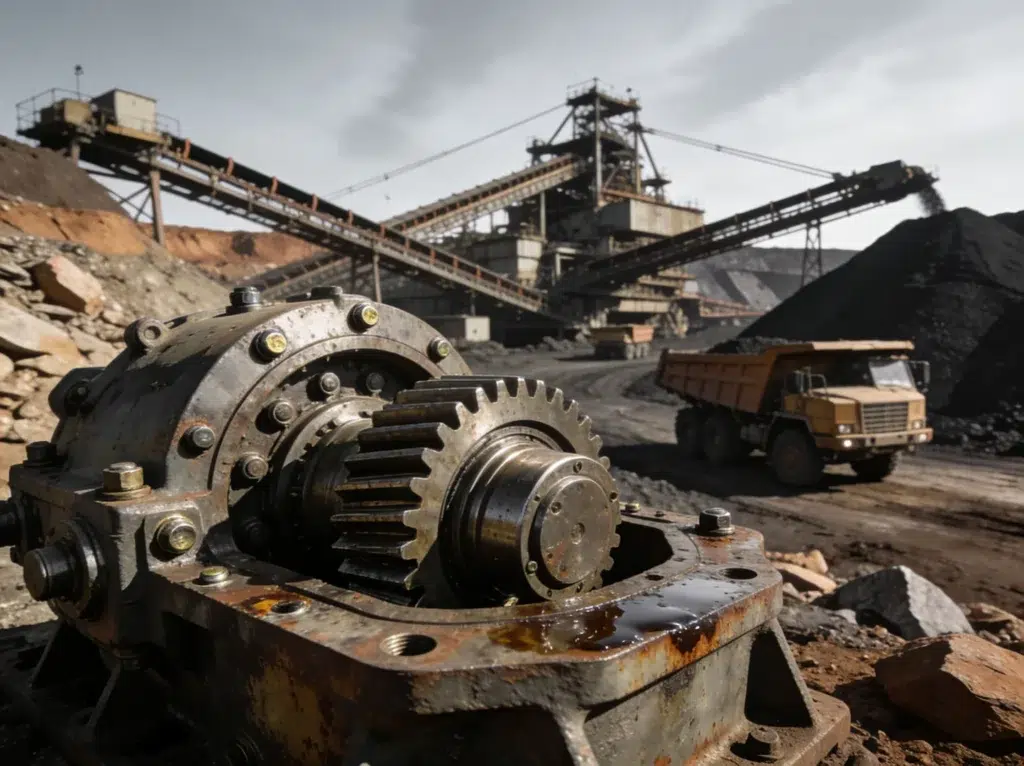
Mississippi industrial operations run under some of the most demanding environmental and mechanical conditions in the Southeast. Heavy industries such as pulp and paper mills along the Mississippi River, coastal chemical plants, and oil and gas extraction sites subject speed reducers to continuous duty cycles. Under these conditions, gearboxes frequently face loads that exceed their original design ratings.
Torque spikes are a primary cause of mechanical overload. In a pulp mill, a temporary jam in a log chipper or conveyor system can cause an instantaneous spike in torque that exceeds the yield strength of the gear teeth. When this occurs, the mechanical energy must go somewhere, resulting in immediate gear tooth breakage or severe shaft deflection.
Environmental heat and humidity across Mississippi also play a major role in accelerating overload failures. High ambient temperatures reduce the viscosity of the gear lubricant. When the oil thins out, it can no longer maintain the critical elastohydrodynamic film between mating gear teeth. This leads to localized metal-to-metal contact, rapid thermal runaway, and accelerated wear. Under these conditions, even a standard operational load can act as an overload, causing micropitting, macropitting, and eventual scuffing of the gear profiles.
If you suspect your system is operating near its mechanical limits, scheduling an Industrial Gearbox Repair consultation can help identify weak points before a catastrophic failure occurs. Furthermore, understanding How Gearbox Condition Monitoring Saves Your Machinery and Your Sanity is essential for tracking thermal and mechanical changes before they lead to an emergency shutdown.
Overloaded Gearbox Repair Mississippi: Diagnostic and Rebuild Procedures
An accurate diagnosis is the first step in resolving any overload-related gearbox failure. When a damaged unit arrives at a specialized rebuilding facility, technicians perform a comprehensive suite of diagnostic tests to map out the internal damage. This process goes far beyond a simple visual inspection to ensure all structural and mechanical deficiencies are identified.
Non-destructive testing is critical for identifying sub-surface cracks caused by fatigue. Technicians use magnetic particle testing on steel shafts and gears to find cracks that are invisible to the naked eye. For non-ferrous components, liquid dye penetrant testing reveals surface-breaking defects. Vibration analysis data, if captured prior to shutdown, is analyzed to pinpoint which bearing bores or gear meshes are running out of tolerance.

Once diagnostics are complete, technicians formulate a precise rebuild plan. This typically involves restoring worn shafts, machining misaligned housing bores, and replacing or manufacturing damaged gears. Utilizing specialized services like Why Shaft Repair Services Can Help You Today and How Gearbox Housing Welding Services Restore Damaged Castings ensures that the structural integrity of the entire assembly is restored to OEM specifications.
1. Precision Shaft Rebuilding and Welding
Shaft wear and deflection are common consequences of severe gearbox overloading. When a speed reducer is subjected to overhung loads or high bending moments, the input and output shafts can bend or experience localized wear at the bearing journals and keyways. If left unaddressed, a deflected shaft will cause improper gear alignment, leading to rapid tooth wear and catastrophic gear failure.
To restore a damaged shaft, technicians use specialized welding and machining techniques. The process begins by preheating the shaft to prevent thermal shock and cracking during the welding phase. Submerged arc welding or gas metal arc welding is then used to build up the worn areas with high-quality, compatible steel alloys. This process deposits new metal onto the worn journals or keyways, providing enough raw material for subsequent machining.
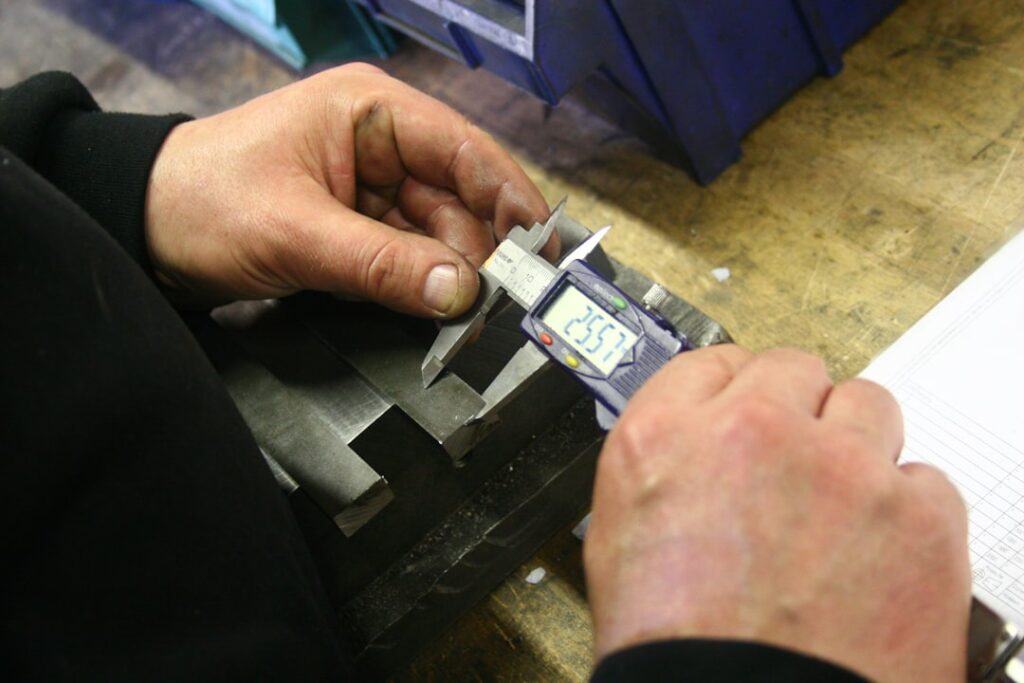
After welding, the shaft is placed in a precision lathe where it is machined back to its original dimensional tolerances. Technicians machine the bearing journals to extremely tight limits, often within ten-thousandths of an inch, to ensure a perfect interference fit with new bearings. For a detailed breakdown of this restoration process, refer to our Step-by-Step Guide to Shaft Rebuild Services and explore the technical nuances in The Art of the Weld: How to Build Up and Repair Worn Shafts.
2. Housing Line Boring and Casting Restoration
Mechanical overload does not just damage gears and shafts; it can also distort the gearbox housing itself. When a gearbox experiences extreme torque, the forces transmitted through the bearings can cause the housing bores to stretch, ovalize, or become misaligned. If the housing bores are out of alignment by even a few thousandths of an inch, the gears will not mesh correctly, causing localized loading on the edges of the teeth.
Casting restoration requires highly specialized line boring equipment to re-establish perfect axial alignment across all bearing bores. The process involves mounting a portable boring bar through the housing. Technicians align the bar using precision dial indicators or laser alignment systems to ensure it is perfectly parallel with the original design centerline. The damaged bores are then machined oversize.
Once machined, the bores are either sleeved with high-strength material or built up using specialized welding procedures before being bored back to their original nominal dimensions. This restores the exact press-fit tolerances required for the bearings. You can learn more about how this heavy-duty machining process works by reading Bore No More: How Housing Line Boring Repairs Heavy Equipment. Additionally, securing the gearbox to its foundation is critical after housing repairs, which is detailed in How to Master Gearbox Mounting Repair in 30 Days.
3. Custom Gear Manufacturing and Reverse Engineering
When a gearbox fails due to overload, the gears themselves are often stripped, chipped, or severely pitted. For older or obsolete gearboxes common in Mississippi pulp mills and chemical plants, sourcing replacement gears from the original equipment manufacturer can take weeks or even months. In these scenarios, custom gear manufacturing and reverse engineering are the only viable ways to minimize downtime.
The reverse engineering process begins by capturing the exact geometry of the damaged components. Technicians use high-precision 3D laser scanners to create a digital three-dimensional model of the gear, even if several teeth are missing or badly worn. Software is then used to reconstruct the original gear geometry, calculating the precise module, pressure angle, helix angle, and number of teeth.
Using this digital data, new gears are manufactured from high-alloy steel forgings. The gears are cut on precision hobbing and shaping machines, followed by heat treatment to achieve the required surface hardness and core toughness needed to resist future overload conditions. To understand how we reconstruct obsolete components, read about The Ins and Outs of 3D Laser Scanner Reverse Engineering. For insights into our manufacturing capabilities, refer to our comprehensive guide on Custom Gear Manufacturing.
4. Emergency Overloaded Gearbox Repair Mississippi Services
When a critical drive system fails in a continuous-production facility, every hour of downtime translates directly into lost revenue. Mississippi operations require rapid-response support to get their machinery back online. Standard repair timelines of several weeks are often unacceptable when a plant’s primary conveyor or mixer is out of service.
We provide dedicated emergency repair services designed to minimize operational disruption. Our technicians work around the clock to perform teardowns, diagnostics, and repairs within a 24 to 48-hour window for critical failures. We manage the entire logistics process, offering free pickup and delivery from your facility directly to our repair center, removing the logistical burden from your maintenance team.
By utilizing advanced in-house machining and stocking a wide array of high-quality bearings, seals, and raw materials, we can execute complex repairs without waiting on external suppliers. For strategies on how to establish a rapid-response plan for your facility, consult our guide on Emergency Gearbox Repair: How to Never Worry About It Again.
5. Full-Speed Spin Testing and Quality Assurance
A rebuilt gearbox must never be put back into service without rigorous testing. Once assembly is complete, the unit must undergo quality assurance procedures to verify that all internal clearances, contact patterns, and thermal characteristics meet or exceed American Gear Manufacturers Association (AGMA) standards.
Our quality control process includes a comprehensive full-speed spin test. The gearbox is mounted on a test stand and run at its rated operating speed. During the run, technicians monitor several key performance indicators:
- Vibration levels: Accelerometers detect any high-frequency vibrations that indicate bearing defects, gear misalignment, or unbalance.
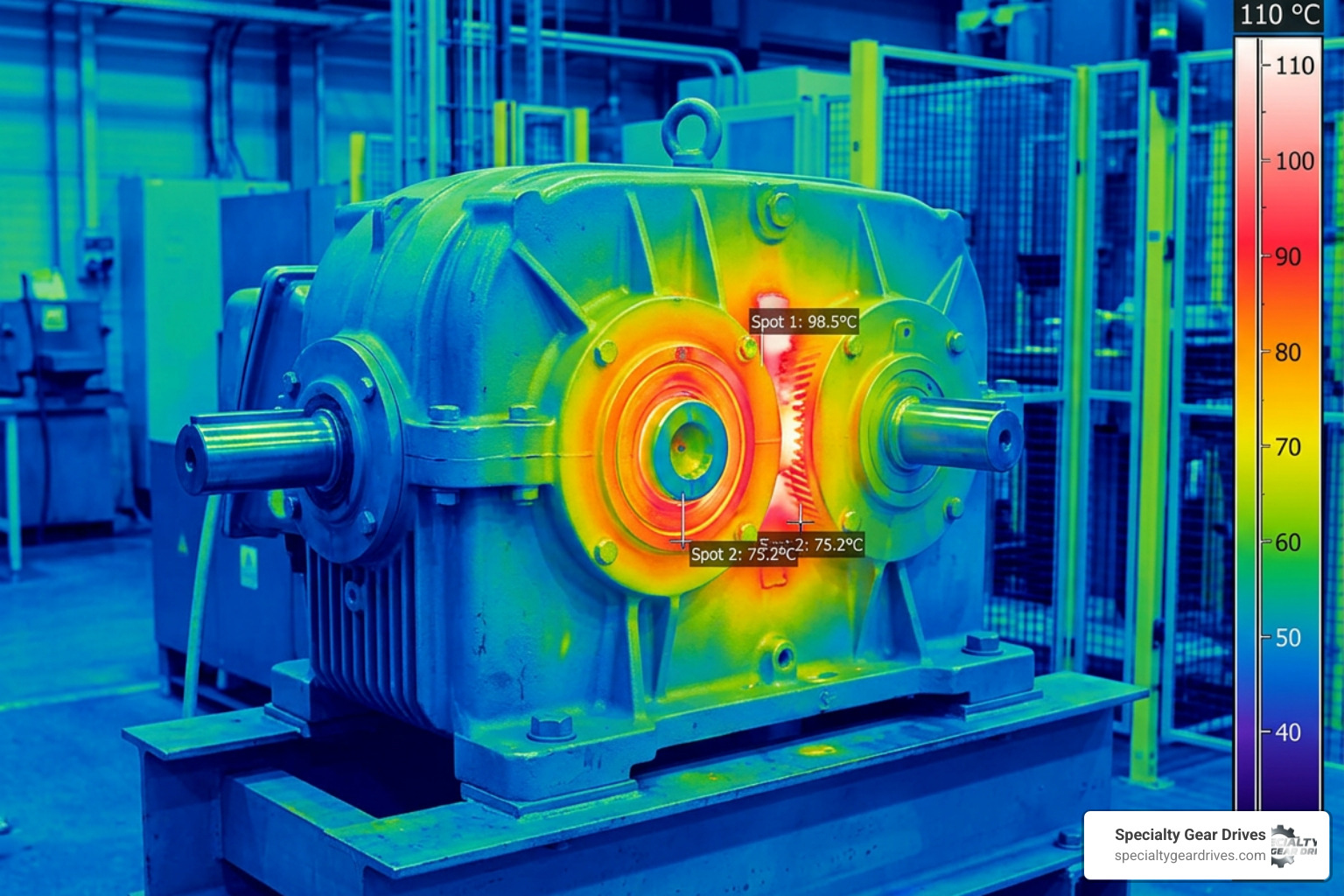
- Operating temperatures: Infrared thermography checks for localized hot spots, which can indicate tight bearing clearances or improper gear meshing.
- No-load current draw: Monitoring the motor’s power consumption helps verify that there is no internal binding or excessive friction.
- Tooth contact patterns: Technicians apply layout dye to the gear teeth to verify that the contact pattern is centered and evenly distributed across the face width under operational rotation.
Only after the unit passes every phase of this testing process is it certified for return. We back this rigorous quality assurance process with a 24-Month Limited Warranty on all workmanship and materials, giving you long-term confidence in the reliability of your rebuilt equipment.
Preventive Maintenance and Monitoring to Avoid Overload
Preventing a gearbox overload is always more cost-effective than repairing the damage after a failure occurs. By implementing a structured preventive maintenance program, industrial facilities can identify the early warning signs of overload and take corrective action before components break.
Modern condition monitoring technologies provide real-time insight into the health of your drive systems. Permanent vibration sensors mounted on the gearbox housing can detect the subtle changes in frequency that occur when gear teeth begin to pit or bearings start to spall. Oil analysis is another essential tool; regular sampling reveals the presence of metallic wear particles, indicating accelerated component degradation.
How to Prevent Overloaded Gearbox Repair Mississippi Failures
To minimize the risk of overload failures in your facility, focus on three primary areas: load management, proper lubrication, and predictive monitoring.
- Install torque-limiting devices: Mechanical shear pins, slip clutches, or electronic overload relays can decouple the motor from the gearbox instantly if a downstream jam occurs.
- Optimize lubrication selection: Ensure you are using the correct lubricant viscosity and additive package for your specific operating temperatures and load profiles. High-load applications often require extreme pressure (EP) lubricants to prevent metal-to-metal contact.
- Conduct routine thermal inspections: Use handheld infrared cameras to inspect your gearboxes during normal operation. A sudden increase in housing temperature is a clear indicator of increased friction, potential overload, or lubrication failure.
Repair vs. Replacement: Cost and Turnaround Comparison
When faced with a damaged gearbox, maintenance managers must decide whether to rebuild the existing unit or purchase a brand-new replacement. While buying new might seem like the simplest option, it is often not the most practical or cost-effective choice for heavy industrial applications.
Rebuilding an overloaded gearbox typically saves up to 60% of the cost of purchasing a new unit from the OEM. These savings can be reinvested into other maintenance priorities or used to upgrade the gearbox’s internal components with stronger materials to prevent future failures.
Lead time is another critical factor. A new industrial gearbox, especially a large custom or right-angle unit, can have OEM lead times ranging from 12 to 26 weeks. In contrast, a comprehensive rebuild can usually be completed in 7 to 10 business days, with emergency services reducing that timeline to just 24 to 48 hours.
| Operational Factor | Rebuilding / Repairing | New OEM Replacement |
|---|---|---|
| Typical Cost | 40% to 50% of new unit cost | 100% retail cost plus shipping |
| Standard Lead Time | 7 to 10 business days | 12 to 26+ weeks |
| Emergency Turnaround | 24 to 48 hours | Rarely available for custom units |
| Custom Modifications | Can upgrade materials/gears during rebuild | Limited to standard catalog specs |
| Warranty | 24-month warranty on rebuild | Standard 12-month OEM warranty |
What certifications should I look for in a Mississippi gearbox repair partner?
When selecting a repair partner, look for facilities that adhere strictly to AGMA standards and maintain documented ISO 9001 quality control procedures. A qualified partner should be able to provide detailed inspection reports, material certifications for any manufactured gears, and documented run-test data. Our rebuild processes meet or exceed these standards, ensuring every unit is restored to original or improved specifications.
How long does an emergency industrial gearbox rebuild take?
An emergency rebuild can be completed in as little as 24 to 48 hours. This rapid turnaround is achieved by dedicating a team of technicians to work around the clock, utilizing in-house machining capabilities to manufacture replacement parts immediately, and bypassing the shipping delays associated with ordering components from overseas OEMs.
Can a cracked gearbox housing be safely repaired?
Yes, a cracked gearbox housing can be safely repaired using specialized cast iron welding or metal stitching procedures. Technicians first perform non-destructive testing to find the exact limits of the crack, drill stop-holes to prevent further spreading, and then use specialized nickel-alloy welding electrodes or high-strength locking keys to restore the structural integrity of the casting.
Conclusion
An overloaded gearbox does not have to result in weeks of lost production and exorbitant replacement costs. By partnering with an experienced industrial repair specialist, Mississippi facilities can restore their critical drive systems to peak operating condition quickly and cost-effectively.
Specialty Gear Drives provides comprehensive industrial gearbox repair, rebuilding, and custom gear manufacturing services across the Southeast, including Florida, Georgia, Alabama, South Carolina, Mississippi, and Louisiana. We understand the unique demands of heavy industries like pulp and paper, petrochemicals, mining, and food processing. With our 24 to 48-hour emergency service, free pickup and delivery, substantial cost savings, and 24-month warranty, we keep your operations moving forward.
If you are dealing with an overloaded gearbox or want to discuss a preventive rebuild, Contact Us today to speak with an application engineer and request a free evaluation.