How to Rebuild Gearboxes: Step-by-Step Guide
Why Rebuilding Gearboxes Is Often the Smartest Call for Industrial Facilities
Rebuilding gearboxes is the process of completely disassembling an industrial gear reducer, inspecting every component, replacing worn or damaged parts, reassembling to OEM specifications, and testing for reliable performance before returning the unit to service.
Here is a quick overview of what the process involves and when it makes sense:
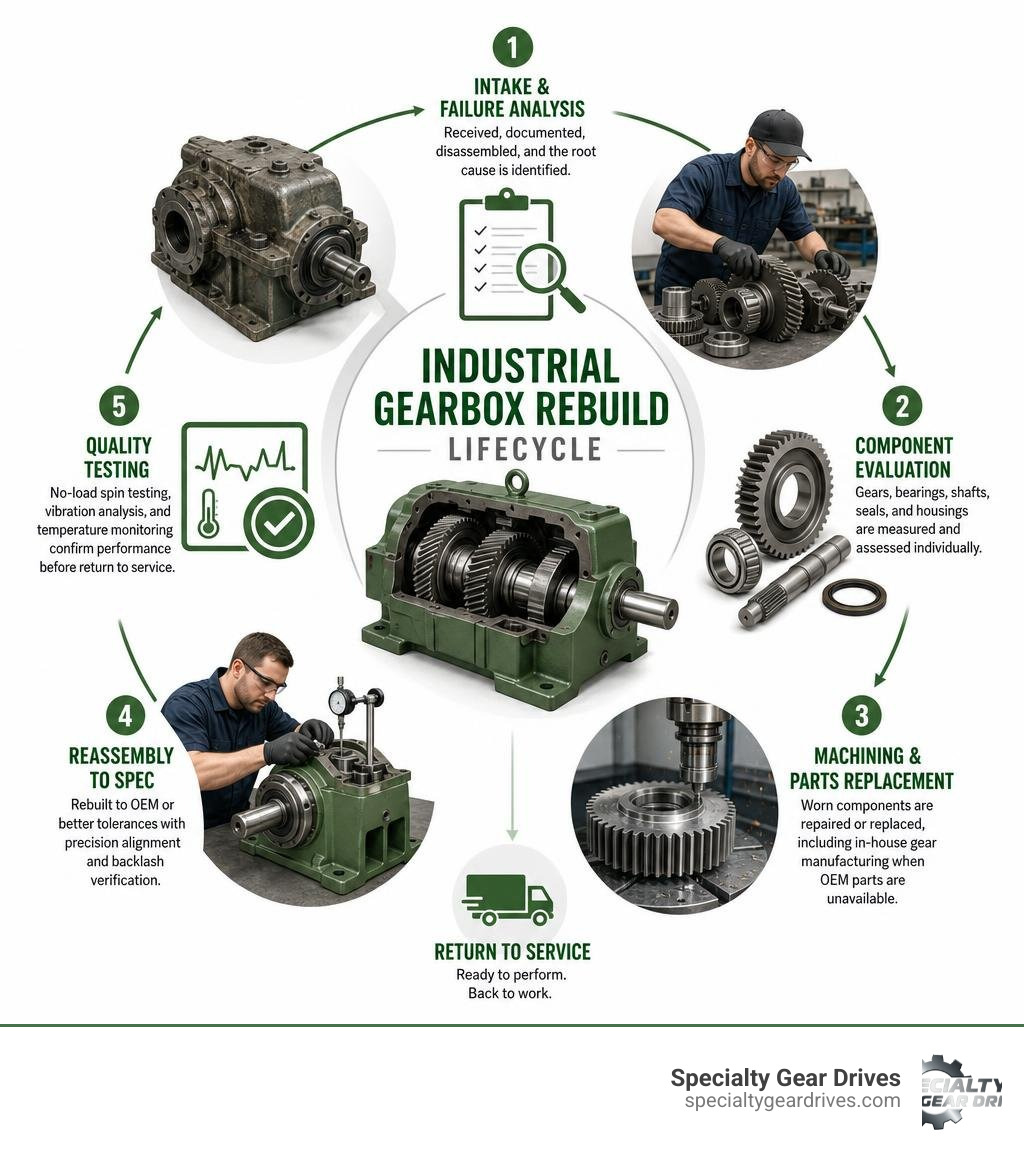
- Intake and failure analysis – The gearbox is received, documented, disassembled, and inspected to identify the root cause of failure.
- Component evaluation – Gears, bearings, shafts, seals, and housings are measured and assessed individually.
- Machining and parts replacement – Worn components are repaired or replaced, including in-house gear manufacturing when OEM parts are unavailable.
- Reassembly to spec – The unit is rebuilt to OEM or better tolerances with precision alignment and backlash verification.
- Quality testing – No-load spin testing, vibration analysis, and temperature monitoring confirm performance before shipment.
A single failed gearbox on a conveyor line or processing system can shut down an entire production shift. For plant maintenance teams across industries like mining, pulp and paper, petrochemical, and food processing, that kind of unplanned downtime is expensive fast. A properly executed rebuild typically costs 40 to 60% less than purchasing a new OEM unit, and a qualified repair shop can often return a unit to service in days rather than the weeks or months it takes to source a new replacement.
The decision is not always simple. Rebuild quality varies significantly depending on who does the work and how thoroughly they do it. A shop that skips the written failure analysis report or performs only a partial teardown is not doing a rebuild; they are doing a patch job that will likely fail again.
This guide walks through the full process of rebuilding an industrial gearbox, how to decide between a rebuild and full replacement, and what separates a high-quality rebuild from one that sends you back to square one.
The Step-by-Step Process of Rebuilding Gearboxes
Rebuilding an industrial speed reducer or gear drive requires a systematic approach to ensure every tolerance meets or exceeds original manufacturing standards. Skipping a single measurement or failing to identify a microscopic crack can lead to premature failure once the unit is placed back under load.
For plants operating in the humid, demanding environments of the Southeast, from Alabama pulp mills to South Carolina chemical plants, gearboxes must withstand severe duty cycles. We use a structured, three-phase process to ensure every rebuilt drive operates reliably under these harsh conditions.

Phase 1: Intake, Disassembly, and Failure Analysis
The rebuild begins the moment the gearbox arrives at our facility. We assign the unit a unique tracking number, take comprehensive photographs of its external condition, and document any visible signs of distress such as oil leaks, housing cracks, or missing hardware.
We then drain the lubricant and perform a complete teardown of the assembly. Every single component is separated, cleaned, and prepared for individual evaluation. This is where we conduct a detailed failure analysis, which is the most critical step of the entire process.
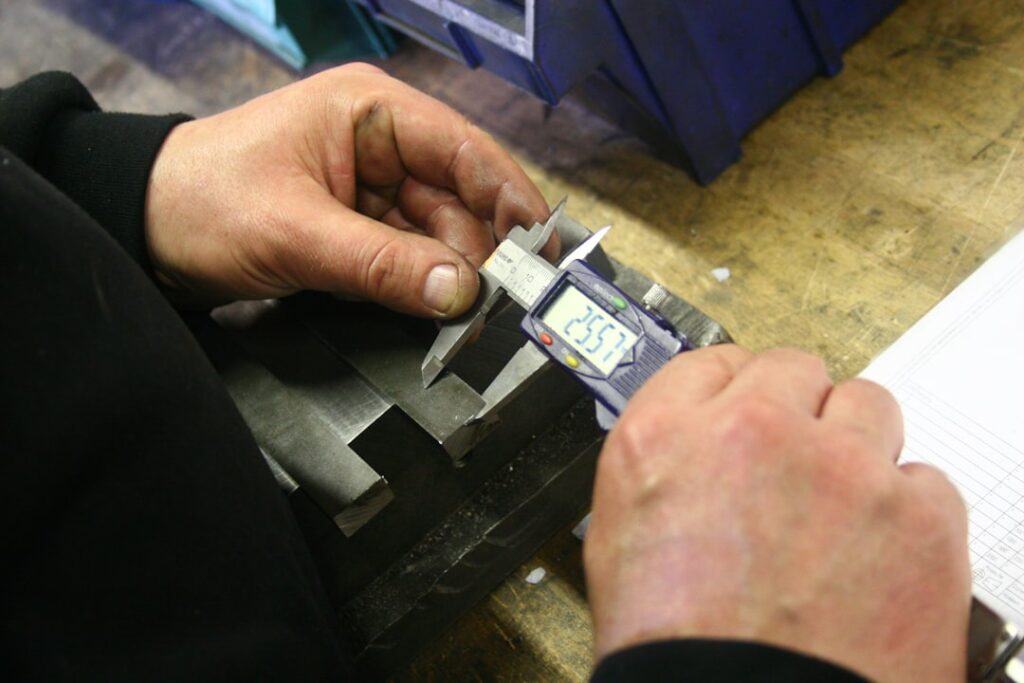
Our technicians perform non-destructive testing, including magnetic particle and dye penetrant inspections, to identify subsurface cracks in the gears and shafts. We inspect the gear teeth for wear patterns, pitting, and spalling, and we check the bearing journals for signs of spinning or fretting.
We also verify the tooth contact patterns to determine if shaft misalignment or housing distortion contributed to the failure. Understanding why the unit failed allows us to make corrective modifications rather than simply replacing worn parts. Implementing proactive strategies like those found in our guide on How Gearbox Condition Monitoring Saves Your Machinery and Your Sanity helps prevent these failure modes from recurring.
Phase 2: Precision Machining and Rebuilding Gearboxes Components
Once we identify the damaged components, we move them to our machining department for restoration or manufacturing. We do not rely on third-party machine shops, which allows us to maintain strict quality control and speed up turnaround times.
If the gears are damaged beyond repair, we utilize our in-house gear manufacturing capabilities. We can perform precision gear hobbing and gear grinding up to 94 inches in diameter to cut new helical, spur, bevel, or worm gears to exact AGMA specifications. You can learn more about our production standards by reading about our Custom Gear Manufacturing capabilities.
Shaft restoration is another critical element of this phase. Worn bearing journals and seal areas are built up using specialized welding or metal spraying techniques, then precision ground back to original tolerances. For details on how we restore these critical power transmission components, refer to our articles on Why Shaft Repair Services Can Help You Today and our Step-by-Step Guide to Shaft Rebuild Services.
Phase 3: Reassembly and Quality Testing
With all components machined, manufactured, or sourced, we begin the precision reassembly process. We replace all bearings, seals, gaskets, and shims as a standard practice.
During assembly, our technicians set and record the shaft end play, bearing preload, and gear backlash. We verify the tooth contact patterns using layout dye to ensure optimal power transfer across the gear faces.
After assembly is complete, the gearbox undergoes a rigorous quality testing protocol. This includes a no-load spin test at rated speed, during which we monitor vibration levels, oil temperature, and noise. We use vibration signature analysis to detect any high-frequency anomalies that could indicate minor misalignment or bearing defects. Only after the unit passes every quality check is it prepped, painted, and cleared for return shipment.

Rebuild vs. Replace: Cost, Lead Times, and Reliability
Plant managers and procurement teams face a constant balance between capital expenditure and operational downtime. When a critical drive fails, deciding whether to rebuild the existing unit or purchase a brand-new replacement is a major decision.
In the Southeast, where logistics and shipping times can vary significantly, the lead time of a new unit often makes replacement impractical, even before considering the financial differences.
| Decision Factor | Rebuilding the Gearbox | Purchasing a New OEM Unit |
|---|---|---|
| Upfront Cost | Typically 40% to 60% less than a new unit | Full market price plus freight |
| Lead Time | 5 to 14 days (24-48 hours for emergencies) | Weeks to several months |
| Reliability | Restored to OEM or better specifications | High, factory-guaranteed |
| Warranty | 24-month warranty on workmanship and parts | Typically 12 months from purchase |
| Obsolete Models | Fully supported via reverse engineering | Not available from OEM |
Financial and Operational Benefits of Rebuilding Gearboxes
Rebuilding an industrial gearbox offers substantial financial advantages over buying new. In most cases, a professional rebuild provides up to 60% savings compared to the cost of a new OEM unit. These savings allow plants to allocate capital budget to other critical maintenance projects rather than spending it on a replacement drive housing that is still perfectly usable.
Operationally, rebuilding is often much faster. Sourcing a new industrial gear reducer can take months, especially if the unit is custom-configured or manufactured overseas. A rebuild keeps the original footprint, shaft sizes, and mounting configurations exactly the same, which eliminates the need to modify baseplates, couplings, or piping during reinstallation.
Choosing a rebuild also supports environmental sustainability by reusing the heavy cast-iron housing and viable internal steel components, reducing raw material waste. For more information on our repair services and how we handle regional logistics, visit our main page on Industrial Gearbox Repair and read Industrial Gearbox Repair – Don’t Let Shipping Costs Grind Your Gears.
When Replacement is the Smarter Option
There are specific scenarios where rebuilding is no longer cost-effective or technically feasible. If the gearbox has suffered catastrophic internal damage that has destroyed the main housing beyond repair, replacement is usually necessary.
Severe housing cracks that compromise structural integrity, or bores that are worn so thin they cannot be safely machined, are clear indicators that the unit has reached the end of its service life. Recurring failures on the same drive can also point to an application issue, suggesting that the gearbox is undersized or poorly suited for the current operational demands. In these cases, upgrading to a larger or different style of drive is the correct engineering decision.
To help identify these critical situations early, refer to our article on Industrial Gearbox Repair Florida: 7 Signs You Need a Pro.
Advanced Engineering and Quality Control in Industrial Rebuilds
High-quality gearbox rebuilding relies heavily on advanced engineering capabilities and strict quality control. Restoring a heavy-duty drive used in a Mississippi lime kiln or a Florida phosphate mine requires more than basic mechanical assembly; it demands precision machining and metrology to ensure the rebuilt unit can handle extreme shock loads.

Reverse Engineering Obsolete and Legacy Gearboxes
Many industrial facilities operate legacy gearboxes from manufacturers that have gone out of business or discontinued specific product lines. When a component in one of these obsolete drives fails, obtaining original OEM drawings or spare parts is impossible.
We solve this issue through precision reverse engineering. Using 3D laser scanning and coordinate measuring machines (CMM), we capture the exact geometry of worn or broken gears and shafts.
Our engineering team uses this data to create detailed CAD models, correcting any original design flaws or wear patterns we identify. We then select modern, high-strength alloys and heat-treatment processes that often exceed the original specifications, giving your legacy equipment a second life. For a deeper look at finding reliable local repair solutions, see Don’t Grind Your Gears and Find the Best Gearbox Repairing Near Me.
Precision Housing and Shaft Restoration
The structural housing of a gearbox is subjected to continuous torsional stress. Over time, bearing bores can become oversized or out-of-round, leading to shaft misalignment and rapid gear wear.
To restore these housings, we use specialized line boring and welding techniques. We weld the worn bores to add fresh material, then use precision line boring machines to cut the bores back to their original concentricity and alignment.
This process ensures that the shafts will sit perfectly parallel, which is essential for proper gear tooth contact. We apply similar precision welding and grinding techniques to restore worn shaft journals.
You can read more about these critical restoration methods in our comprehensive guides:
- Everything You Need to Know About Line Boring Machining
- How Gearbox Housing Welding Services Restore Damaged Castings
- The Art of the Weld: How to Build Up and Repair Worn Shafts
Frequently Asked Questions about Industrial Gearbox Rebuilds
Understanding the technical details of the rebuilding process helps maintenance managers make informed decisions during unexpected equipment failures. Below are answers to some of the most common questions we receive regarding industrial gear reducer rebuilds.
What is the typical turnaround time for an industrial gearbox rebuild?
Standard rebuilds are typically completed within 5 to 14 business days, depending on the availability of replacement parts and the complexity of any required machining.
When a critical drive fails and halts production, we offer 24-48 hour emergency services to minimize downtime. We handle the entire process in-house, including gear cutting and shaft grinding, which allows us to compress the repair schedule significantly. For strategies on managing these urgent situations, refer to our article on Emergency Gearbox Repair: How to Never Worry About It Again.
How do you determine the root cause of a gearbox failure?
Determining the root cause of failure requires a systematic inspection of all internal components during disassembly. We analyze wear patterns on the gear teeth to look for signs of misalignment, overloading, or inadequate lubrication.
We also examine the bearings for fatigue, skidding, or contamination. We analyze the remaining oil for metal debris and moisture content, which helps us identify if seal failure or environmental factors caused the breakdown. This comprehensive analysis ensures we fix the underlying issue rather than just replacing the damaged parts.
Can obsolete gearboxes be rebuilt without original OEM drawings?
Yes, obsolete and legacy gearboxes can be rebuilt without original drawings. We use advanced metrology tools, including 3D scanning and CMM machines, to reverse engineer every internal component.
Our team reconstructs the original design parameters, tooth profiles, and shaft dimensions to create new manufacturing drawings. This allows us to manufacture exact drop-in replacements for any discontinued model, often upgrading the materials to improve overall durability.
Conclusion
Rebuilding your industrial gearboxes is a highly effective way to restore critical machinery to like-new condition, reduce lead times, and save up to 60% compared to the cost of buying new OEM units. By choosing a comprehensive rebuild over a simple repair, you ensure that every bearing, seal, and gear is inspected, verified, and aligned to perform reliably under the heavy demands of your plant operations.
At Specialty Gear Drives, based in Largo, Florida, we provide complete in-house rebuilding and gear manufacturing services for heavy industries across Florida, Georgia, Alabama, South Carolina, Mississippi, and Louisiana. We stand behind our work with a comprehensive 24-Month Limited Warranty on all rebuilt units.
Whether you operate a pulp mill in Mississippi, a chemical plant in Louisiana, or a manufacturing facility in Georgia, we offer 24-48 hour emergency services and free pickup and delivery to keep your operations moving. Contact us today through our Industrial Gearbox Repair page to request a quote or schedule an inspection.