Shaft Repair Services: 5 Rules You Must Follow
When a Shaft Fails, Every Hour of Downtime Has a Price Tag
Shaft repair services are specialized industrial procedures that restore worn, bent, scored, or cracked rotating shafts to their original operating specifications, without necessarily replacing them.
Here is a quick summary of what professional shaft repair typically covers:
| Repair Type | Best For | Typical Downtime Saved |
|---|---|---|
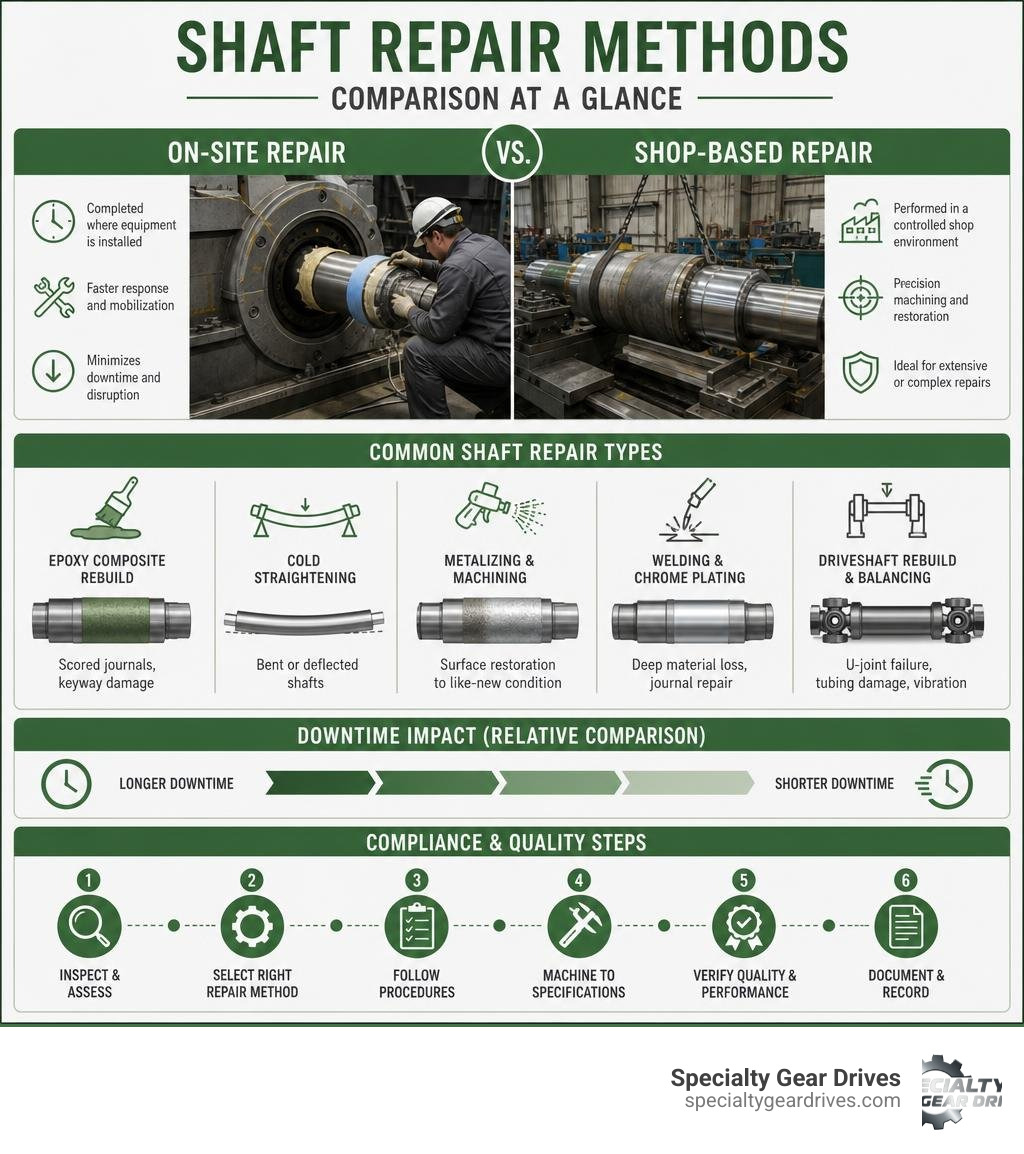
| On-site epoxy composite rebuild | Scored bearing journals, keyway damage | Reduces days to hours |
| Cold straightening | Bent or deflected shafts up to 1,500mm dia. | Eliminates replacement lead time |
| Metalizing and precision machining | Surface restoration to like-new condition | Faster than full shaft replacement |
| Welding and hard chrome plating | Deep material loss, journal repair | Shop-based, 1-5 day turnaround |
| Driveshaft rebuild and balancing | U-joint failure, tubing damage, vibration | Days vs. weeks for new shaft |
A single shaft failure on a conveyor line, a crusher, or a marine propulsion system does not just damage one component. The bearing fails first, then the journal gets grooved and gouged. By the time the machine trips offline, you are often looking at scored metal, misalignment, and a growing list of secondary damage.
In heavy industrial facilities across the Southeast, whether that is a pulp mill in Alabama, a phosphate processing plant in Florida, or a petrochemical operation on the Louisiana Gulf Coast, unplanned shaft failures are one of the leading causes of extended production shutdowns. The traditional fix meant pulling the shaft, rigging it out with a crane (sometimes removing a roof section for large equipment like wind turbines), and shipping it to a machine shop for weeks of work.
That is no longer the only option. Modern shaft repair methods range from in-situ epoxy rebuilds completed in hours to class-approved cold straightening and precision metalizing processes that restore shafts to better-than-original performance. Knowing which method to use, and when, is where most facilities get it wrong.
The five rules below cut through the confusion.
Rule 1: Diagnose the Root Cause of Shaft Damage First
Before starting any repair, you must determine exactly why the shaft failed. Simply rebuilding a worn journal or welding a cracked keyway without addressing the underlying mechanical issue guarantees a repeat failure, often within weeks of restarting the machinery.
Bearing failure is the most frequent culprit behind shaft damage. When a bearing fails, its inner ring can seize or begin to spin on the shaft. This spinning action causes severe journal grooving, gouging, and friction-induced heat.
Several distinct mechanical and environmental factors lead to this kind of wear:
- Environmental Debris: Abrasive particles like phosphate dust in central Florida plants or wood fibers in Alabama pulp mills bypass worn seals, entering the bearing housing and grinding away the shaft profile.
- Chemical Attack: Corrosive process chemicals or high humidity near coastal Gulf facilities attack the metal surface, causing pitting that compromises the bearing seat.
- Lack of Lubrication: Insufficient or contaminated lubricant increases friction, generating extreme heat that can warp the shaft and gall the metal.
- Grounding Issues: Stray electrical currents can pass through the bearings, causing electrical pitting and fluting that rapidly destroys both the bearing and the shaft journal.
If you skip failure analysis, you are only treating the symptom. For example, a shaft that is bent due to structural misalignment will continue to run hot and destroy new bearings until the alignment is corrected.
When material loss is extensive, welding is often required to rebuild the surface. You can learn more about the metallurgy and thermal controls required for these procedures in The Art of the Weld: How to Build Up and Repair Worn Shafts.
Rule 2: Match the Repair Method to the Metallurgy and Load
You must select a repair technique that preserves the mechanical properties of the parent metal while handling the torque and rotational loads of your specific application. Using the wrong repair process can introduce thermal stress, cause hydrogen embrittlement, or result in a weak mechanical bond that shears under load.

Different shaft materials require distinct handling:
- Aqualoy and Stainless Steel: Commonly used in marine propulsion and chemical pumps, alloys like Aqualoy (AQ17, AQ19, AQ22) and 316 stainless steel offer excellent corrosion resistance. However, they are sensitive to heat. Applying excessive heat during repair can destroy their corrosion-resistant properties or cause warping.
- Alloy and Carbon Steel: High-torque industrial shafts, such as those in heavy gear reducers, are typically made of alloy or carbon steel. These metals require precise pre-heating and post-weld heat treatment to prevent cracking.
The primary repair methods vary significantly in their application and limitations:
Cold Straightening
This method uses high-capacity hydraulic presses to correct bent shafts without applying heat. By avoiding thermal stress, the original metallurgy and grain structure of the steel remain completely unaffected. It is highly effective for shafts up to 1,500mm in diameter.
Metalizing (Thermal Spray)
Metalizing sprays molten metal onto a prepared, rotating shaft. It is an excellent process for restoring worn bearing journals because it does not create a heat-affected zone in the parent metal, eliminating the risk of thermal distortion. It restores the shaft to like-new dimensions at a fraction of replacement cost.
Welding
Welding is necessary for deep structural repairs, such as rebuilding stripped keyways or heavily gouged areas. It provides a true metallurgical bond, but it requires strict thermal monitoring, specialized filler metals, and post-weld machining to prevent distortion.
For situations where the structural integrity of a casting or housing is also compromised, pairing shaft work with specialized structural welding is critical. You can read about these casting restoration techniques in How Gearbox Housing Welding Services Restore Damaged Castings.
Epoxy Metal Composites
Epoxy composites are used for rapid, on-site repairs of scored journals and low-load components. These materials require no hot work and can be applied at room temperature, but they rely on a mechanical bond and are not suitable for high-torque transmission zones.
Rule 3: Evaluate In-Situ vs. Shop-Based Shaft Repair Services
Choosing between an on-site repair and transporting the shaft to a dedicated machine shop depends on a balance of downtime costs, safety, and the required precision of the finished repair.
| Factor | On-Site (In-Situ) Epoxy Repair | Shop-Based Machining & Metalizing |
|---|---|---|
| Downtime | Hours (typically 4 to 12 hours) | Days to weeks |
| Rigging & Transport | None required | High (requires rigging, cranes, freight) |
| Machinery Disassembly | Minimal | Complete teardown |
| Precision & Tolerance | Good (using forming techniques) | Extreme (precision grinding to <0.01 mm) |
| Structural Strength | Moderate (mechanical bond) | Maximum (metallurgical bond/original spec) |
| Applicable Standards | Temporary to semi-permanent | Permanent class-approved |
Traditional shop repairs require extensive rigging, heavy crane work, and sometimes structural modifications to the building just to extract a large shaft. This transport process adds immense cost and extends downtime from hours to weeks.
In some cases, the housing itself is damaged alongside the shaft, requiring specialized boring equipment to restore concentricity. For a deeper look at how boring repairs are managed alongside shaft work, see Bore No More: How Housing Line Boring Repairs Heavy Equipment.
When to Deploy On-Site Shaft Repair Services
On-site epoxy composite repairs are ideal for rapid turnaround on non-critical machinery or where disassembly is physically or financially impractical. Using specialized polymeric metals, technicians can rebuild a worn shaft seat directly on the machine.
This process utilizes precision forming techniques where a split-former, machined to the exact shaft diameter, is clamped over the applied epoxy. The material cures at room temperature without hot work, making it safe for volatile environments like chemical plants or paper mills.
Common applications include air handlers, industrial ventilation fans, cooling tower shafts, and light duty conveyors.
Why Heavy Industry Relies on Professional Shop-Based Shaft Repair Services
High-torque, high-speed applications require the absolute precision that only a controlled machine shop environment can provide. Large industrial shafts, such as those found in mining crushers, paper mill pulp presses, and heavy maritime vessels, operate under immense rotational forces and must handle torque loads up to 1,000,000 lb-ft.
Professional shop-based services utilize heavy-duty lathes, cylindrical grinders, and dynamic balancing machines to ensure the repaired shaft runs without a trace of vibration. Dynamic balancing is critical; even a minor imbalance at high speed will quickly destroy bearings, seals, and the surrounding gear teeth.
Shop repairs also allow for precision keyway cutting, hard chrome plating, and deep structural welding that cannot be performed safely or accurately in the field.
When a shaft journal is rebuilt in the shop, the mating housing must also be perfectly aligned. To understand how professional services coordinate housing alignment with shaft repairs, read Line Boring Gearbox Housing: Find Professional Services.
Rule 4: Enforce Strict Quality, Safety, and Class Compliance
You must verify that all repair work meets strict engineering standards and safety certifications. A failed shaft on a critical piece of machinery can cause catastrophic structural failure, putting personnel at risk and resulting in millions of dollars in secondary damage.
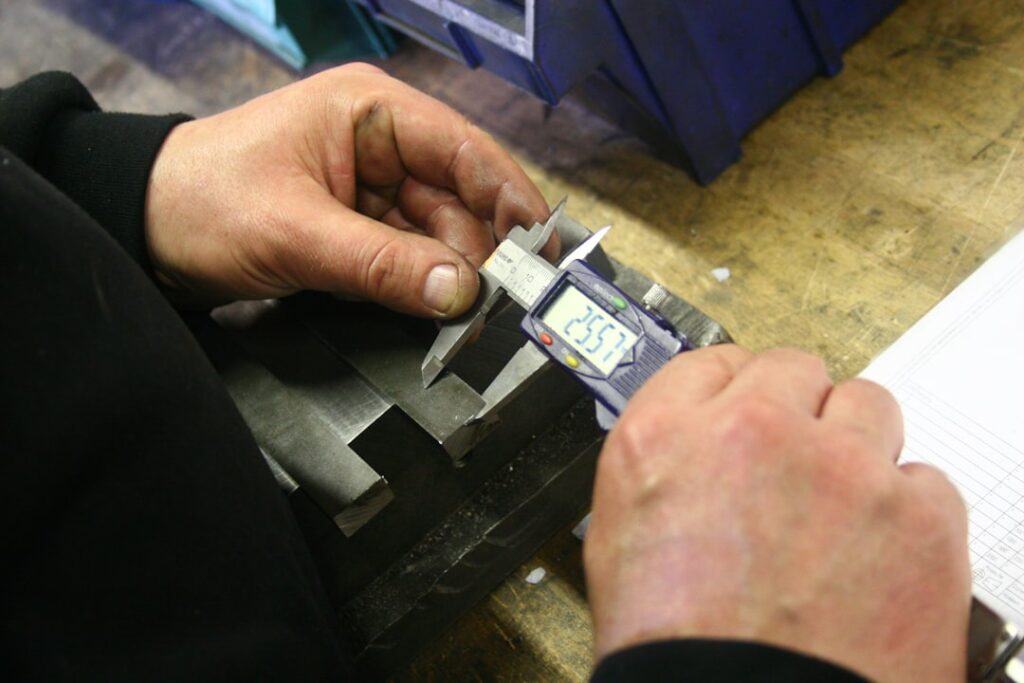
Non-destructive testing (NDT) is the foundation of quality control in shaft restoration. Before any repair begins, the shaft must be thoroughly cleaned and inspected for sub-surface cracks or defects. Technicians use liquid penetrant testing and magnetic particle inspection to identify micro-fractures that are invisible to the naked eye. Once the repair is complete, these same NDT procedures must be repeated to verify that no new cracks were introduced during the welding, straightening, or machining processes.
For marine applications and heavy industrial equipment, repairs must comply with specific classification societies and engineering standards:
- ABS (American Bureau of Shipping) Rules: Governs cladding and welding processes for tailshafts and propulsion components.
- Bureau Veritas: Approved cold straightening as a permanent, unconditional repair method as early as 1972, provided strict NDT guidelines are followed.
- ISO 484/2: Dictates the allowable tolerances, geometry, and alignment standards for marine shafts and propellers.
- ASE J755 & ABYC-P6: Industry standards that define the exact dimensions, tapers, and keyway tolerances for drive shafts to ensure safe power transmission.
Never accept a repaired shaft without a comprehensive quality report detailing the pre- and post-repair NDT results, final dimensional measurements, and alignment tolerances.
Rule 5: Follow a Standardized, Multi-Step Restoration Process
A reliable shaft repair cannot be rushed. It requires a systematic, documented sequence of steps to ensure the finished component matches or exceeds its original manufacturing specifications.
The standard professional restoration process follows these phases:
- Comprehensive Inspection & Diagnostics: Perform visual checks, runout measurements, and initial NDT crack detection. Document the exact deflection, wear patterns, and dimensional loss.
- Disassembly & Deep Cleaning: Strip all auxiliary components, bearings, and seals. Clean the shaft down to bare metal using solvent degreasing, grit blasting, or chemical cleaning to remove rust, scale, and grease.
- Rebuilding & Material Application: Apply the selected repair method. This may involve cold straightening under a hydraulic press, thermal spraying of metal alloys, or precision welding with controlled pre-heating.
- Precision Machining & Grinding: Mount the shaft on a heavy-duty lathe or cylindrical grinder. Machine the repaired areas back to the precise tolerances required for a perfect interference fit with the bearings.
- Dynamic Balancing & Quality Testing: Spin the shaft on a balancing rig to detect and eliminate any rotational vibrations. Perform final NDT penetrant testing to confirm the repaired surface is completely free of defects.
- Final Alignment & Verification: Check the straightness of the fully restored shaft. The final maximum deviation must not exceed 0.05 mm, ensuring smooth, long-term operation once reinstalled in the machinery.
Frequently Asked Questions about Shaft Repair
Can bent shafts be permanently repaired without heat?
Yes, bent shafts can be permanently repaired without heat using a process called cold straightening. This method utilizes high-capacity hydraulic presses to apply controlled force, gradually pushing the shaft back into alignment.
Because no heat is applied, there is zero risk of metallurgical distortion, thermal stress, or changes to the steel’s original grain structure. This process is fully approved by major classification societies like Bureau Veritas as a permanent repair solution.
What are the limitations of DIY epoxy shaft repairs?
DIY epoxy repairs are excellent temporary stopgaps for emergency situations, but they have major mechanical limitations. Polymeric epoxies rely entirely on a mechanical bond to the metal surface rather than a true metallurgical bond, meaning they cannot handle high-torque or high-shear loads.
Additionally, DIY applications lack the precision machining and dynamic balancing required for high-speed shafts. This can cause vibration issues that rapidly destroy bearings and seals.
How does bearing failure damage industrial shafts?
When a bearing fails, its inner ring often seizes to the shaft journal or loses its tight interference fit. As the shaft continues to rotate inside the seized ring, it creates extreme friction.
This friction leads to severe journal grooving, gouging, and localized heat generation. The heat can warp the shaft, alter the metallurgy of the steel, and cause severe misalignment within the gearbox or drive system.
Conclusion
When a critical industrial shaft fails, you need a partner who understands the high stakes of mechanical downtime. At Specialty Gear Drives, based in Largo, Florida, we specialize in the comprehensive repair, rebuilding, and manufacturing of heavy industrial gearboxes and drive components. We serve facilities throughout the Southeast, including Florida, Georgia, Alabama, South Carolina, Mississippi, and Louisiana.
We understand the unique demands of regional industries, from the high-temperature environments of Gulf Coast petrochemical plants to the abrasive conditions in Florida’s phosphate mines and the continuous-duty cycles of pulp and paper mills in Alabama and Mississippi. Our services are designed to get your operations back online safely and efficiently.
We offer several key advantages to minimize your operational disruption:
- 24–48 Hour Emergency Service: Rapid response to critical failures when every hour of downtime counts.
- Free Pickup and Delivery: We handle the logistics and transport of your heavy components directly to our facility and back.
- Up to 60% Savings: Restore your equipment to like-new condition at a fraction of the cost of purchasing a new OEM gearbox.
- 24-Month Warranty: We stand behind the quality of our craftsmanship with a comprehensive two-year warranty on our repairs.
Do not let a damaged shaft halt your production lines. Contact us today to schedule an inspection, request an emergency repair quote, or learn more about our complete industrial gearbox restoration capabilities by visiting Industrial Gearbox Repair.