Essential Industrial Gear Types and Mechanical Configurations
Selecting the correct gear geometry determines how effectively an industrial drive handles operating stresses, torque multiplication, and shock loads. Heavy industrial plants rely on a specific family of mechanical gearing profiles to maintain continuous operation across extreme production cycles.
Straight spur gears remain the standard choice for parallel-shaft systems operating at moderate speeds. Because their teeth run parallel to the axis of rotation, spur gears transmit pure radial loads directly across the gear face. However, they create instantaneous tooth-to-tooth line contact that can generate noise and vibration under high-load or high-RPM operating conditions.
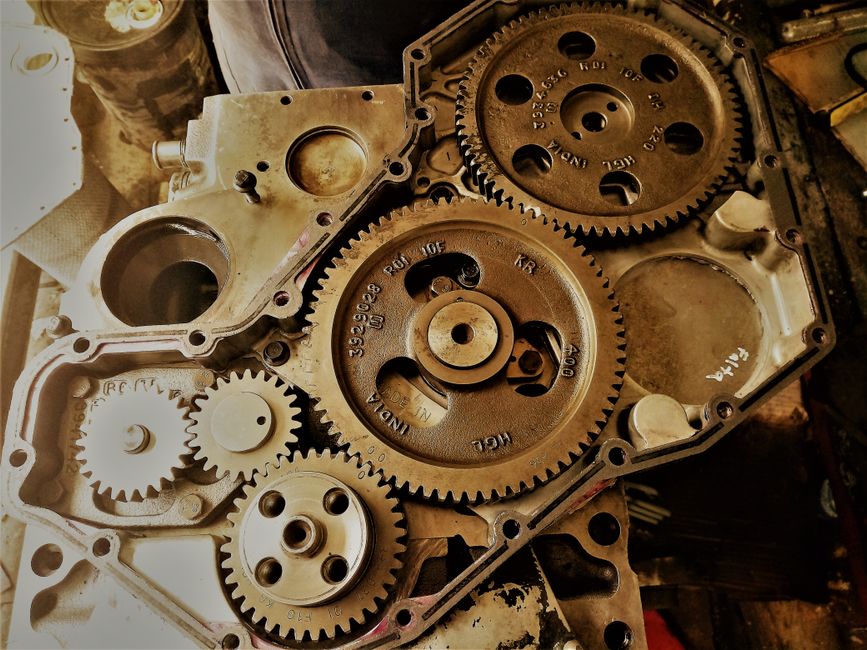
Helical gears address this challenge through angled teeth that engage progressively, allowing multiple teeth to share the operating load simultaneously. This design provides high torque ratings, quieter operation, and increased shock absorption for demanding environments. The helix angle introduces an axial thrust component that must be managed by industrial thrust bearings or countered by a double helical (herringbone) profile. Double helical gears feature opposing tooth angles across a single face, eliminating axial thrust forces altogether.
Bevel gearing allows power transmission between intersecting shafts, typically configured at a 90-degree right angle. Spiral bevel gears utilize curved, angled teeth to provide gradual tooth engagement similar to helical gears, ensuring smooth torque transfer in heavy bucket elevators, rolling mills, and marine propulsion drives. When matching input and output shafts operate at a 1:1 speed ratio with 90-degree intersecting axes, miter gears are utilized to redirect mechanical drive paths without changing speed.
Internal splines and precision internal gears provide high-surface-area shaft engagement within space-constrained housings. For facility teams balancing heavy operational demands, using the complete guide to custom industrial gears helps match tooth geometries, backlash specifications, and mounting configurations directly to continuous-duty processing environments.
Heavy Planetary Drives and High-Torque Gearsets
Planetary gear systems deliver exceptional torque density by splitting torsional loads across multiple planet gears driven by a central sun gear. A rigid planet carrier supports the planet gears as they orbit within a stationary or rotating internal ring gear, creating high reduction ratios in a compact footprint.
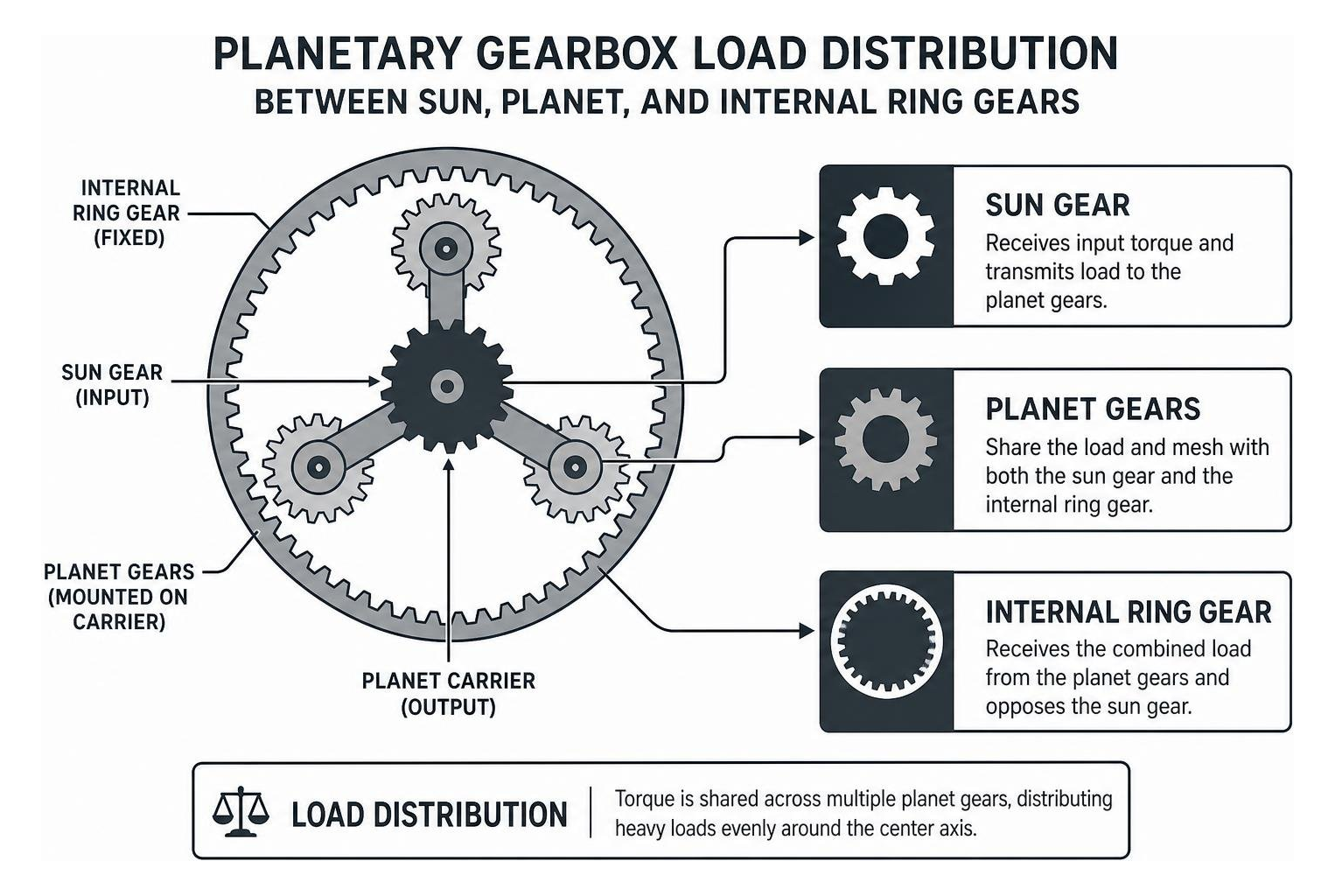
This coaxial arrangement distributes heavy operational shock loads evenly around the center axis, preventing localized shaft deflection under variable loads. Heavy manufacturing operations rely heavily on planetary systems to drive primary equipment, such as cement kilns, aggregate crushers, and paper mill pulpers. You can review detailed planetary calculations and reduction principles in our gear reducer gearbox guide 2026 to evaluate mechanical performance parameters for large industrial equipment.
Worm Gearing and Specialty Speed Reducer Configurations
Worm gear sets provide large single-stage reduction ratios while fitting neatly into compact, right-angle installations. The assembly consists of a case-hardened steel worm mesh driving a sacrificial bronze gear wheel, relying on sliding tooth contact rather than rolling contact to transmit mechanical power.
The friction inherent to sliding contact makes bronze selection critical to prevent galling and manage heat buildup. High-ratio worm drives often exhibit self-locking capabilities, meaning the output gear cannot backdrive the worm shaft, which provides essential safety on inclined conveyor systems and heavy material hoists. For deeper engineering specifications on lead angles, efficiency ratings, and lubrication, consult our comprehensive guide to worm gear speed reducers.
Modern Gear Manufacturing Methods and In-House Machining Capabilities
Precision gear production requires dedicated manufacturing equipment to convert forged alloy blanks into tight-tolerance industrial components. Completing all machining, tooth generation, and finishing processes within a single facility gives engineering teams total control over dimensional accuracy, metallurgical integrity, and production schedules.
Managing processes in-house eliminates the communication errors and logistics delays that occur when outsourcing operations across multiple third-party machine shops. When production equipment in chemical plants, paper mills, or mining operations goes offline, direct control over turning, hobbing, grinding, and inspection allows our team to accelerate turnaround times. Plant engineers can learn more about full-scope capabilities through our specialized custom gear manufacturing services designed to support heavy processing infrastructure.
Precision CNC Machining and Splining in Gear Manufacturing
Producing a high-performance gear begins by creating an accurate blank using multi-axis CNC turning and milling centers. Machining the outer diameter, internal bore, and locating faces with precise runout control ensures tooth profiles remain concentric with the mounting shaft during operation.
Precision turning handles external diameters from small high-speed shafts up to large 8-inch or larger continuous drive journals. Custom shafting requires tight straightness tolerances, often held to .0003 inches per inch, to prevent catastrophic imbalance in high-load drivelines.
Wire electrical discharge machining (EDM) uses an electrically energized wire to erode metal with extreme accuracy. This process cuts intricate internal splines, metric keyways, and custom tooth geometries in hardened alloys where conventional cutting tools would deflect or fail. Standard keyway broaching complements wire EDM by generating high-volume shaft-locking interfaces quickly.
High-Tolerance Gear Hobbing, Shaping, and Profile Grinding
Gear hobbing is the standard continuous cutting process for generating external spur, helical, and worm gear profiles. A rotating, fluted cutting tool known as a hob meshes with a synchronized rotating gear blank, progressively carving tooth spaces across the face width with uniform pitch and depth.
Gear shaping utilizes a reciprocating pinion-shaped or rack-shaped cutter that strokes vertically while gradually feeding into the blank. Shaping is necessary when cutting internal ring gears, herringbone sets without center relief grooves, or cluster gears where adjacent shoulders prevent a hob cutter from clearing the part.
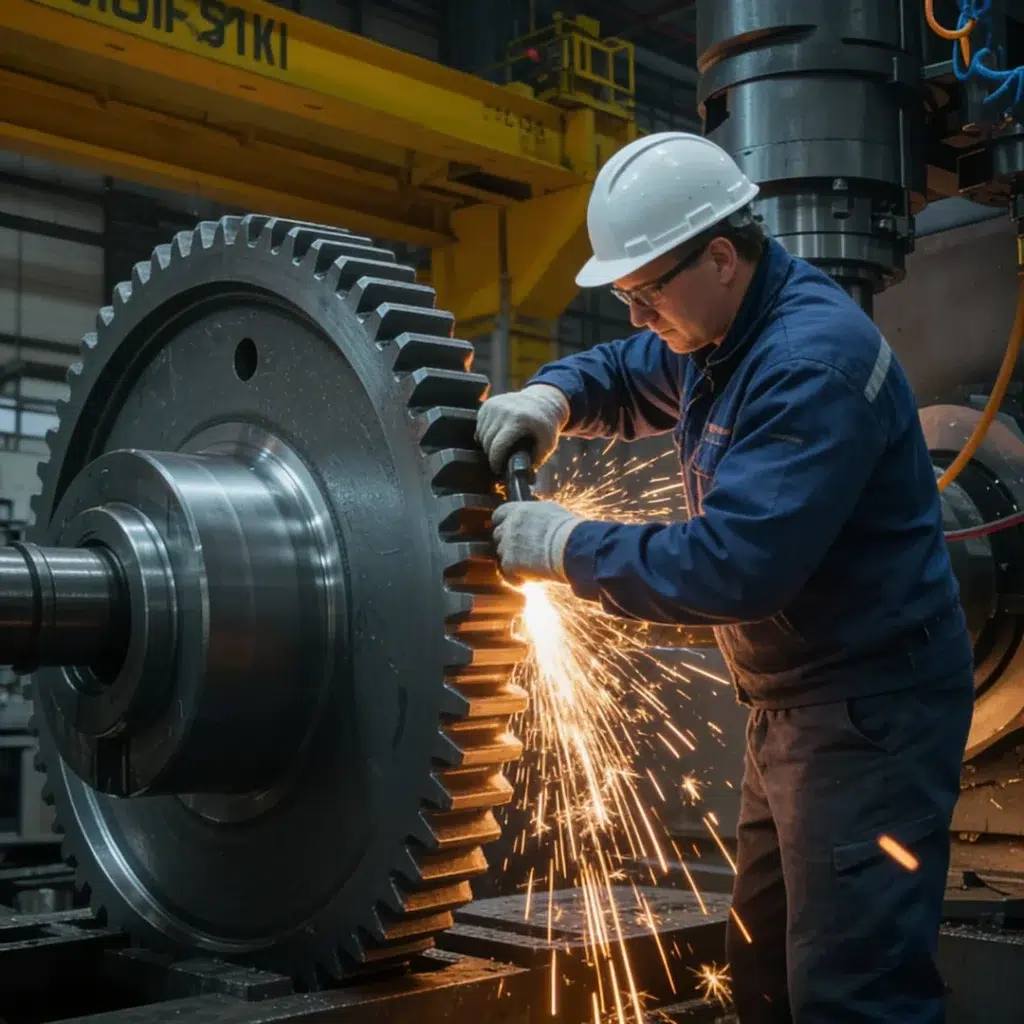
Following heat treatment, precision gear profile grinding eliminates metallurgical distortion introduced during thermal cycles. CNC profile grinders utilize vitrified or cubic boron nitride (CBN) wheels to restore pitch accuracy, tooth spacing, and involute form. For an extensive technical breakdown of pitch systems, diametral pitches ranging from 16DP to 200DP, and module standards, refer to our custom gear manufacturing imperial guide 2026.
Metallurgy, Heat Treatment, and Protective Finishes
Industrial gears must balance surface hardness to resist contact wear with core toughness to absorb continuous dynamic shock loads without brittle fracture. Selecting the proper alloy and thermal processing path is essential for equipment exposed to heavy industrial duty cycles.
Carburizing introduces carbon into the outer layer of low-carbon alloy steels (such as 8620 or 9310) at elevated temperatures, followed by quenching. This produces a hard, wear-resistant outer case while retaining a ductile core. Induction hardening selectively heats tooth flanks using high-frequency electromagnetic coils before rapid quenching, leaving core metal and internal hubs untouched. Nitriding diffuses nitrogen into the surface of alloy steels at lower temperatures, producing a hard case with minimal thermal distortion, making it ideal for high-precision components.
| Material Grade | Primary Alloy Constituents | Typical Core Hardness | Case Hardening Depth | Primary Industrial Applications |
|---|---|---|---|---|
| AISI 4140 | Chromium-Molybdenum Steel | 28–34 HRC | 0.030″–0.060″ (Induction) | General industrial drive gears, shafts, pinions |
| AISI 4340 | Nickel-Chromium-Moly Alloy | 32–38 HRC | 0.040″–0.070″ (Induction) | Heavy shock-load mining and aggregate drives |
| AISI 8620 | Low-Carbon Nickel-Chrom-Moly | 25–30 HRC | 0.040″–0.090″ (Carburized) | Heavy-duty speed reducers, kiln drives |
| 17-4 PH | Martensitic Stainless Steel | 35–42 HRC (H900) | Through-Hardened | Corrosive chemical, food processing, washdown |
| Bronze 907 | High-Tin Phosphor Bronze | 70–85 HRB | N/A (Homogeneous) | Worm gear wheels, high-sliding contact drives |
Surface plating and chemical conversions protect gear teeth, internal splines, and exposed shaft journals from aggressive plant environments. Manganese phosphate and black oxide coatings improve oil retention and prevent metal-to-metal scuffing during initial equipment commissioning. Electroless nickel plating and specialized zinc finishes provide corrosion protection for drives operating in moist, chemical, or coastal industrial settings across the Southeast.
Quality Control, Metrology, and Industry Certifications
Dimensional verification validates that manufactured gears match intended CAD geometry, backlash allowances, and AGMA quality standards before mechanical assembly. Thorough quality programs rely on precision metrology equipment to inspect raw blanks, semi-finished components, and finished tooth flanks.

Strict quality control practices ensure that every drive component performs reliably under full operating loads. Manufacturing operations that comply with quality standards such as ISO 9001:2015 maintain traceability across material certifications, heat treatment logs, and final inspection reports.
For mission-critical assemblies deployed in specialized aerospace or clean industrial settings, controlled ISO 7 cleanroom assembly environments limit airborne particulate contamination to no more than 10,000 particles per cubic foot. This level of environmental control protects delicate bearings, internal splines, and high-precision gears from abrasive particulate ingress during final assembly.
Advanced Metrology and Tolerance Verification in Gear Manufacturing
High-precision gear verification relies on dedicated analytical tools to inspect involute form, tooth lead, pitch variation, and composite runout. Specialized CNC gear inspection centers verify that tooth profiles match design tolerances within +/- .0001 inches.
Coordinate measuring machines (CMMs) measure physical dimensions, bore positions, and shaft alignments with micron-level accuracy. Optical shaft measurement systems quickly evaluate total runout, journal diameters, and concentricity across complex drive shafts up to extended lengths, identifying potential balance issues before dynamic installation.
Prototyping, Reverse Engineering, and Maintenance Support
Plant maintenance engineers frequently face broken, worn, or obsolete gearing from legacy machinery where original manufacturer support no longer exists. Reverse engineering provides a reliable path to recreate precision replacement components from damaged samples.
Our engineering team measures existing gear geometry, identifies original materials using hardness testing and optical emission spectroscopy, determines original pitch and pressure angles, and models exact replacement components in CAD. If plant equipment shows signs of early wear or unexpected gear failure, facilities can utilize our full industrial gearbox repair services to restore housings, replace worn shafts, and install upgraded gearsets.
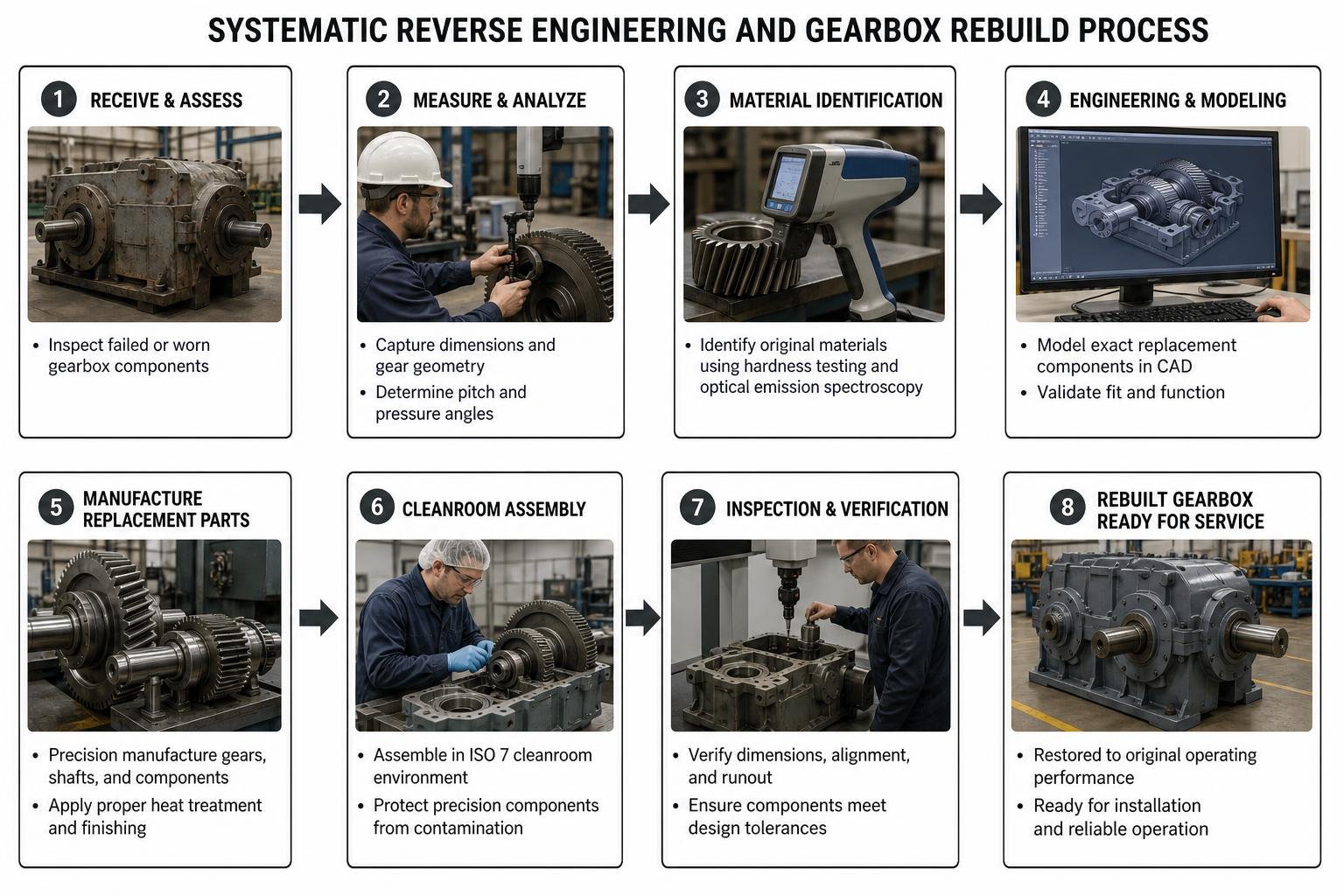
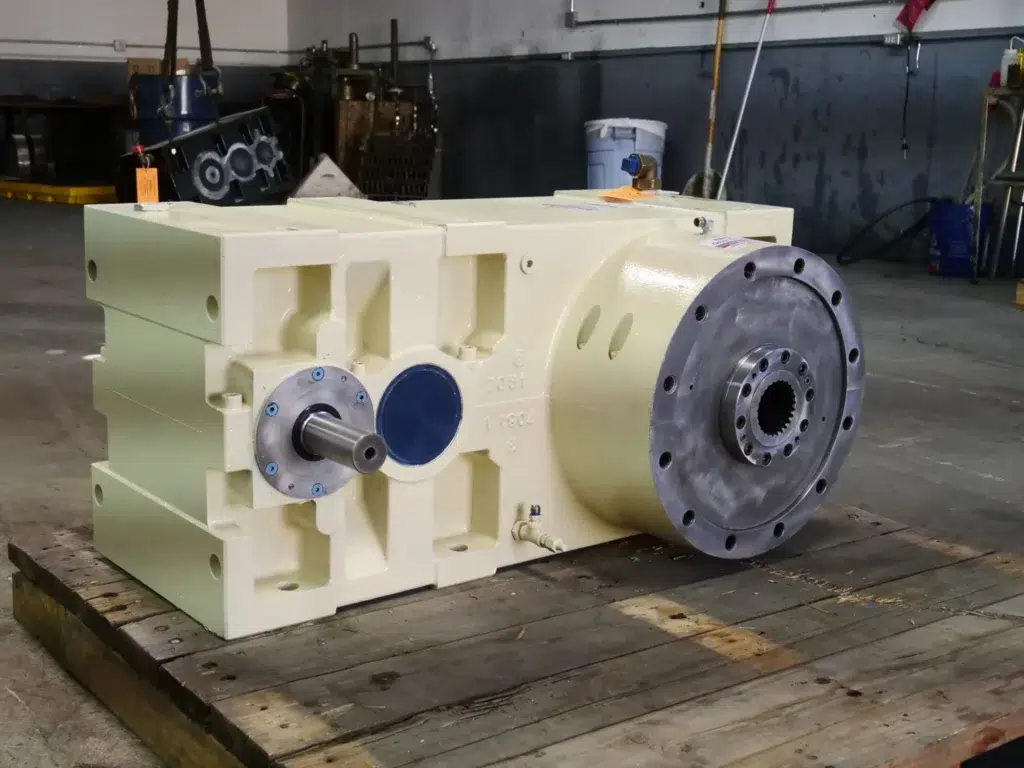
When an internal failure damages shafts, bearing journals, and housings simultaneously, completing a full gearbox rebuild brings equipment back to original operating performance. Operations teams can review our technical methodology in rebuilding industrial gearboxes to see how systematic dimensional inspection and precision assembly keep processing lines running reliably.
Frequently Asked Questions about Gear Manufacturing
What are the tightest tolerances achievable in custom gear manufacturing?
Custom gear manufacturing operations routinely achieve cutting and grinding tolerances within +/- .0001 inches. Meeting these tight limits requires CNC profile grinding, temperature-controlled machining environments, and analytical gear analyzers capable of verifying AGMA Class 12 through 15 quality standards. Shaft straightness tolerances can be held to .0003 inches per inch to eliminate high-speed vibration.
How do heat treatment methods affect heavy industrial gear performance?
Heat treatment determines whether a gear can withstand severe bending stresses and continuous contact fatigue. Carburizing creates a deep, hardened outer case that resists micro-pitting, while retaining a tough, shock-absorbing internal core that prevents sudden tooth fracture under heavy dynamic loads. Unhardened gears or improperly heat-treated alloys will rapidly degrade from spalling, scuffing, and fatigue cracking.
Why is complete in-house manufacturing important for custom industrial gears?
Complete in-house manufacturing gives engineering teams total oversight of blank turning, hobbing, shaping, heat treatment, grinding, and quality inspection under one roof. This single-source accountability prevents machining errors between disparate third-party shops, eliminates outside shipping delays, and allows rapid shop turnaround times when heavy industrial plants face unscheduled mechanical outages.
Conclusion
Specialty Gear Drives manufactures, rebuilds, and repairs heavy industrial gear components and mechanical power transmission systems at our Largo, Florida facility. Our full in-house capabilities allow us to manage every production stage, from initial blank turning and precision hobbing to final tooth grinding and coordinate metrology.
Industrial plants across Florida, Georgia, Alabama, South Carolina, Mississippi, and Louisiana depend on our engineering team for rapid turnaround times during unscheduled mechanical breakdowns. We provide 24–48 hour expedited shop turnaround alongside free pickup and commercial delivery across our Southeastern service territory, helping you minimize production downtime.
Every industrial gear and gearbox rebuilt in our facility is supported by a comprehensive 24-month operational warranty. When your processing lines, conveyors, or kilns require precision replacement gears or complete drivetrain restoration, request custom gear manufacturing directly from our engineering team to keep your heavy plant operations running smoothly.