In Depth Guide to Alabama Coal Mining
Why Alabama Coal Mining Still Matters
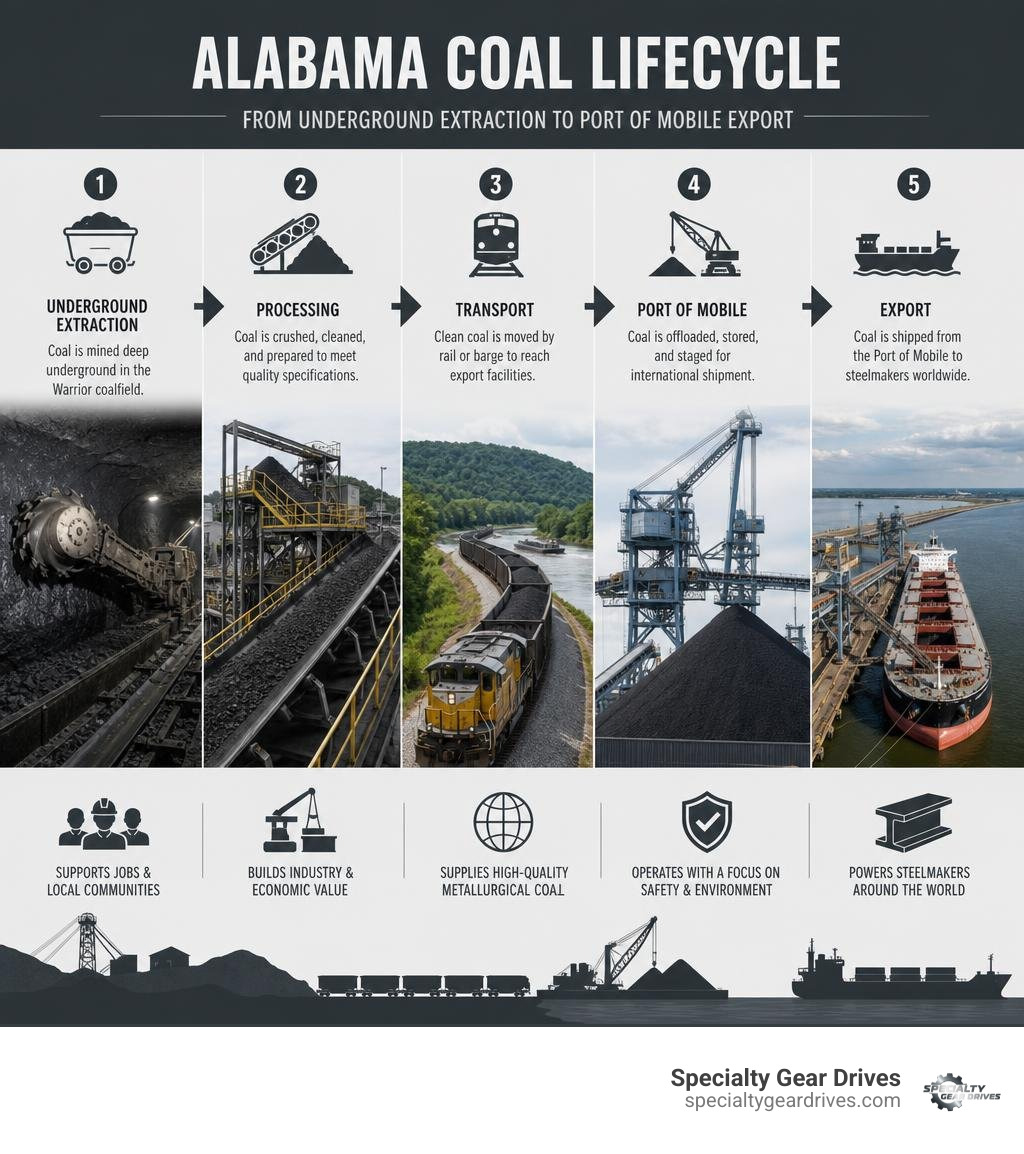
Alabama coal mining is now driven mainly by metallurgical coal used to make steel, not by coal burned in local power plants. Most active production comes from deep underground mines in the Warrior coalfield, where high-quality bituminous coal is processed, moved by rail or barge to the Port of Mobile, and shipped to steelmakers around the world.
For plant and mine leaders, the practical takeaway is clear:
- Alabama’s coal industry depends on high-output underground equipment, conveyors, preparation plants, and export infrastructure.
- Metallurgical coal made up about 82% of the state’s 2018 coal production.
- The state produced roughly 14 million short tons in 2019, largely from underground mines.
- Coal remains a major source of industrial jobs, payroll, port activity, and steel supply-chain value.
Coal helped move Alabama from an agricultural economy toward iron, steel, rail, and manufacturing, especially around Birmingham. Its history also includes difficult labor conditions, including convict leasing and dangerous early mining practices. Modern mines operate under far stricter safety, environmental, and reclamation rules, but they still face demanding conditions: deep workings, methane control, water management, and continuous material handling.
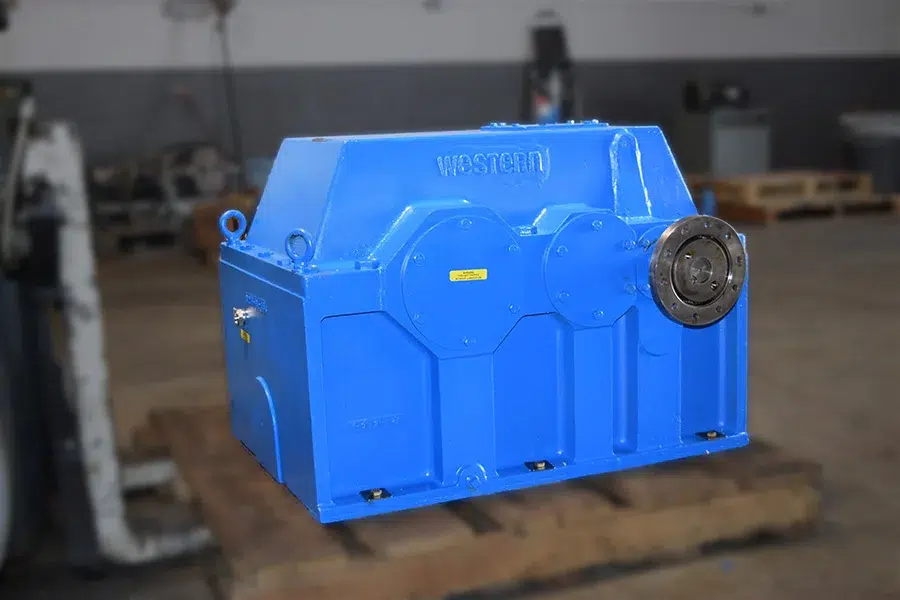
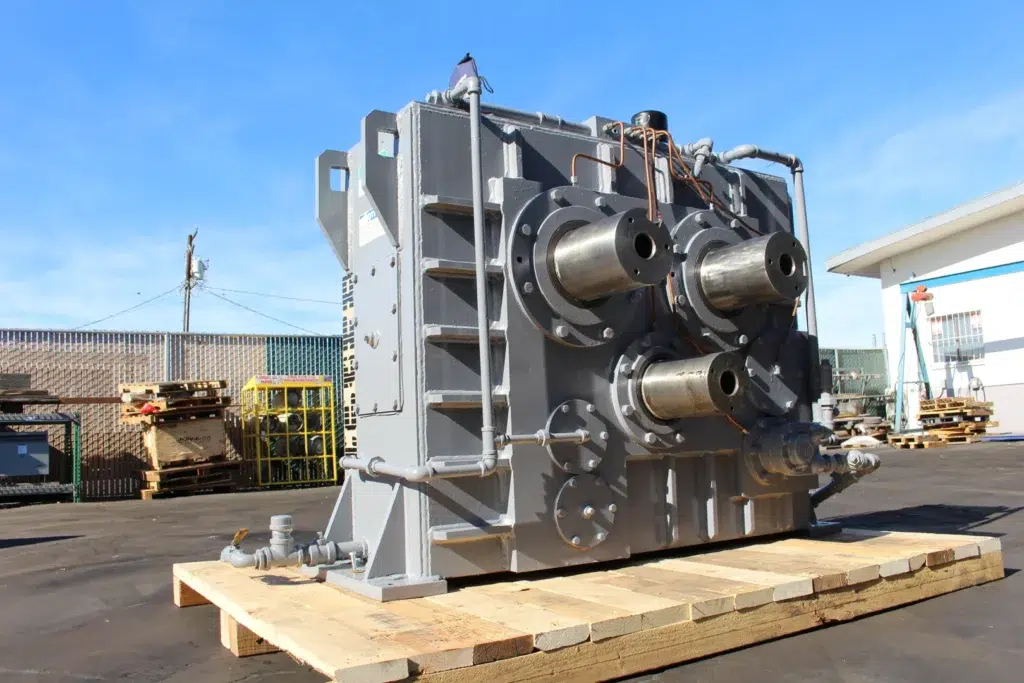
The equipment behind that output matters. Longwall systems, continuous miners, crushers, wash plants, skip hoists, and conveyor networks all rely on heavy-duty gear reducers, speed reducers, and helical, bevel, and worm gearboxes. A drive failure can halt production far beyond the failed component.
I am Peter Clark, owner of Specialty Gear Drives, an industrial gearbox repair and manufacturing company serving heavy industries across the Southeast. My work supporting mining equipment, conveyors, cement plants, marine systems, wind turbines, and heavy manufacturing lines informs this guide to Alabama coal mining; all gearbox repair and line boring work is performed in-house at our Florida facility, with rapid response, expedited logistics, and fast shop turnaround when downtime is at stake.
Geology, Coalfields, and History of Alabama Coal Mining
The coal-bearing strata of Alabama anchor the southern terminus of the expansive Appalachian coal basin, a structural formation stretching across nearly 70,000 square miles. These deposits formed during the Pennsylvanian period within the Pottsville Formation, which consists of interbedded sandstones, shales, siltstones, and high-rank bituminous coal seams.
Early industrial efforts targeted prominent geological horizons, most notably the Pratt, Mary Lee, and Blue Creek seams. The Pratt seam, often measuring around 57 inches in thickness (including roughly 10 inches of interbedded rock), provided early miners with accessible, high-yield material. Over decades of intensive extraction, production transitioned deeper underground into the Mary Lee and Blue Creek zones, which are celebrated for their strong coking characteristics, low ash content, and superior thermal efficiency.
The Four Primary Bituminous Basins
Geologists classify Alabama’s coal resources across four distinct bituminous fields:
- The Warrior Field: Covering the Black Warrior Basin northwest of Birmingham, this is the largest, most productive, and commercially dominant basin in the state. Almost all active underground longwall operations tap into its deeply buried, gas-rich seams.
- The Cahaba Field: Positioned southeast of the Warrior field, this elongated, structurally folded basin historically yielded significant thermal and coking coal, though geological faulting limits large-scale modern extraction.
- The Coosa Field: A narrow trough located along the southeastern edge of the Appalachian fold-and-thrust belt, containing localized bituminous deposits that saw limited historical exploitation.
- The Plateau Field: Spanning Lookout Mountain and Sand Mountain in northeastern Alabama, this field contains shallow, discontinuous seams primarily extracted via small surface mining operations.
Of the state’s estimated 4 billion tons of economically recoverable coal reserves, the Warrior basin holds the vast majority, with metallurgical grades making up approximately 85% of that underground wealth.
Industrial Growth, Birmingham Steel, and Labor Evolution
Commercial extraction began prior to the Civil War, but Alabama’s industrial boom took off during the late 19th century. In 1876, experiments confirmed that baking Warrior basin coal inside specialized ovens produced superior metallurgical coke. This fuel sustained temperatures high enough to smelt the vast iron ore deposits of Red Mountain inside industrial blast furnaces. The convergence of coal, iron ore, and limestone within a ten-mile radius established Birmingham as the “Magic City” and transformed northern Alabama into an industrial powerhouse.
This expansion carried severe social and labor costs. Following the Civil War, mining corporations relied on the convict-lease system, leasing predominantly Black state and county prisoners to work deep seams under brutal conditions for a daily debt credit of just 30 cents. Tragedies were frequent, such as the 1911 Banner Mine explosion that killed 125 leased convict miners. Alabama was the last state in the country to abolish convict leasing, ending the practice on June 30, 1928.
Free miners organized under the Knights of Labor and later the United Mine Workers of America (UMWA) District 20. While surface company towns enforced strict racial segregation, underground crews earned comparable piece rates and shared mutual hazards. Major strikes across the late 19th and 20th centuries fought against scrip currency, company commissaries, and dangerous room-and-pillar mining practices, cementing organized labor’s presence in the state’s industrial corridor.
Metallurgical vs. Thermal Coal Production and Economic Impact
The modern coal sector operates under a distinct market reality: domestic power utilities have largely shifted toward natural gas and cleaner-burning sub-bituminous coals imported from the Powder River Basin in Wyoming, while Alabama operators focus on metallurgical coal production.
| Characteristic | Metallurgical (Met) Coal | Thermal (Steam) Coal |
|---|---|---|
| Primary End Use | Blast furnace steel manufacturing | Electricity generation & steam boilers |
| Share of State Output | ~82% to 85% of total production | ~15% to 18% of total production |
| Primary Markets | International exports (Europe, Asia, South America) | Local industrial plants (cement, lime, paper) |
| Chemical Properties | High Coke Strength (CSR), high fluidity, low sulfur | Moderate BTU, higher volatile matter & moisture |
| Mining Method | Deep underground mechanized longwall & continuous | Mostly surface strip mines & contour cuts |
| Economic Value | High market premium based on global steel indices | Lower, fixed utility contract pricing |
High-Volatile Coking Coal and Global Export Value
Metallurgical coal functions as both a fuel and a reducing agent inside integrated blast furnaces. Raw coal undergoes thermal distillation in coke ovens for 48 to 72 hours, converting it into hard, porous carbon blocks known as coke.
When loaded into a blast furnace with iron ore and limestone, the coke provides structural support for the burden, supplies carbon monoxide to strip oxygen from the ore, and generates the intense heat required for molten iron production. Alabama’s Blue Creek and Mary Lee seams yield coking coal characterized by exceptional fluidity, high Coke Strength After Reaction (CSR), and low sulfur content. These traits prevent furnace degradation and make the state’s met coal a necessary blending component for steelmakers across 35 countries.
Workforce Demographics, Wages, and State Economic Revenue
The economic footprint of Alabama mining extends far beyond the active face. According to state figures, direct coal extraction accounts for over 2,600 highly skilled jobs and an annual direct payroll exceeding $348 million.
Underground mining in the metallurgical sector provides some of the highest industrial wages in the Southeast. Starting underground personnel earn around $85,000 annually, with experienced equipment operators, electricians, and mechanics regularly exceeding $100,000 after two years on site. The industry generates over $2.2 billion in annual direct economic output, supporting secondary equipment suppliers, logistics operators, and local public infrastructure through coal severance taxes and mineral royalties.
Modern Extraction Methods and Infrastructure
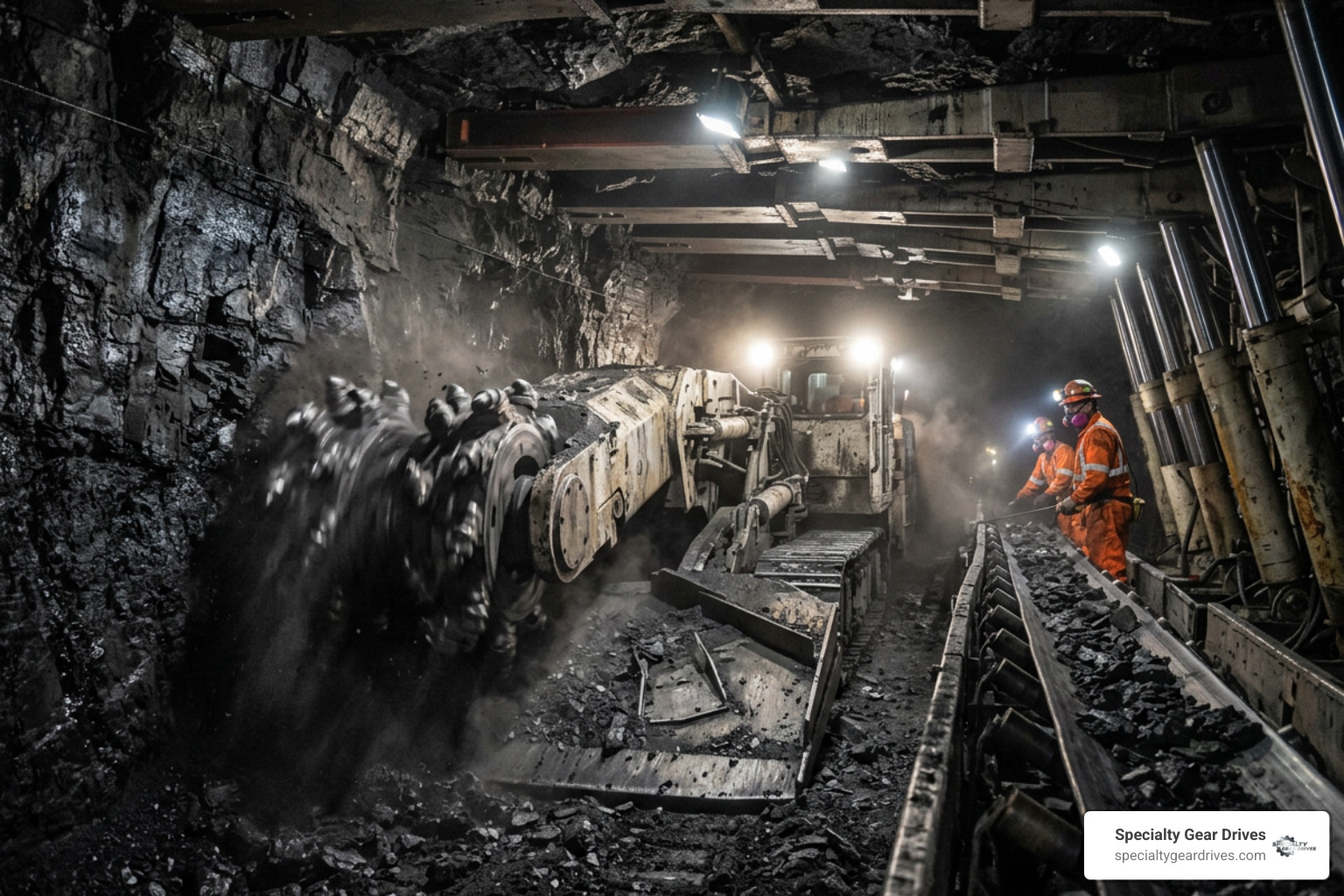
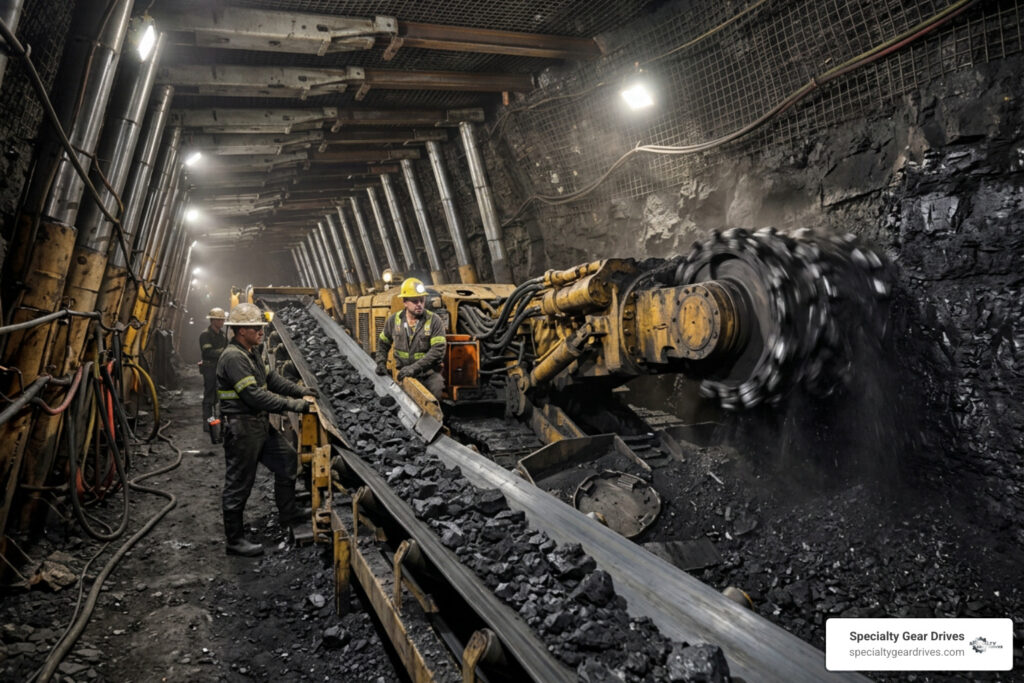
Modern coal extraction has moved past pickaxes and mule-drawn carts, evolving into an automated, capital-intensive industry. Surface mines utilize heavy continuous excavators and draglines to uncover shallow seams, while deep underground operations depend on multi-million-dollar extraction units.
Underground mines rely on continuous miners to cut entry headings, shuttle cars and ram cars to transfer product, and continuous roof bolters to secure strata overhead. Coal processing facilities—or preparation plants—then clean, sort, and blend raw coal using heavy flotation circuits, vibrating screens, and heavy-media cyclones.
Keeping these heavy continuous extraction systems running requires careful attention to rotating machinery. Maintenance managers frequently consult our A-Z guide to gear overhaul services in Alabama to plan maintenance schedules for high-torque underground equipment.
Deep Underground Longwall Systems in Alabama Coal Mining
Deep in the Black Warrior Basin, major operators such as Warrior Met Coal run operations including Mine No. 4, Mine No. 7, and the Blue Creek Mine No. 1 complex. Operating at vertical depths ranging from 1,500 to over 2,100 feet, these facilities rank among the deepest underground coal mines on the North American continent.
Deep mining at this scale centers on the mechanized longwall mining system. A rotating shearer travels back and forth across a coal face extending 1,000 feet or wider, cutting away the seam in continuous passes. Massive hydraulic roof shields support the overburden directly above the work area. As the shearer cuts and the armored face conveyor clears the raw coal, the shields advance, allowing the unsupported rock strata behind them to collapse safely in a controlled zone called the gob.
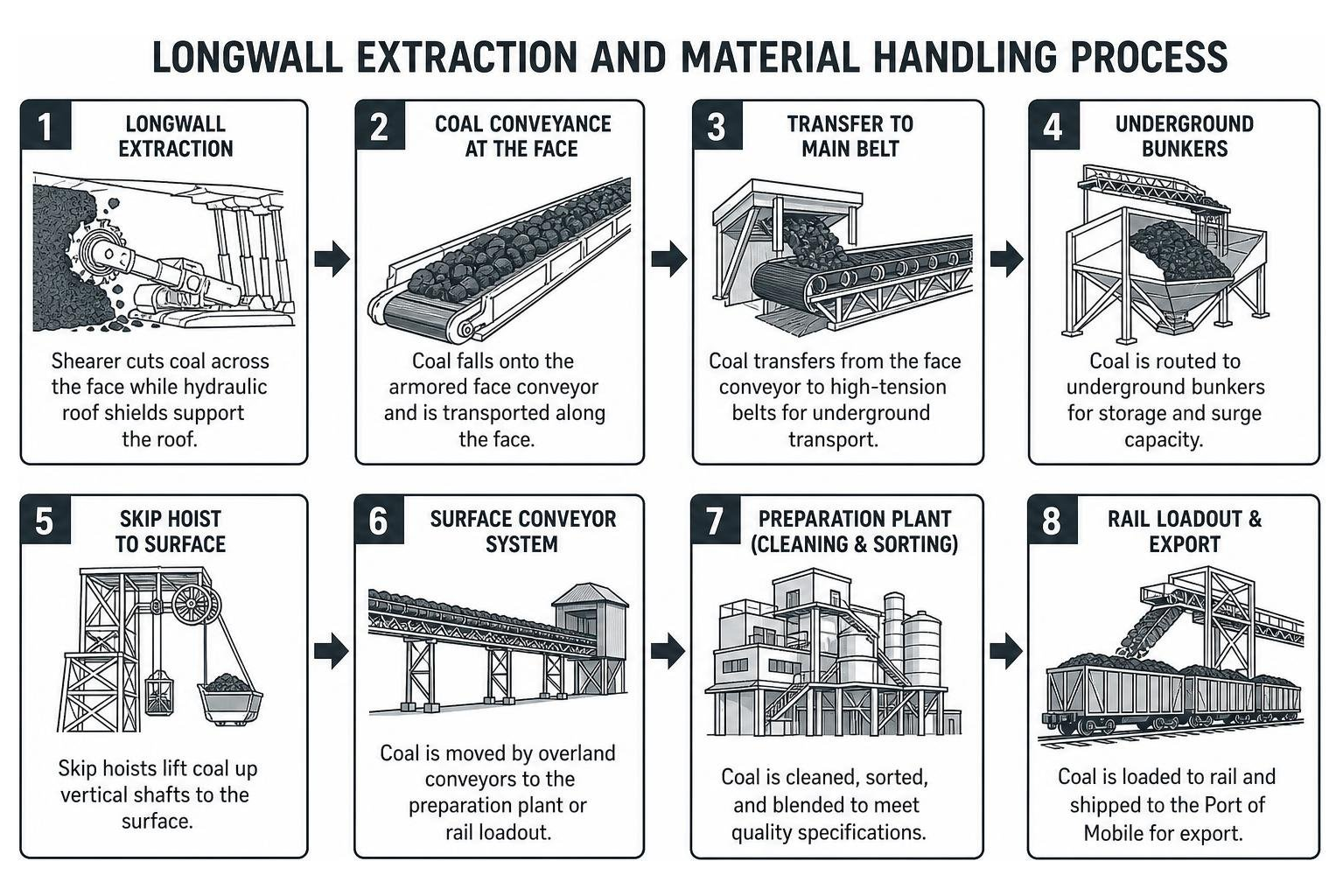
The extracted material dumps onto a series of high-tension belts and underground bunkers before heavy skip hoists lift thousands of tons per hour up vertical shafts to overland conveyor networks. The immense continuous torque loads placed on shearer drums, armored face conveyors, and mainline take-up drives make proactive condition monitoring necessary. Many plant engineers use local gearbox vibration analysis services in Alabama to detect bearing fatigue, gear tooth pitting, and shaft misalignment before a sudden mechanical stoppage stalls an entire production panel.
Logistics, Port of Mobile, and McDuffie Coal Terminal
Extracted metallurgical coal travels through an integrated logistics network that connects rural mining complexes directly to international shipping channels.
Coal moves from prep plant loadout silos via direct rail links (operated by CSX and Norfolk Southern) or via river barges traveling the navigable Black Warrior and Tombigbee Waterway systems directly to the Gulf of Mexico.
The primary hub for this material is the Port of Mobile and its specialized McDuffie Coal Terminal. McDuffie is the third-largest coal export terminal in the United States and the single largest port of entry for specialized coal imports. Handling both river barges and unit trains, the terminal features deepwater bulk berths capable of loading ocean-going vessels bound for South America, Europe, and Asia. Export coal represents nearly half of the total operating revenue for the Alabama State Port Authority, backed by more than $150 million in modern shoreside infrastructure investments.
Environmental Reclamation, Safety Standards, and Future Prospects
Modern mining in Alabama operates under comprehensive state and federal regulatory frameworks, overseen by the Alabama Surface Mining Commission (ASMC), the Mine Safety and Health Administration (MSHA), the Office of Surface Mining Reclamation and Enforcement (OSMRE), and the Alabama Department of Environmental Management (ADEM).
Mine Safety Protocols and Methane Management in Alabama Coal Mining
Operating thousands of feet underground in the Black Warrior Basin presents distinct geological challenges, primarily high methane gas concentrations. Active Blue Creek seam mines liberate between 25 and 30 million cubic feet of methane daily.
To manage this hazard, operators use extensive ventilation and degasification systems:
- Vertical Degasification Wells: Drilled from the surface into virgin coal seams months ahead of extraction to drain pure methane gas, which is often captured and fed into commercial natural gas pipelines.
- High-Volume Ventilation Fans: Massive surface fan installations force hundreds of thousands of cubic feet of fresh air through dedicated intake shafts every minute.
- Intake and Exhaust Overcasts: Engineered concrete overcasts separate fresh airflow from contaminated return air paths.
- Continuous Atmospheric Monitoring: Methane sensors hardwired along continuous miner heads, longwall shearers, and return airways instantly kill equipment power if gas concentrations reach 1.0%.
- Emergency First Response: Teams participate in rigorous annual safety and rescue competitions, such as the Alabama Surface Mine First Responder Competitions held at the Alabama Fire College in Tuscaloosa.
Due to strict safety compliance, leading regional operators maintain overall incident rates that sit more than 50% below the national mining average.
SMCRA Compliance, Legacy Land Reclamation, and Long-Term Reserves
Environmental remediation is integrated into the full mining lifecycle pursuant to the Surface Mining Control and Reclamation Act of 1977 (SMCRA). Active operators post reclamation bonds, backfill surface cuts, re-establish natural topographical contours, manage water runoff, and re-vegetate mined acreage with native hardwoods and grasses.
For legacy sites abandoned prior to 1977, the Alabama Department of Labor Mining Division manages the Abandoned Mine Land (AML) Reclamation Program. Funded through mandatory per-ton fees on active operations along with federal allocations from the Bipartisan Infrastructure Law (BIL) and AMLER grants, the program remediates open vertical shafts, eliminates hazardous highwalls, controls mine subsidence, and constructs active water treatment systems to neutralize acid mine drainage. Under federal guidelines, Alabama can retain up to 30% of certain BIL grants to fund perpetual water treatment infrastructure.
The future of Alabama’s coal industry remains anchored to its massive reserve base. Recent federal approvals for major mining plans in Tuscaloosa County—authorizing the recovery of over 53 million tons of federal metallurgical coal between Mine No. 4 and Blue Creek Mine No. 1—will generate an estimated $400 million in annual economic output while extending active mine lifespans out to 2046 and 2067. With an estimated 300-year supply of accessible coking coal remaining, Alabama remains central to the global industrial supply chain.
Public sentiment in the state supports this role. Independent polling shows that 68% to 69% of Alabama voters view the mining industry favorably, while 79% favor adding modern environmental controls to maintain existing base-load infrastructure rather than retiring industrial facilities outright.
Frequently Asked Questions About Coal Mining in Alabama
What makes Alabama coal so valuable on the global market?
Alabama’s underground deposits in the Black Warrior Basin consist primarily of premium, high-volatile bituminous metallurgical coal. This material exhibits high fluidity, low sulfur and ash content, and superior Coke Strength After Reaction (CSR) ratings. These chemical properties make it an ideal reducing agent and fuel inside blast furnaces, commanding premium pricing from international steel manufacturers over common steam coal.
How deep are the underground coal mines in Alabama?
Deep underground coal mines in Alabama, such as Warrior Met Coal’s Mine No. 7 and Blue Creek operations in Tuscaloosa and Jefferson counties, operate at depths between 1,500 and 2,100 feet below the surface. These operations are among the deepest underground coal mines in North America, requiring specialized elevator skip hoists, deep vertical ventilation shafts, and high-strength longwall support shields.
How long are Alabama’s metallurgical coal reserves projected to last?
Alabama holds approximately 4 billion short tons of economically recoverable coal reserves, roughly 85% of which is high-grade metallurgical coal. Based on current production volumes of 13 to 15 million short tons per year, these reserves are projected to sustain mining operations for more than 300 years.
Conclusion
The coal extraction sector in Alabama represents an advanced, high-stakes manufacturing environment that supplies the raw materials needed for global steel production. From deep longwall shearers working thousands of feet down to the high-speed overland conveyors feeding preparation wash plants and the barge loadouts along the Black Warrior River, every stage of this supply chain relies on heavy mechanical drivetrains.
When a high-torque gear reducer, planetary drive, or heavy speed reducer fails in a continuous mining system, wash plant, or material handling line, unexpected downtime can quickly disrupt tight production and shipping schedules. Specialty Gear Drives supports plant maintenance engineers, operations managers, and procurement teams across Alabama, Georgia, Florida, South Carolina, Mississippi, and Louisiana with comprehensive rebuild and manufacturing capabilities.
We overhaul and manufacture helical, bevel, and worm gearboxes, gear reducers, and custom gearing tailored to the demands of mining machinery, overland conveyors, cement processing plants, marine systems, wind turbines, and heavy industrial facilities. All precision line boring, gear hobbing, case repair, and rebuild work is completed entirely in-house at our Florida facility. We provide rapid response, expedited logistics, free pickup and delivery, and dependable shop turnarounds backed by a 24-month operational warranty.
Contact Specialty Gear Drives today to learn how our industrial gearbox repair services keep your material handling, crushing, and drive systems operating at full capacity.