5 Things You Need to Know Before Ball Mill Gearbox Repair
How to Plan and Execute a Ball Mill Gearbox Repair
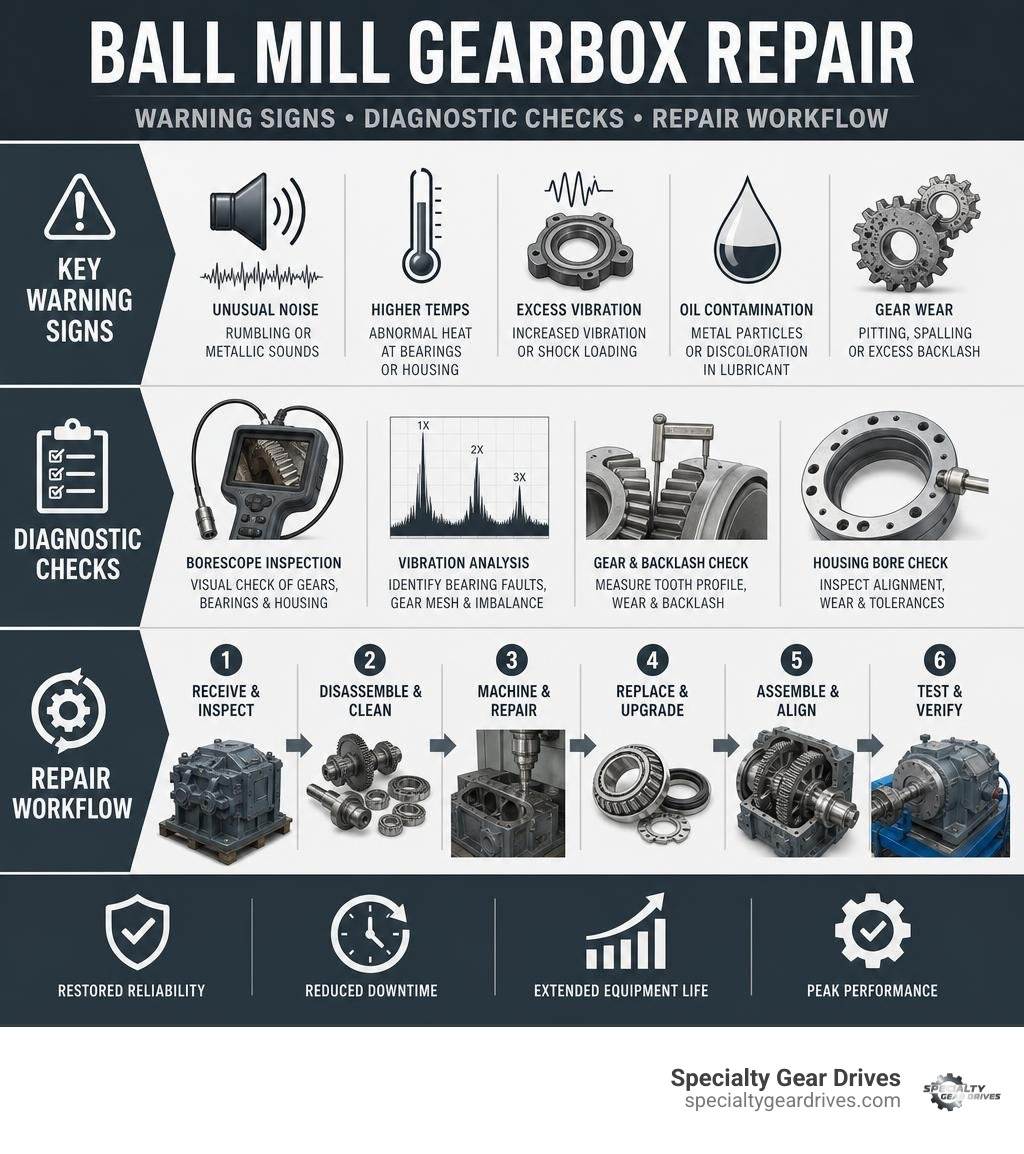
A successful ball mill gearbox repair requires diagnosing internal wear early, isolating root causes, and executing precision mechanical rebuilds before a complete drive failure halts your processing line.
Here is the straightforward workflow to restore your mill drive:
- Perform non-invasive diagnostics: Use internal borescope inspections and vibration spectrum analysis to identify gear mesh backlash, tooth pitting, and bearing fault frequencies.
- Evaluate rebuild feasibility: Check gear tooth profiles and housing bores; re-machining or cutting custom replacement gears often saves up to 60% compared to buying new OEM units.
- Execute full shop reconditioning: Send the reducer to an industrial machine shop for complete teardown, line boring of worn housings, cryogenic bearing installation, and dynamic spin load testing.
Ball mills in mining, cement, and power plants run under punishing torque loads. Catching wear early keeps your drive train running without unexpected outages.
I’m Peter Clark, owner of Specialty Gear Drives in Largo, Florida, where our team specializes in heavy-duty ball mill gearbox repair and custom gear manufacturing for industrial operations across the Southeast. Over decades of restoring high-torque helical, bevel, and planetary gear reducers, I have helped plant managers cut lead times and restore critical milling equipment to factory tolerances.
1. Recognize the Core Failure Modes in Ball Mill Drive Trains
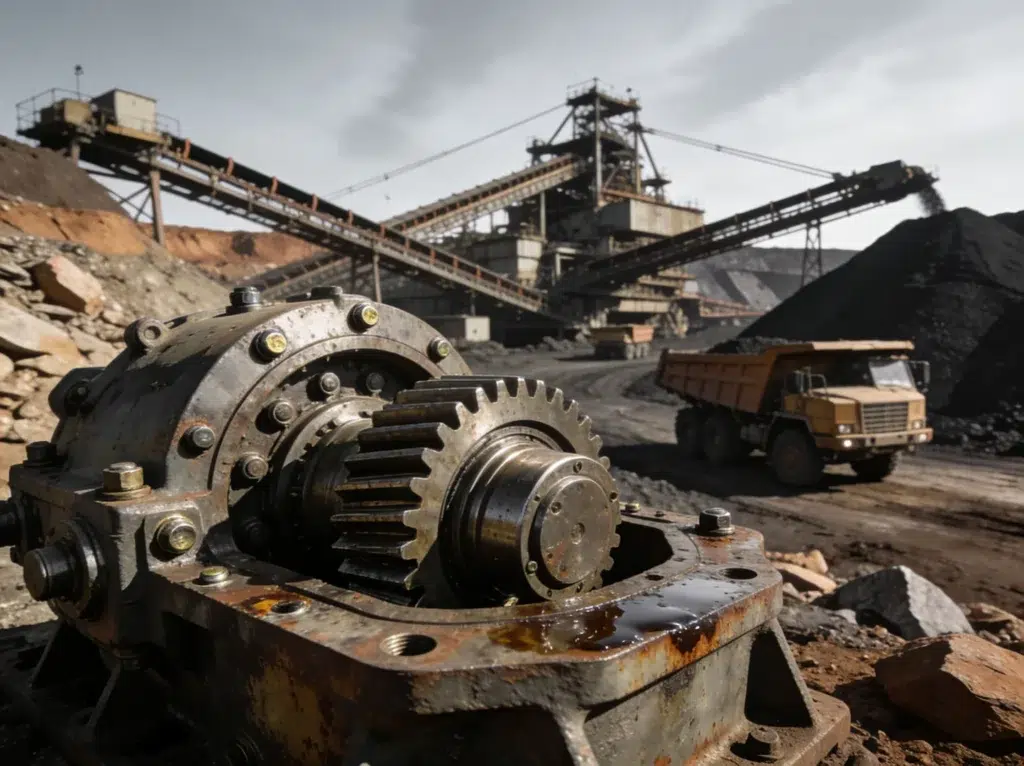
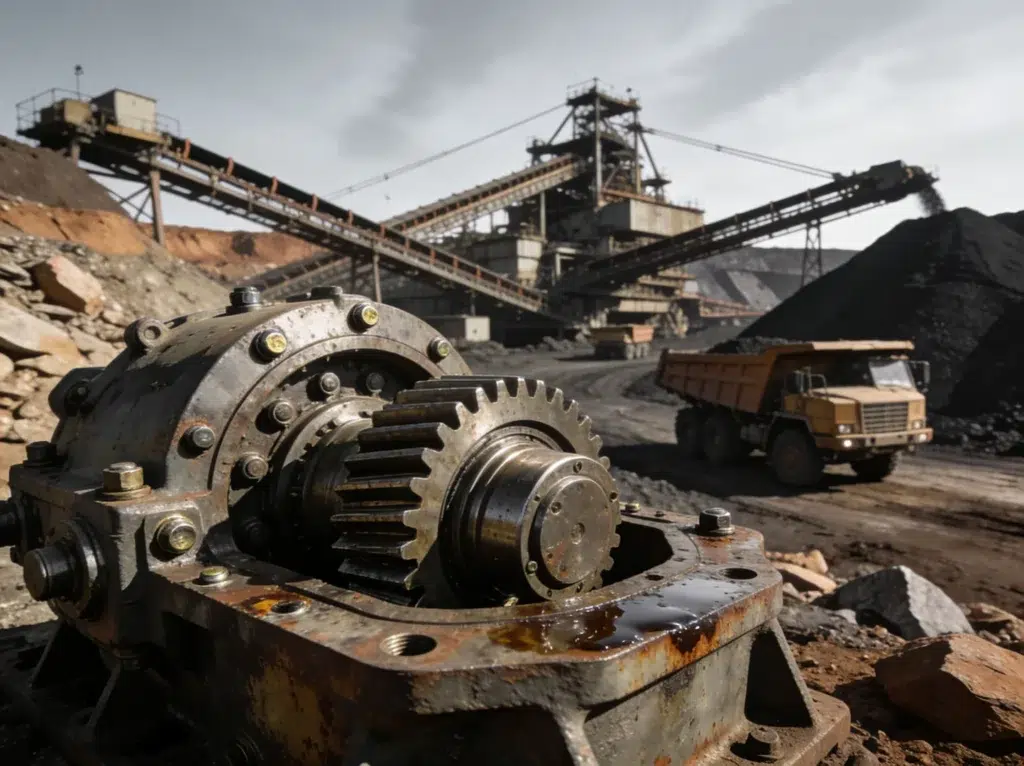
Grinding operations expose drive trains to continuous torsional vibration, thermal cycling, and heavy shock loading. Ball mills rotate drum shells weighing tens or hundreds of tons filled with raw ore, limestone, or clinker alongside steel grinding media. That constant tumbling creates dynamic load swings that transmit straight through the girth gear, pinion shaft, and gear reducer.
When lubrication films thin or alignment drifts, drive components degrade quickly. Catching these problems requires knowing exactly how mechanical stress manifests across the internal gearing, bearing assemblies, and structural housings.
Pinion and Girth Gear Wear Mechanics
Pinion and girth gear sets experience intense contact pressures along their pitch lines. Initial surface fatigue starts as micro-pitting—microscopic craters created when elastohydrodynamic oil films shear under load. Without intervention, these micro-pits coalesce into destructive macro-pitting and surface spalling, tearing metal away from the active tooth flank.
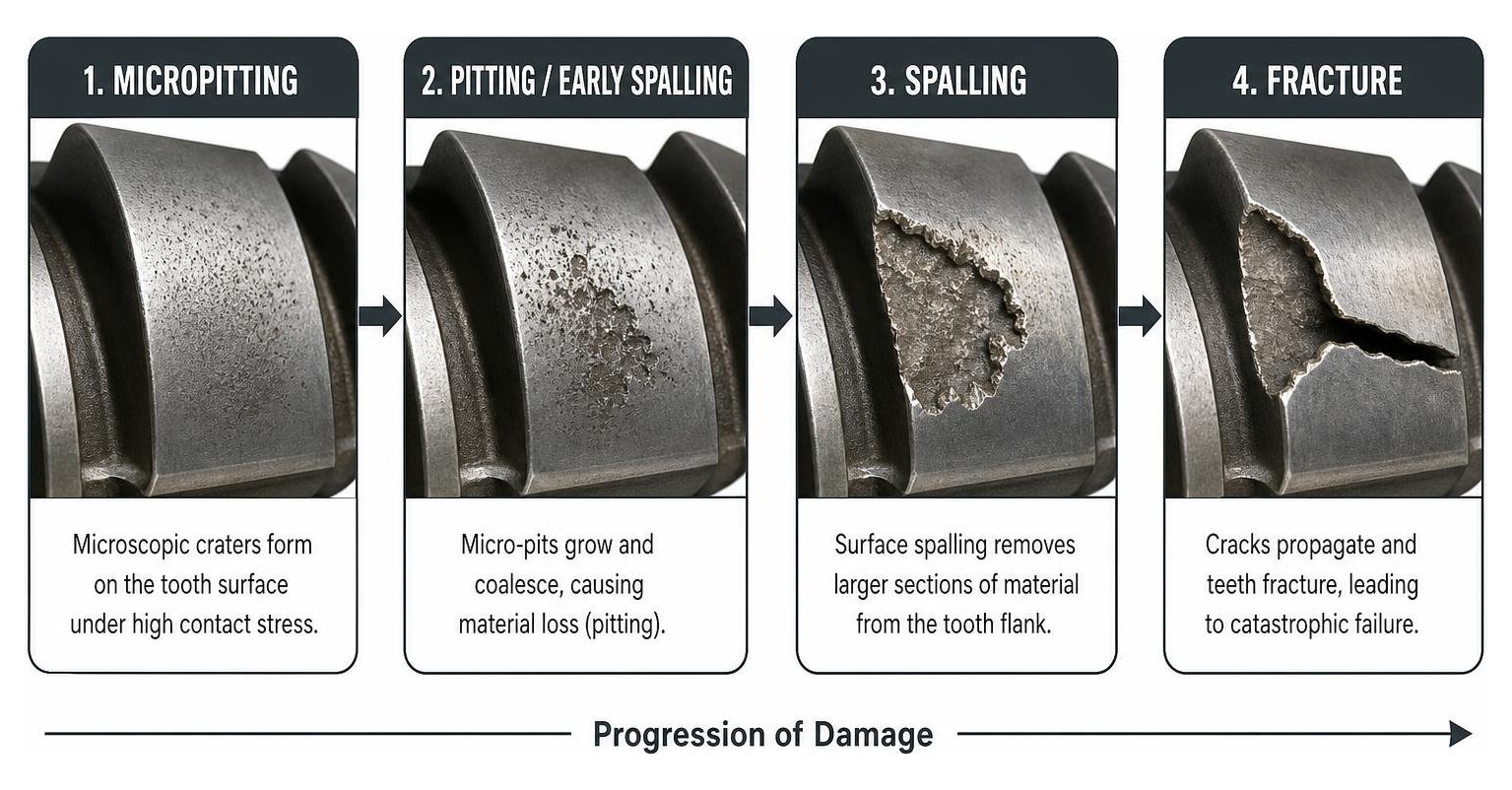
As material breaks free, tooth profiles deviate from their original involute geometry. This profile error increases backlash, which accelerates mechanical shock loads every time the mill charges or surges. To restore worn gear sets properly, replacement components must match or exceed original OEM Rockwell and Brinell hardness ratings. When original design prints are unavailable, we reverse-engineer the exact pitch, pressure angle, and helix angle from the physical components to machine new gears that mesh precisely without localized stress concentrations. Avoiding Common Gear Reducer Repair Mistakes You Can’t Afford to Make ensures your drive train avoids premature tooth failure after reinstallation.
Bearing Degradation and Housing Bore Migration
The large spherical roller and tapered roller bearings inside a ball mill speed reducer handle massive radial and thrust forces. When particulate contamination enters the lubricating oil or cyclic fatigue reaches its limit, bearing raceways develop flaking, skidding marks, and cage pocket wear.
As bearing clearances widen, the outer rings begin to micro-rotate inside the cast housing. This relative movement causes fretting corrosion, wearing the bore oversize and out-of-round. Once a housing bore loses its interference fit, shafts skew out of parallel alignment, multiplying gear tooth misalignment across every internal reduction stage. Correcting this requires structural restoration, and understanding How Gearbox Housing Welding Services Restore Damaged Castings helps explain how compromised metal is built back up before precision horizontal line boring restores factory centerline dimensions.
2. Advanced Diagnostic Methods Before Dismounting the Reducer
Pulling a multi-ton industrial gearbox out of a processing plant is a major logistical undertaking. Plant engineers across industrial hubs in Georgia, Alabama, Mississippi, and Louisiana rely on non-destructive diagnostics to evaluate internal conditions before committing to a planned outage.
High-resolution video borescope inspections through inspection covers allow direct visual assessment of intermediate pinions, bull gears, and bearing cages. Technicians can visually inspect the gear mesh contact pattern, measuring the active wear band across the face width without uncoupling the motor or removing the main cover.
Vibration spectrum analysis provides a continuous window into internal mechanical health:
- Gear Mesh Frequency (GMF) sidebands: Prominent sidebands spaced at the shaft running speed indicate tooth profile errors, pitch runout, or eccentric mounting.
- Bearing defect frequencies: High-frequency energy peaks highlight outer race (BPFO), inner race (BPFI), or rolling element (BSF) flaws long before surface spalling causes severe mechanical jamming.
- Time waveform analysis: Sharp, periodic impact spikes point directly to cracked, chipped, or broken teeth.
Routine lubricant oil sampling and analytical ferrography complement vibration data. Particle shape and concentration analyses reveal whether suspended debris consists of cutting wear from abrasive contamination, spherical fatigue particles from rolling elements, or large laminar flakes from gear tooth spalling. If your mill drive shows sudden shifts in baseline vibration or elevated iron counts, review Industrial Gearbox Repair Florida 7 Signs You Need a Pro to determine whether immediate shop intervention is warranted.
Identifying Standstill Marks and Inactivity Corrosion
Gear drives that sit idle during seasonal turnarounds or extended plant shutdowns face unique threats. Ambient humidity inside non-climate-controlled plants condenses on cold steel components, accumulating along the boundary lines where stationary gear teeth touch.
This moisture displaces thin boundary oil films, causing localized chemical oxidation known as standstill marks. These dark transverse etching lines disrupt the smooth profile of the gear teeth, acting as initiation sites for aggressive micropitting once the drive starts up again. Nearby operating equipment can also transmit ground vibrations to stationary gearboxes, causing rolling elements to vibrate against raceways in a phenomenon called false brinelling. Inspecting internal housings also confirms whether internal protective epoxy primer is intact or delaminating into flakes that can clog pressurized lubrication nozzles.
3. The Economics: Repair and Rebuild vs. Complete Replacement
Sourcing a brand-new ball mill gear reducer from an overseas original equipment manufacturer often requires lead times stretching from 30 to 50 weeks. In continuous-duty mining operations and cement manufacturing, prolonged downtime easily eclipses the cost of the hardware itself.
Choosing an end-to-end industrial rebuild reduces capital expenditures significantly. Sourcing a complete restoration through our specialized machine shop can save up to 60% compared to purchasing a brand-new unit, while delivering equal or greater operational longevity. Our resource on The Complete Guide to Gearbox Rebuilds with a 24-Month Warranty details how comprehensive mechanical overhauls deliver lasting reliability backed by complete warranty protection.
Evaluating Girth Gear and Pinion Reusability
During intake evaluation, drive components undergo non-destructive magnetic particle and ultrasonic testing to verify internal structural integrity. If a large girth gear shows surface wear within standard re-machining thresholds and zero subsurface fatigue cracks, its tooth profiles can be re-cut and dressed rather than scrapped.
When a girth gear segment is cracked from extreme shock loads, specialized CNC gear cutting equipment allows us to manufacture precision replacement girth gears up to 20 feet in diameter. Matching the precise metallurgy, core toughness, and surface hardness ensures the new pinion and girth gear mesh smoothly without premature wear.
4. Drive Configurations: Planetary, Helical, and Bevel Helical Demands
Ball mills utilize different gear reducer architectures depending on available plant footprint, motor placement, and overall reduction ratio requirements.
| Gearbox Configuration | Torque Density | Footprint Profile | Motor Mounting Alignment | Primary Maintenance Focus |
|---|---|---|---|---|
| Parallel Shaft Helical | Moderate to High | Large longitudinal footprint | Parallel to mill axis | Gear mesh alignment, bearing endplay, oil bath circulation |
| Bevel Helical | High | Compact right-angle footprint | Perpendicular to mill axis | Bevel pinion backlash, axial thrust bearing preloads |
| Planetary (Epicyclic) | Maximum | Ultra-compact coaxial footprint | Inline / Coaxial with pinion shaft | Planet carrier alignment, internal oil filtration, heat dissipation |
Key Heavy-Duty Engineering Features to Require
Heavy industrial applications—such as grinding limestone in cement facilities, pulverizing coal in power generation stations, or processing aggregate slurries—place unique demands on gear reducers. When selecting or rebuilding a ball mill drive, verify these core engineering features:
- High-grade alloy steel gearing: Carburized, hardened, and precision-ground gear teeth (AGMA Class 12+) that resist surface fatigue and shock fractures.
- Heavy-duty bearing arrangements: Premium spherical roller and double-row tapered roller bearings selected for high radial load capacities.
- Forced-feed lubrication circuits: Integrated oil pumps, dual filtration assemblies, and heat exchangers that continuously deliver clean, cooled oil directly to gear meshes and bearing pockets.
- Advanced sealing systems: Contactless labyrinth seals and dual-lip fluoropolymer oil seals that lock out abrasive mill dust while preventing lubricant leakage.
- Rigid structural housings: Heavy cast iron or fabricated steel housings designed with internal ribbing to prevent structural flexing under peak operational torque.
5. Step-by-Step In-Shop Ball Mill Gearbox Repair Process
Restoring a multi-ton industrial drive reducer requires dedicated heavy machine tools, precise quality standards, and controlled shop environments.

Every overhaul follows a rigorous mechanical sequence to eliminate hidden faults, as outlined in our review of A Practical Guide to Precision Gearbox Rebuild Service.

- Intake, Decontamination, and Disassembly: The complete reducer is de-greased and washed before being disassembled using hydraulic pullers and heavy overhead cranes.
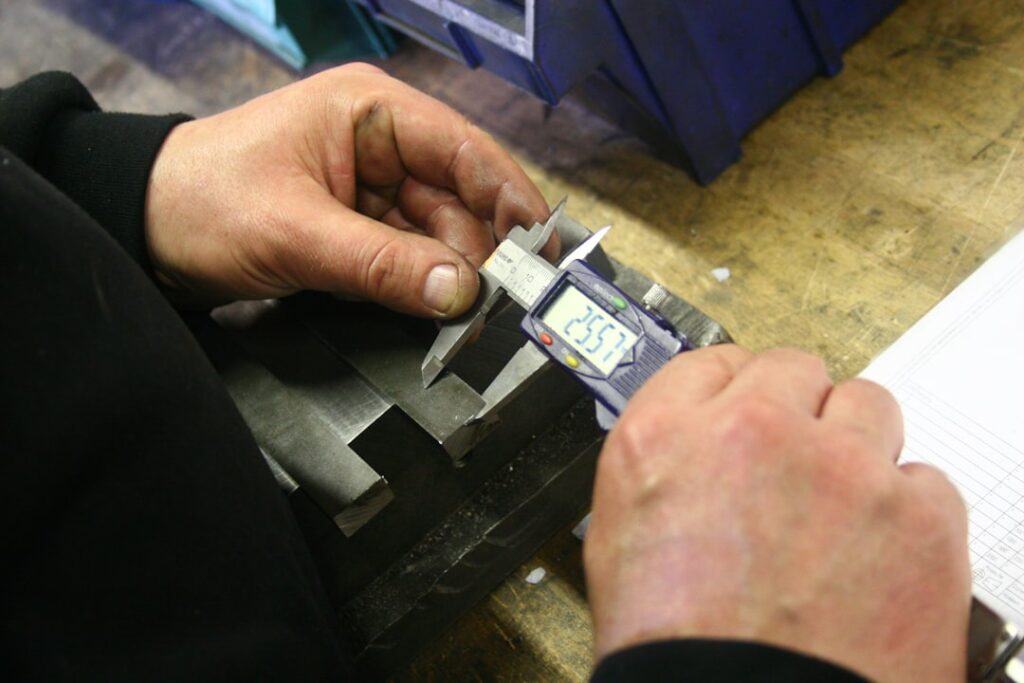
- Dimensional and Metallurgical Inspection: Housing bores, shaft journals, and gear teeth are measured against OEM tolerances using precision micrometers, bore gauges, and coordinate measuring arms.
- Root Cause Failure Analysis: Engineers inspect fracture faces, contact patterns, and bearing raceways to isolate whether failure stemmed from misalignment, lubrication breakdown, contamination, or mechanical overloading.
- Housing Line Boring and Machining: Damaged housing bores are built up and line-bored on large horizontal boring mills to re-establish true centerline geometry.
- Precision Gear Manufacturing and Grinding: Worn gears are re-profiled or manufactured from high-strength alloy forgings, utilizing CNC gear hobbing and tooth profile grinding.
- Cryogenic Bearing Fitting: New Timken and SKF bearings are installed using liquid nitrogen thermal fitting, allowing components to slide into place without heat-induced structural stress.
- Assembly and Tolerance Calibration: Shafts, gears, and bearing packs are assembled with precise axial endplay, radial clearances, and gear mesh backlash.
Line Boring and Custom Gearing in Ball Mill Gearbox Repair
Restoring housing bores to original factory centerlines is critical. When bearings fail catastrophically, the outer raceways often spin, scoring the cast bores. Line boring restores exact bore roundness and parallel shaft alignment.
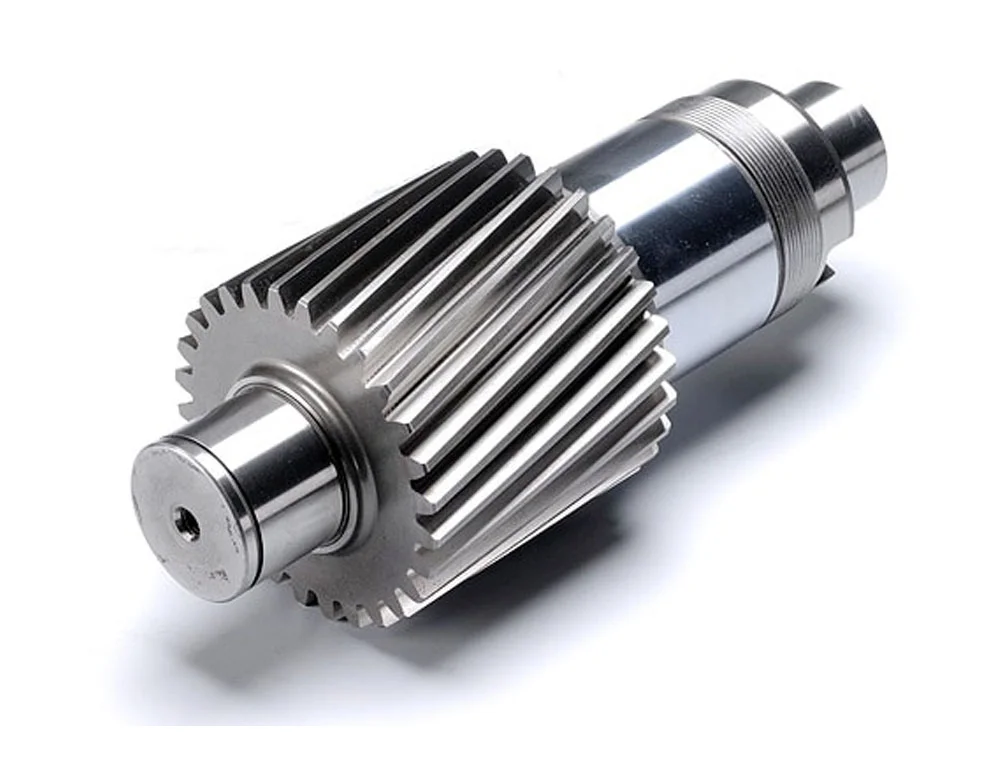
When replacement gearing is needed, our in-house CNC gear cutters generate precision spur, single-helical, double-helical (herringbone), and bevel gear sets. Controlling the machining and heat-treating processes in-house eliminates third-party delays and guarantees correct metallurgical hardness.
Testing, Quality Certification, and Expedited Turnaround
Before shipping back to the plant, rebuilt drives undergo rigorous testing:
- Dynamic spin load testing: Running the gearbox across speed ranges to verify smooth operation.
- Vibration spectrum verification: Accelerometers monitor gear mesh and bearing frequencies to confirm zero abnormal resonant peaks.
- Operating temperature profiling: Infrared thermography tracks bearing housing heat dissipation to detect localized friction issues.
- Tooth contact pattern verification: Transfer bluing verifies balanced, full-face contact across every gear mesh under load.
When an unexpected failure halts a production line in South Carolina or Florida, speed is vital. Our team coordinates expedited freight logistics and round-the-clock shop shifts to minimize downtime. If your plant faces an unplanned breakdown, see How to Never Worry About 48 Hour Gearbox Emergency Again to learn how rapid shop turnarounds get equipment operational quickly.
6. Proactive Maintenance and Preservation of Reserve Units
Keeping a ball mill gear drive running smoothly requires strict fluid management and continuous condition monitoring. Lubrication is the lifeblood of heavy industrial reducers; clean oil cushions tooth contact, carries away frictional heat, and prevents microscopic metal-to-metal contact.
Regular fluid maintenance should include:
- Routine offline micro-filtration down to 3 microns to extract abrasive mining dust.
- Strict adherence to ISO clean oil targets and viscosity specifications based on ambient operating temperatures.
- Automated condition monitoring systems tracking real-time vibration, oil temperature, and motor current draw.
For comprehensive maintenance strategies across different industrial assets, explore Everything You Need to Know About Gearbox Repair.
Storage Preservation Protocols for Ball Mill Gearbox Repair Spares
Spare ball mill speed reducers kept in storage can deteriorate if left unprotected. High ambient humidity in coastal environments like Mississippi and Louisiana will degrade unprotected internal surfaces.
These proactive preservation steps prevent standstill oxidation, protect roller bearings from false brinelling, and ensure your standby unit is ready for service whenever it is called upon.
Frequently Asked Questions About Ball Mill Drive Systems
How long can an industrial ball mill gearbox operate before requiring a full overhaul?
With consistent lubrication, clean operating oil, stable operating loads, and proper alignment, heavy-duty helical and planetary ball mill gearboxes routinely operate for 8 to 15 years before requiring a comprehensive overhaul. Routine condition monitoring helps identify the ideal overhaul window well before catastrophic failure occurs.
What causes standstill marks on stationary spare gearboxes?
Standstill marks occur when humid air inside an idle gearbox condenses along the contact line where meshing gear teeth rest together. The water displaces thin lubricating oil films, creating an acidic, corrosive interface that etches dark oxidation lines into the precision-machined tooth faces.
How does in-house gearbox rebuilding achieve OEM or better performance?
In-house rebuilding pairs precision reverse engineering with modern material upgrades. By line boring housings to factory centerlines, installing premium bearings via liquid nitrogen shrink fitting, applying protective polymer coatings, and cutting replacement gears with modern CNC tooth crowning profiles, a rebuilt unit often surpasses the durability of the original equipment.
Conclusion
A reliable ball mill drive train is central to maintaining steady throughput in cement manufacturing, mining, power generation, and heavy industrial processing. Recognizing the early warning signs of gear wear, bearing distress, and housing bore migration allows maintenance teams to schedule precision rebuilds proactively rather than reacting to catastrophic breakdowns.
At Specialty Gear Drives, all diagnostic evaluations, precision machining, line boring, gear manufacturing, and dynamic testing are performed entirely in-house at our advanced Largo, Florida repair facility. We support industrial plants throughout Florida, Georgia, South Carolina, Alabama, Mississippi, and Louisiana with rapid emergency response, expedited logistics, free pickup and delivery, and a comprehensive 24-month operational warranty.
Contact our engineering team today to schedule an evaluation or request an immediate quote for your industrial gearbox repair.