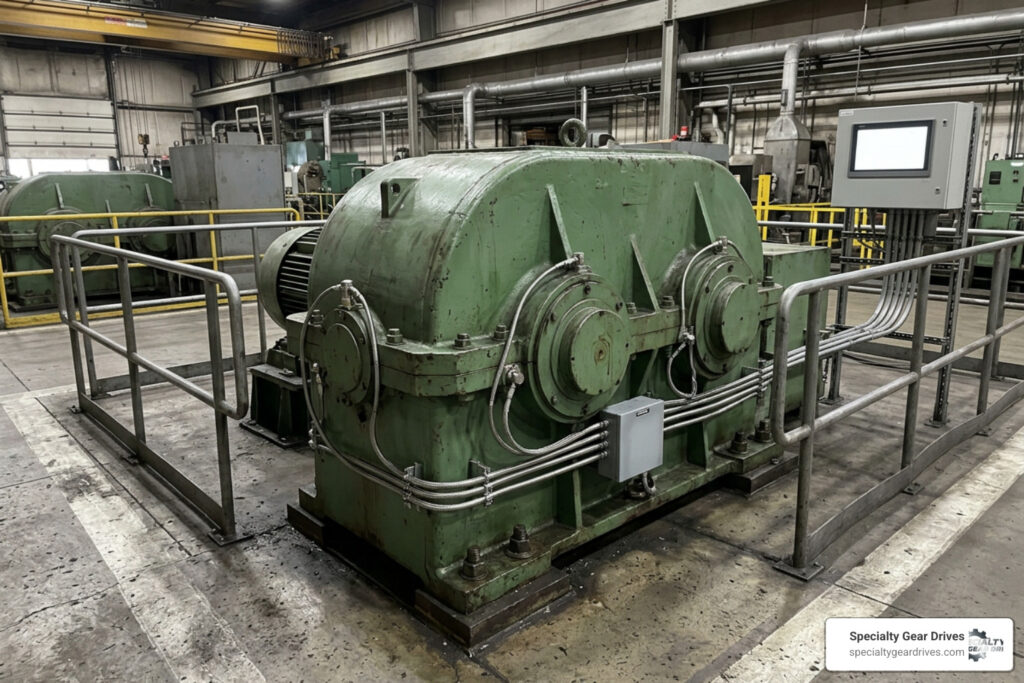
A–Z Guide to Gearbox Predictive Maintenance
What Is Gearbox Predictive Maintenance (And Why It Matters)
Gearbox predictive maintenance is a condition-based strategy that uses real-time sensor data, oil analysis, and thermal monitoring to detect developing faults before they cause failure. Instead of replacing parts on a fixed schedule or waiting for something to break, you intervene only when the data says it’s time.
Here’s what that means in practice:
- Vibration analysis detects gear tooth wear, bearing defects, and misalignment weeks before failure
- Oil analysis reveals wear debris, contamination, and lubricant breakdown between visual inspections
- Infrared thermography identifies abnormal heat signatures at mesh zones and bearing housings
- Acoustic emission monitoring catches early-stage fatigue cracks, even on slow-speed gearboxes
- AI and sensor fusion combines all three data streams to classify faults with 89%+ accuracy and estimate how much time remains before a rebuild is needed
A single gearbox failure on a hot strip mill can shut down production for 5 to 21 days and cost anywhere from $500,000 to $3 million in lost output, emergency repairs, and downstream disruption. That’s not a worst-case scenario; it’s a well-documented range across heavy industry. And 85% of those failures show detectable warning signs weeks before they happen.
The core problem with calendar-based preventive maintenance is that it assumes gearboxes wear out predictably. Most don’t. Only 11 to 23% of components follow that pattern. The rest fail randomly, triggered by shock loads, contamination, or lubrication breakdown, none of which a scheduled oil change or inspection will catch if the timing is wrong.
Predictive maintenance closes that gap. It answers what is the current condition of this gearbox rather than when was it last serviced.
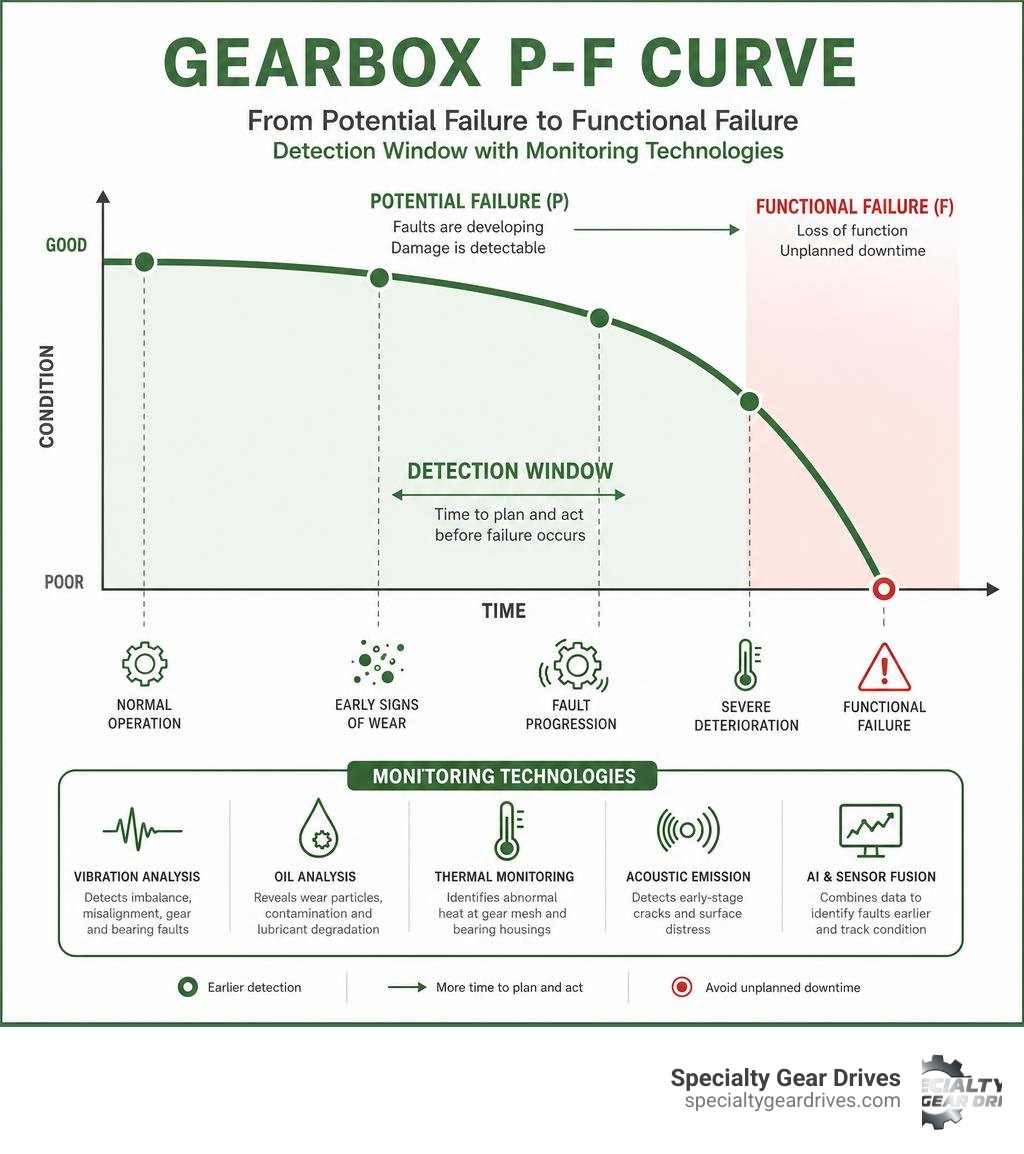
Simple guide to gearbox predictive maintenance:
Core Principles of Gearbox Predictive Maintenance
The foundation of predictive maintenance lies in understanding the P-F curve. This curve represents the timeline of a machine component from the initial point where a potential failure begins to the point where it suffers a functional failure.
Point P is the earliest moment a fault becomes detectable using specialized tools like high-frequency accelerometers or analytical ferrography. Point F represents the moment the gearbox can no longer perform its intended function, such as when a shaft seizes or a gear tooth strips completely. The time between Point P and Point F is your warning window, which allows you to plan repairs during scheduled outages rather than reacting to a sudden midnight breakdown.
Traditional time-based preventive maintenance relies on the bathtub curve, which assumes components have a predictable wear-out phase after a certain number of operating hours. In heavy industrial environments, this assumption is incorrect. Most failures are random, caused by operational stresses, temperature swings, and environmental contamination.
By tracking the actual physical condition of your equipment, you avoid the risks of unnecessary intervention. Opening a healthy gearbox for a scheduled inspection can introduce airborne dust, moisture, or alignment errors, creating infant mortality failures that would not have occurred if the unit was left sealed. You can learn more about how tracking these parameters protects your machinery by reading about How Gearbox Condition Monitoring Saves Your Machinery and Your Sanity.
Primary Failure Modes in Industrial Gearboxes
Industrial gearboxes are mechanically complex, but their failures generally originate from three main areas. Gear tooth damage accounts for 34% of all gearbox failures, bearing faults make up 28%, and lubrication system degradation accounts for 18%. The remaining failures are typically caused by structural issues like shaft deflection, housing cracks, or severe input and output shaft misalignment.
Each of these failure modes leaves a distinct physical signature in your monitoring data. The table below outlines how these common issues manifest across different sensor types.
| Failure Mode | Vibration Signature | Oil Analysis Finding | Thermal Signature |
|---|---|---|---|
| Gear Tooth Wear / Spalling | Rising Gear Mesh Frequency (GMF) sidebands | Increased large ferrous particles (PQ index) | Temperature rise at the active mesh zone |
| Bearing Outer Race Defect | Peaks at BPFO with running speed sidebands | Non-ferrous alloy wear debris (brass/bronze) | Localized heating at the bearing housing |
| Lubrication Degradation | High-frequency floor rise (acoustic emission) | Viscosity drop, oxidation, water presence | Overall housing temperature increase |
| Shaft Misalignment | Dominant 2x running speed amplitude | Minimal wear debris in early stages | Temperature gradient between coupled shafts |
Vibration Analysis for Gearbox Predictive Maintenance
Vibration analysis is the primary tool for detecting mechanical defects in rotating machinery. By mounting accelerometers on the bearing housings, we capture high-frequency signals that reveal the internal health of the gear train.
Every gear set has a specific Gear Mesh Frequency (GMF), calculated by multiplying the number of teeth on a gear by the rotational speed of its shaft. When gears are healthy, the GMF peak remains stable. As teeth wear, pit, or crack, the impact forces generate sidebands around the GMF peak, spaced at intervals equal to the shaft rotational speed. Tracking the growth of these sidebands allows us to monitor the progression of gear tooth damage long before any audible noise is heard.
For bearings, we monitor specific defect frequencies that correspond to their internal geometry. These include the Ball Pass Frequency Outer (BPFO), Ball Pass Frequency Inner (BPFI), Ball Spin Frequency (BSF), and Fundamental Train Frequency (FTF).
A tiny pit on the outer race will generate a tiny impact every time a roller passes over it, showing up as a clear peak at the BPFO. Using high-frequency accelerometers with proper magnetic or stud mounting ensures these micro-impacts are captured clearly, preventing them from being lost in background machine noise.
Oil Analysis and Tribology
Oil analysis serves as the internal health check for your closed gear drive, revealing issues that vibration sensors might miss in their early stages. Regularly sampling the lubricant allows us to track three critical properties: wear debris, fluid condition, and external contamination.
Analytical ferrography is the process of separating and examining wear particles under a microscope to determine their shape, size, and composition. For example, flat, shiny fatigue flakes indicate gear tooth spalling, while spherical particles often point to bearing fatigue.
By tracking these particles, we can identify component wear before the damage is severe enough to alter the machine’s vibration profile.
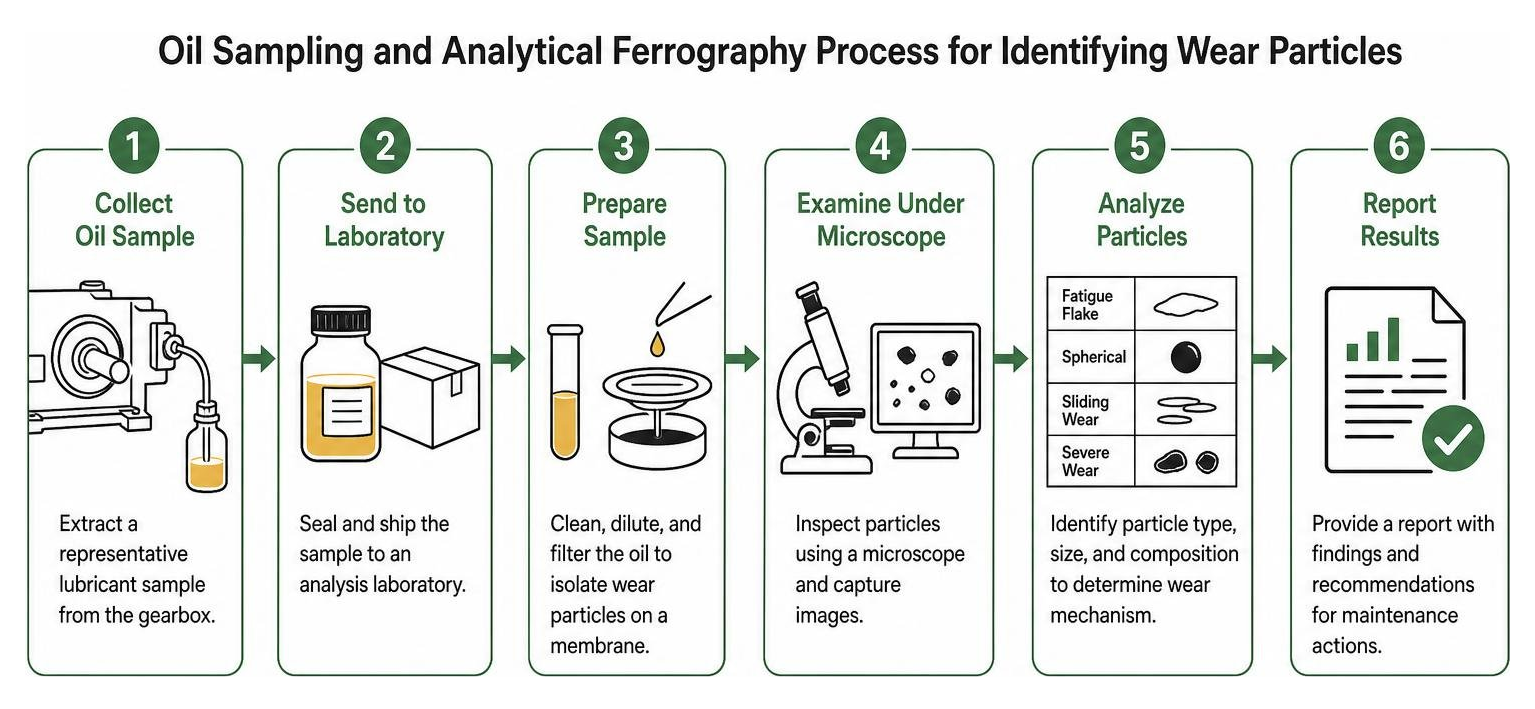
Contamination is a major driver of accelerated wear, particularly in high-humidity or dusty environments like phosphate mines in Florida or coastal paper mills in Alabama. Water contamination destroys the oil’s film strength, leading to metal-on-metal contact, while solid dust particles act as abrasive polishing agents.
Maintaining target ISO cleanliness codes, such as 16/14/11, is essential for maximizing the life of your gears and bearings. A sudden drop in viscosity or a rise in acid number indicates the lubricant is breaking down thermally or chemically, signaling that an oil change is required to protect the internal components.
Infrared Thermography and Acoustic Emission
Infrared thermography allows us to map the surface temperature of the gearbox housing to detect localized thermal gradients. Under normal operating conditions, heat is distributed evenly across the housing, with a predictable rise during high-load periods.
An abnormal temperature rise at a specific bearing cap indicates excessive friction, which is often caused by a lack of lubrication, over-greasing, or a bearing that has entered the early stages of mechanical failure.
Acoustic emission testing is highly effective for monitoring very slow-speed gearboxes, such as those operating below 10 RPM in heavy plate mills or chemical agitators. Traditional vibration analysis struggles at these speeds because the mechanical impact energy is too low to register on standard accelerometers.
Acoustic emission sensors operate in the ultrasonic range, typically from 100 kHz to 1 MHz, listening for the high-frequency stress waves generated by micro-cracking, friction, and fluid turbulence. This technology can provide several months of advance warning for fatigue cracks before they propagate through a gear tooth or shaft.
Implementing Gearbox Predictive Maintenance in Heavy Industry
Deploying a successful predictive maintenance program requires a structured approach that focuses on your most critical assets first. Trying to monitor every gearbox in a plant from day one is expensive and often leads to data overload.
The process begins with an asset criticality analysis to rank your gearboxes based on their impact on safety, production downtime, and replacement cost. The following criteria are commonly used to establish this ranking:
- Production Impact: Does a failure immediately halt the entire production line?
- Replacement Lead Time: How long will it take to source or manufacture replacement gears?
- Repair Cost: What is the cost of a full rebuild compared to a localized bearing replacement?
- Safety and Environmental Risk: Would a catastrophic failure cause a chemical spill or pose a risk to workers?
Once your high-priority gearboxes are identified, you must establish a healthy baseline by collecting continuous data under normal operating loads for two to four weeks. This baseline represents the normal signature of the machine.
From there, you can set realistic alarm thresholds that account for normal load variations, avoiding the false alarms that often occur with rigid, off-the-shelf ISO standards. When an alarm is triggered, the predictive system should automatically generate a work order in your Computerized Maintenance Management System (CMMS), ensuring that your maintenance team can address the issue before it leads to a catastrophic failure. If you already have a gearbox showing signs of wear, securing professional Industrial Gearbox Repair is the best way to restore your baseline performance.
AI and Multi-Modal Sensor Fusion
Modern predictive maintenance programs are moving away from isolated data analysis toward multi-modal sensor fusion. Instead of analyzing vibration, oil, and temperature data separately, AI-driven platforms combine these data streams into a single analytical model.
This approach mirrors how a skilled engineer diagnoses a problem, looking at multiple symptoms to confirm a single root cause.
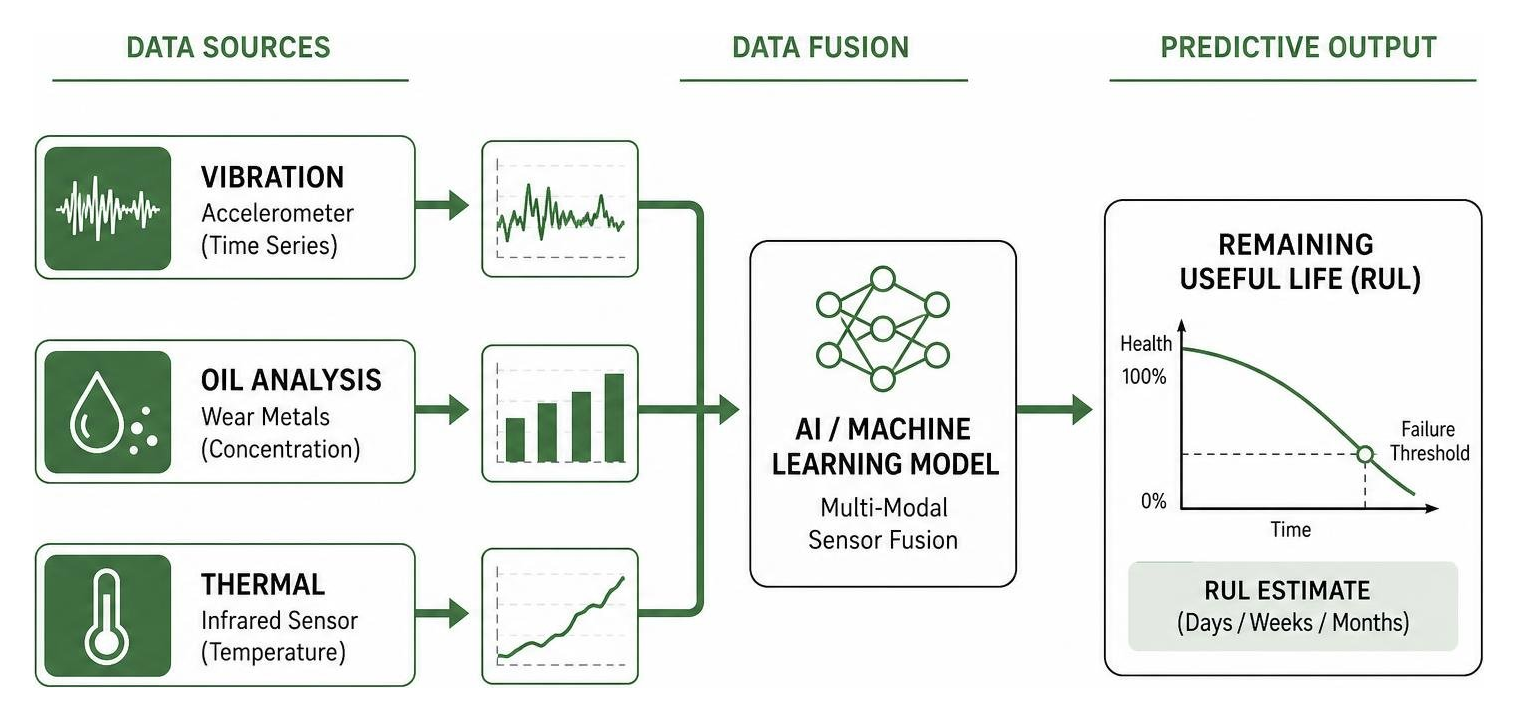
By fusing these data points, machine learning algorithms can classify specific faults with high accuracy. For example, if a vibration sensor detects a rising peak at the gear mesh frequency, the AI looks for a corresponding rise in ferrous particles in the oil and a temperature increase at the mesh zone.
If all three indicators align, the system can confidently diagnose gear tooth spalling and estimate the Remaining Useful Life (RUL) of the gear set, allowing you to schedule repairs during your next planned outage.
Deploying Gearbox Predictive Maintenance Programs
Deploying a predictive maintenance program across your facility is a phased process that typically takes several months to fully integrate.
- Months 1 to 3: Focus on asset criticality ranking, sensor selection, and baseline data collection on your most critical gearboxes.
- Months 4 to 8: Install continuous online monitoring sensors and integrate the data streams with your existing SCADA and CMMS platforms.
- Months 9 to 14: Train your maintenance team on interpreting alerts, establish clear response workflows, and begin using predictive analytics to plan repairs.
- Month 15 and beyond: Move to full predictive operations, refining your AI models and expanding the program to secondary assets.
A successful rollout depends heavily on training and culture change. Your technicians must trust the sensor data even when the gearbox sounds and looks normal to the naked eye.
Starting with a small pilot program on two or three critical gearboxes allows your team to gain confidence in the technology as they see early warnings turn into successful, planned repairs.
Financial Impact and ROI of Predictive Monitoring
The financial return on a predictive maintenance program is achieved through avoided downtime, reduced repair costs, and optimized spare parts inventory.
Catching a bearing defect in its early stages might require a simple weekend bearing replacement. Letting that same bearing run to failure can destroy the gear shafts, housing, and electric drive motor, turning a minor repair into a major capital expense.

With continuous monitoring providing weeks of advance warning, you can reduce your safety stock of expensive, long-lead spare parts. Instead of keeping multiple complete gear reducers on hand, you can order specific gears, bearings, and seals only when the data indicates a repair is approaching.
Most plants see a full return on their monitoring investment in less than three months, driven by the avoidance of a single major unplanned outage.
Frequently Asked Questions about Gearbox Maintenance
Why does calendar-based preventive maintenance fail for industrial gearboxes?
Calendar-based maintenance assumes that mechanical wear is directly tied to operating hours, but research shows that only 11 to 23% of industrial components follow this predictable wear pattern. The vast majority of gearbox failures are random, triggered by factors like sudden shock loads, lubricant contamination, or improper installation.
Additionally, performing scheduled preventive maintenance on a healthy, sealed gearbox introduces risks. Every time a gearbox is opened for a visual inspection or an oil change, there is a risk of introducing airborne dust, moisture, or alignment errors, which can lead to premature failure.
How do you monitor slow-speed gearboxes operating below 10 RPM?
Monitoring slow-speed gearboxes requires specialized techniques because the mechanical energy generated by rotating parts at low speeds is too low for standard vibration sensors to detect. The most effective approach combines acoustic emission testing with analytical ferrography and shock pulse measurement.
Acoustic emission sensors detect high-frequency stress waves in the 100 kHz to 1 MHz range, which are generated by micro-cracking and friction long before they cause measurable vibration. Analytical ferrography complements this by identifying the size, shape, and metallurgy of wear debris suspended in the oil, providing clear evidence of component degradation at any speed.
What is the typical payback period for a predictive maintenance program?
The typical payback period for a gearbox predictive maintenance program is under three months. This rapid return on investment is achieved by avoiding a single catastrophic failure on a critical production line, which can easily cost hundreds of thousands of dollars in lost output and emergency shipping premiums for replacement parts.
By identifying faults early, you can plan repairs during scheduled weekend outages, eliminating production downtime and reducing repair costs. To understand how to handle these situations when a sudden issue does arise, you can read our guide on Emergency Gearbox Repair: How to Never Worry About It Again.
Conclusion
Transitioning from reactive firefighting to a structured predictive maintenance program is the most effective way to ensure the long-term reliability of your heavy machinery. By monitoring vibration, oil quality, and thermal signatures, you can identify developing faults weeks in advance, allowing you to schedule repairs on your own terms.
When your monitoring data indicates that a gearbox requires professional attention, Specialty Gear Drives is ready to assist. Based in Largo, Florida, we provide expert industrial gearbox repair and rebuilding services for heavy industries across the Southeast, including pulp and paper mills in Alabama and Mississippi, chemical plants in Louisiana, and manufacturing facilities in Georgia and South Carolina.
We offer 24 to 48-hour emergency service, free pickup and delivery, a 24-month warranty on all rebuilds, and savings of up to 60% compared to the cost of purchasing a new unit. If you suspect your equipment is showing early signs of wear, read our guide on Industrial Gearbox Repair Florida: 7 Signs You Need a Pro to evaluate your machinery, or search our resources on how to Don’t Grind Your Gears and Find the Best Gearbox Repairing Near Me.
For comprehensive rebuild services and technical support, visit our main page on Industrial Gearbox Repair to learn how we can help you keep your plant running smoothly.