In Depth Guide to Comparing Lightnin Mixer Models
- Manufacturer: SPX FLOW (Lightnin brand, founded 1923, headquartered in Rochester, New York)
- Product range: Over 40 product types including top-entry, side-entry, portable, sanitary, magnetic, and in-line mixers
- Key applications: Sludge mixing, aeration, flocculation, neutralization, chemical blending, and flash mixing
- Power range: 1 to 200 HP (0.75 to 150 kW) for heavy-duty top-entry models
- Speed range: 9 to 280 rpm depending on series and configuration
- Notable series: Series 10, 70 Series, 80 Series, 700/800 Series
- Global reach: Sales and support in more than 150 countries
Lightnin has been building industrial mixers for over 100 years. That is not a marketing number. It reflects a long track record of engineering development across some of the most demanding mixing environments in heavy industry, from deep municipal wastewater basins to sterile pharmaceutical vessels to large-scale petroleum storage tanks.
What sets Lightnin apart from generic mixer brands is the depth of their mechanical engineering. Proprietary gearbox designs, specialized impeller geometries, and protection systems like true drywells are built into the product line at a level that directly affects how long your equipment runs between failures, and how much it costs to keep it running.
If you manage a facility in the Southeast US and your Lightnin mixer gearbox is showing wear, excessive noise, or seal leaks, this guide will help you understand exactly what you have, what the critical components are, and what your options look like.
I’m Peter Clark, and in the sections below I’ll walk you through each major Lightnin mixer series, the gearbox technology behind them, and how to match the right configuration to your process.
Core Mechanical Configurations of Lightnin Mixers
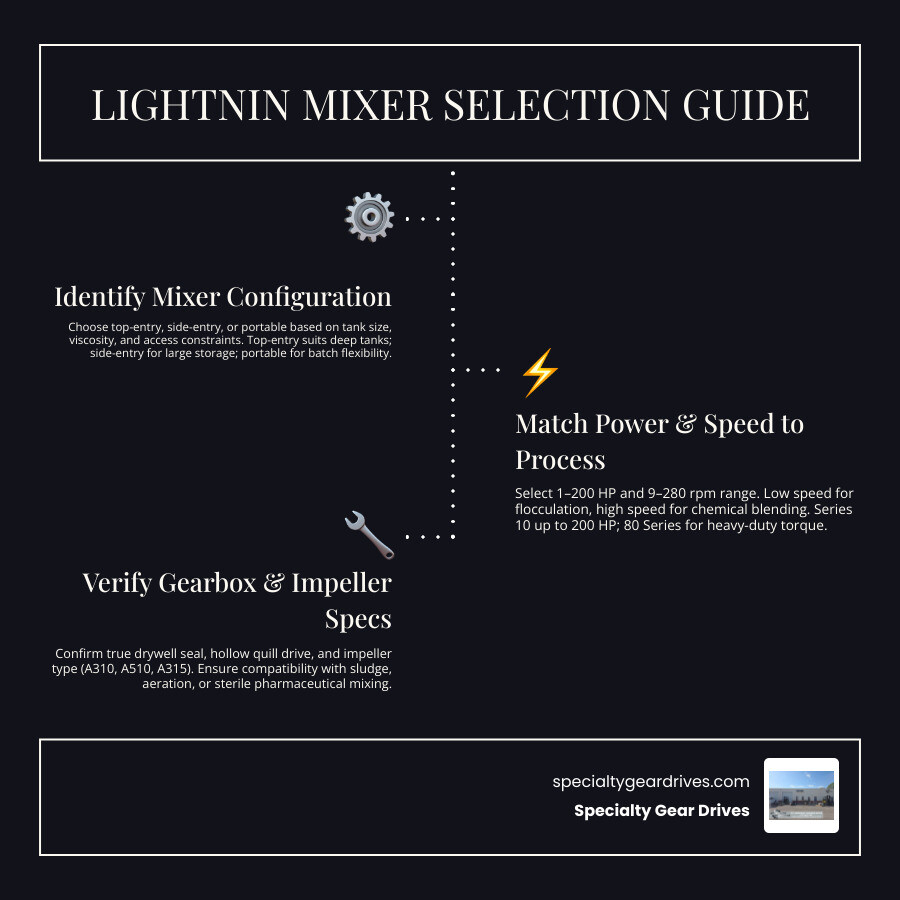
Industrial mixing requires different mechanical approaches depending on tank volume, fluid viscosity, and spatial constraints. Lightnin addresses these variables through several distinct structural configurations.
| Mixer Configuration | Typical HP Range | Common Mounting Options | Primary Applications | Key Advantage |
|---|---|---|---|---|
| Top Entry | 1 to 200+ HP | ANSI or DIN Flange, Beam Mount | Wastewater basins, large reactors, mining slurries | Handles extreme torque and long shaft lengths |
| Side Entry | 1 to 75 HP | Tank Wall Flange | Petroleum storage, pulp chest blending | High localized velocity, easy ground-level access |
| Portable | 0.25 to 5 HP | Clamp, Angle Riser, Tote Bridge | Small batch chemicals, blending, pilot plants | High flexibility, direct or gear-drive options |
| Sanitary | 0.5 to 10 HP | Tri-Clamp, Welded Flange | Pharmaceuticals, biotech, food processing | Seal-less magnetic drives, zero contamination risk |
| In-Line / Static | Continuous Flow | Pipe Flanges | Inline chemical dosing, water treatment | No moving parts, relies on process flow velocity |
Heavy-Duty Top Entry Lightnin Mixers
Top entry units are the workhorses of heavy industrial processing. They are mounted directly above the open or closed vessel, supporting long overhung shafts that extend deep into the fluid.
The primary engineering challenge for top-entry mixers is managing the bending moments and mechanical runout caused by fluid forces acting on the impellers. Lightnin addresses this by separating the mixer drive from the shaft deflection forces. This design reduces wear on the internal speed reducers and ensures the drive gears maintain precise alignment.
Portable and Compact Lightnin Mixers
Portable mixers are designed for smaller volumes, typically under 5,000 gallons. These units are commonly used in specialty chemical blending, food preparation, and water neutralization tanks.
They utilize modular assemblies that allow operators to switch between direct-drive motors for high-speed dispersion and gear-driven units for higher viscosity fluids. Because these units are frequently moved or adjusted, their mounting assemblies must withstand continuous vibration without slipping.
Side Entering Mixers
Side-entry mixers are installed through the lower wall of large-volume storage tanks. They are particularly useful in petroleum refining and pulp and paper processing, where keeping solids suspended in massive, flat-bottomed tanks is critical.
By pushing fluid horizontally across the bottom of the tank, these units prevent sediment buildup with a relatively low horsepower draw. Maintenance is simplified because the drive motor and gearbox are accessible from the ground, eliminating the need to climb to the top of a tall tank.
Sanitary Mixers
Sanitary mixers are engineered for sterile environments where product purity is the absolute priority. These units are built with polished stainless steel housings and specialized sealing systems to prevent any lubricant migration into the process fluid.
Many sanitary designs utilize magnetic drives, which eliminate the need for a physical shaft to penetrate the tank wall, removing the mechanical seal as a potential point of failure or contamination.
Magnetic Mixers
Magnetic mixers, or mag-mixers, use a magnetic coupling to transmit torque from the drive motor outside the tank to the impeller inside.
Because there is no physical shaft connection, the tank remains completely sealed. This configuration is widely used in biotechnology applications where even a microscopic seal leak could ruin a multi-million dollar batch of biological product.
In-Line Mixers
In-line mixers are installed directly into the process piping. They can be static units, which use a series of fixed, helical elements to fold the flowing fluid over itself, or dynamic units, which feature a small, high-speed impeller housing to blend additive streams directly into the main flow.
These mixers are highly efficient for continuous-duty chemical dosing and water treatment processes.
Heavy-Duty Top Entry Lightnin Mixers
Heavy-duty top-entry mixers are designed to handle high-torque, continuous-duty applications where mechanical reliability is critical. Lightnin offers three primary series in this category: the Series 10, the 70 Series, and the 80 Series.

The Series 10 is designed for medium-torque applications. It features high-efficiency helical gearing and parallel shafts housed in a rigid, compact frame.
One of the defining design elements of the Series 10 is its oversized output shaft connection. By increasing the diameter of this connection, the mixer limits shaft deflection at the seal to less than 0.010 inches. This rigidity extends the operational life of the mechanical seal.
When seal maintenance is eventually required, the top-entry seal design allows for complete replacement in under 30 minutes without needing to disturb the main shaft or use heavy jacking plates. The gears are lubricated with synthetic oil, which only requires changing once a year under standard operating conditions.
The 70 Series is built for higher torque demands, offering power ratings from 1 to 200 HP and output speeds ranging from 280 down to 9 rpm. These units utilize double or triple reduction helical gearing to manage heavy load variations.
For plants running these high-torque units, understanding the wear patterns on helical gear teeth is essential to preventing catastrophic failure. You can read more about these wear patterns in our guide on Everything You Need to Know About Gearbox Repair.
The 80 Series is engineered specifically for applications with high fluid forces and exceptionally long impeller shafts. It features a hollow quill drive design.
In a standard mixer, bending forces on the shaft are transmitted directly into the gearbox drive gears, causing misalignment and rapid tooth wear. The 80 Series hollow quill design isolates these shaft flexures, transferring the bending loads to heavy-duty bearings in the mixer housing while the drive gears only transmit pure rotational torque.
Portable and Compact Lightnin Mixers
The Enhanced Classic Line (ECL) represents the modern evolution of Lightnin’s portable mixer line. These units are built to meet strict OSHA, CE, and ATEX safety standards while maintaining a lightweight, modular footprint.
ECL mixers are available in both direct-drive and gear-drive configurations. Direct-drive models run at motor speed, making them ideal for low-viscosity blending and dispersing dry powders into liquids.
Gear-drive models use internal speed reducers to lower the shaft speed while increasing the available torque, allowing them to handle higher viscosity fluids and larger batch volumes without overloading the motor.
For hazardous or explosive environments, such as chemical storage rooms or solvent processing areas, ECL mixers can be equipped with ATEX-compliant air motors. These air-driven motors are rated safe for explosive atmospheres up to 250°F and feature integrated speed control valves.
Mounting stability is a critical factor for portable mixers. The ECL line offers a heavy-duty, four-point clamp assembly that secures the mixer to the tank rim, preventing the unit from shifting under torque loads.
Fixed-mount options and angle risers are also available for permanent installations. If the mounting assembly is not properly maintained, vibration can damage both the mixer and the tank wall. To prevent these issues, operators should review our practical guide on How to Master Gearbox Mounting Repair in 30 Days.
Proprietary Gearbox Engineering and True Drywell Technology
The heart of any heavy-duty mixer is its gearbox. Because mixers operate directly over process vessels, standard industrial gearboxes present a constant risk of oil leakage down the output shaft and into the product. Lightnin solves this through proprietary gearbox engineering and true drywell technology.
A true drywell is a physical barrier built into the gearbox housing. In a standard gearbox, the output shaft exits the bottom of the oil reservoir through a traditional lip seal. Over time, shaft runout and thermal cycling degrade this seal, allowing oil to run down the shaft.
In a true drywell design, the output shaft is routed through an internal, sealed dam that rises above the oil level. The lubricant reservoir surrounds this dam but cannot make contact with the shaft opening itself.
Even if the primary seals fail completely, gravity cannot pull the oil down the shaft because the lubricant is physically contained within the drywell chamber. This design is critical for municipal water systems and pharmaceutical processes where lubricant contamination would result in immediate batch rejection or regulatory fines.
Maintaining these specialized gearboxes requires precise mechanical alignment and bearing preload calibration. When gears or bearings wear out, a complete rebuild is often necessary to restore the unit to OEM specifications.
To understand the step-by-step process of extracting, cleaning, and rebuilding these complex drives, consult The Ultimate Guide to Gearbox Rebuild.
Impeller Selection and Fluid Dynamics Optimization
The gearbox provides the torque, but the impeller does the actual work of mixing. Matching the impeller geometry to the specific process requirements is critical to reducing energy consumption and preventing mechanical strain on the mixer drive.

The A310 and A510 are low-solidity hydrofoil impellers designed for flow-controlled processes like blending and solids suspension. These impellers feature laser-cut, contoured blades that generate high axial flow with minimal turbulence.
By optimizing the lift-to-drag ratio, the A310 improves mixing results by up to 40% compared to traditional pitched-blade turbines, allowing plants to use smaller motors and lower-horsepower gearboxes to achieve the same mixing rate.
For municipal and industrial wastewater applications, ragging is a constant threat. Fibrous materials, wipes, and rags can wrap around standard impeller blades, creating massive mechanical imbalances that destroy gearbox bearings.
The Clean Edge Impeller (A333) features a swept-back blade design that allows fibrous materials to slide off the blade tips. This self-cleaning action prevents rag buildup, stabilizing the mechanical load on the mixer drive and reducing unscheduled maintenance downtime.
In gas-liquid applications, such as fermentation or aeration basins, the A315 gas handling impeller is designed to disperse gas bubbles throughout the liquid matrix. The A315 improves mass transfer by up to 30% while reducing energy costs by up to 45% compared to standard radial-flow turbines, making it highly effective for deep-tank aeration.
Industrial Applications and Wastewater Treatment Challenges
Wastewater treatment plants present some of the most abusive environments for mixing equipment. From corrosive chemicals to abrasive solids, every component of a mixer is subjected to continuous wear.
In equalization and neutralization basins, mixers must rapidly blend incoming chemical streams to stabilize pH levels before biological treatment. These basins experience large fluctuations in liquid levels, which subjects the mixer shaft to changing bending forces as the impellers submerge and emerge.
Flocculation basins require gentle, low-shear mixing to encourage chemical flocs to clump together without shearing them apart. This requires high-volume, low-speed axial flow impellers driven by high-ratio gear reducers.
Sludge mixing and aeration require continuous-duty, high-torque mixers capable of handling high solids concentrations. When these units are overloaded due to rising sludge density, the gearbox experiences extreme thermal and mechanical stress.
Facilities operating under these demanding conditions in the Gulf Coast region can find localized technical support and rebuild strategies in our overview of Overloaded Gearbox Repair Mississippi Top 5 Expert Services.
Frequently Asked Questions About Lightnin Mixers
What is the benefit of a hollow quill drive in Lightnin mixers?
The hollow quill drive isolates the gearbox gears and bearings from the bending moments and shaft flexures caused by fluid forces acting on the impeller.
By routing the mixer shaft through a hollow sleeve, or quill, the bending loads are absorbed by heavy-duty bearings mounted directly to the mixer frame. The internal gears only transmit rotational torque, preventing gear misalignment and extending the life of the gear teeth.
How does a true drywell protect the mixing process?
A true drywell uses an internal, physical dam inside the gearbox housing that rises above the oil level, isolating the output shaft opening from the lubricant reservoir.
Because the oil cannot pool around the shaft seal, gravity cannot pull lubricant down the shaft into the mixing vessel. This design provides absolute protection against product contamination, even if the primary mechanical seals wear out.
What specifications are critical when selecting a Lightnin mixer?
When specifying a mixer, you must evaluate the process torque requirements, the desired shaft speed, the motor horsepower and electrical classification, the mounting style, and the maximum shaft length.
Additionally, the overhung load and bending moment capacities of the mixer drive must be calculated to ensure the gearbox can support the shaft weight and fluid forces without premature bearing failure.
Conclusion
Lightnin mixers are engineered to provide reliable service in the most demanding industrial environments. However, even the best-engineered gearboxes eventually require maintenance, bearing replacements, or complete rebuilds due to continuous duty and high torque loads.
At Specialty Gear Drives, we repair and rebuild industrial gearboxes for heavy industries across the Southeast, including municipal wastewater, chemical processing, pulp and paper, and mining facilities. From our fully equipped facility in Largo, Florida, we serve plants throughout Florida, Georgia, Alabama, South Carolina, Mississippi, and Louisiana.
We perform all line boring, gear manufacturing, and gearbox rebuilding work completely in-house to ensure strict quality control. Our regional services are built around minimizing your plant’s downtime:
- 24-48 Hour Rapid Response: We expedite logistics and shop turnaround to get your critical mixing processes back online quickly.
- Free Pickup and Delivery: We handle the transportation of your heavy gear drives to and from our Florida facility at no additional cost.
- Up to 60% Savings: Rebuilding your existing Lightnin gearbox with our precision machining services costs significantly less than purchasing a brand-new replacement unit.
- 24-Month Warranty: We stand behind our work with a comprehensive, two-year warranty on all rebuilt industrial gearboxes.
Whether you need a standard industrial rebuild or specialized high-torque services comparable to our Philadelphia Gearbox Repair program, we have the in-house tooling to restore your mixer drive to factory specifications.
To schedule a pickup or discuss your mixer gearbox symptoms with an engineer, please fill out our Repair Form or visit our Contact Us page today.