A Practical Guide to Precision Gearbox Rebuild Service
When a Gearbox Fails, the Clock Starts Immediately
A precision gearbox rebuild service is the fastest and most cost-effective way to get a failed industrial gearbox back to full operating spec without the lead times and expense of buying new. For plant managers and maintenance engineers dealing with a stopped conveyor, a seized reducer on a processing line, or a gearbox that’s been running rough for weeks, the core question is simple: how fast can this be fixed, and will it hold?
Here is a quick overview of what a precision rebuild involves and what to expect:
- What it is: A complete teardown, inspection, and reassembly of your gearbox to OEM tolerances using quality parts, including bearings, seals, and gears
- How long it takes: Emergency rebuilds can be completed in as little as 24 hours; standard rebuilds typically run 7 to 10 business days
- How it compares to replacement: A rebuild can take as little as one-third the time of specifying and ordering a new unit, at a fraction of the cost
- Warranty: Reputable providers back their work with multi-year warranties covering both parts and labor
- Who it’s for: Any industrial facility running helical, planetary, bevel, worm, or spur gearboxes in applications like mining, oil and gas, pulp and paper, food processing, or power generation
A single gearbox failure on a production line can shut down an entire shift. In industries where unplanned downtime costs tens of thousands of dollars per hour, waiting weeks for an OEM replacement is rarely an option.
The sections below walk through exactly how a precision rebuild works, what the process looks like from teardown to testing, how costs compare to replacement, and what to look for in a service provider.
What is a Precision Gearbox Rebuild Service?
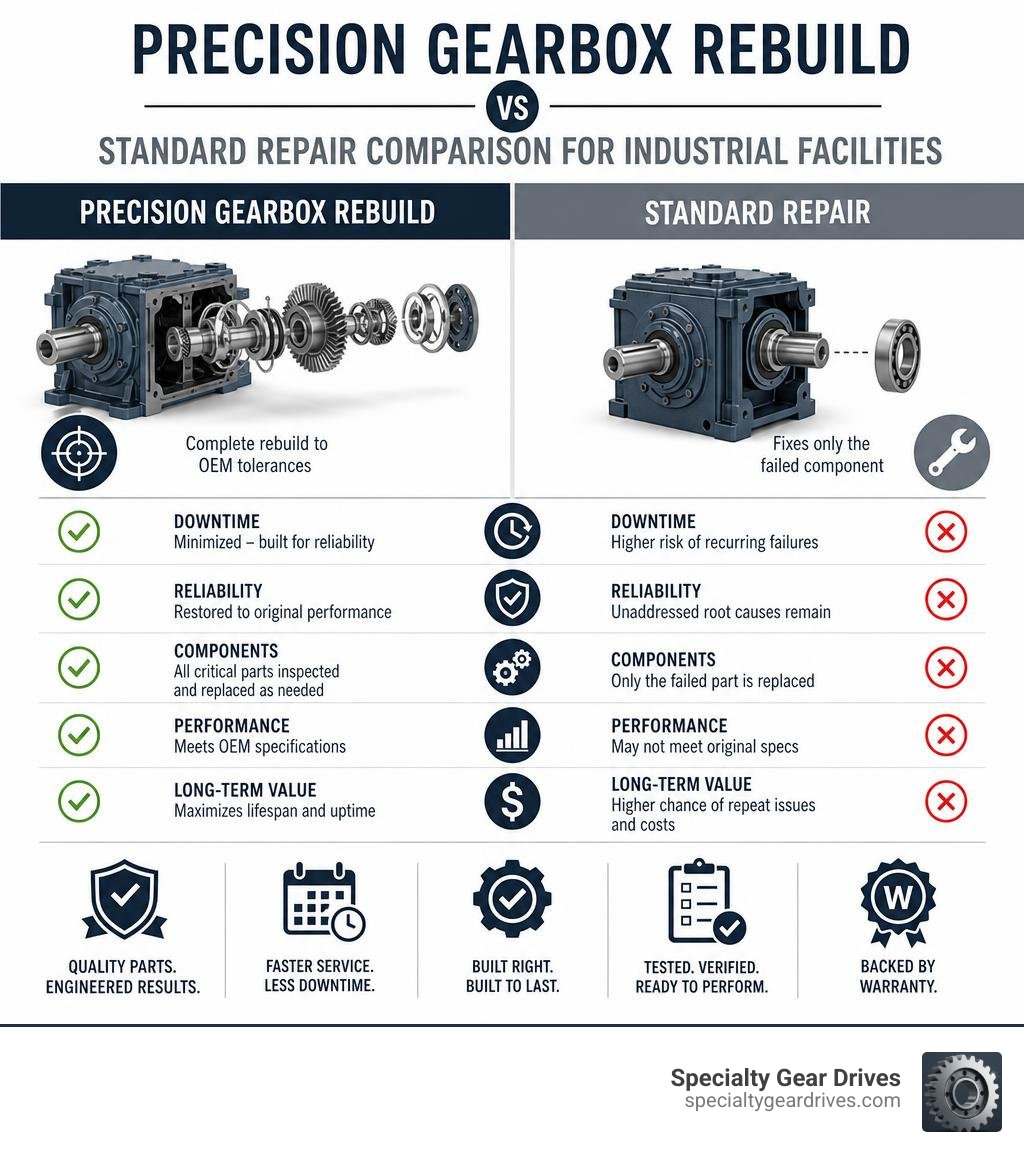
A precision gearbox rebuild service is an exhaustive engineering process that completely overhauls an industrial gearbox to restore it to its original design specifications. This service goes far beyond patching up a broken part to get a machine spinning again.
A standard repair focuses on fixing only the component that failed. If a bearing fails, a standard repair shop might only replace that specific bearing and slide the unit back onto the plant floor. This approach ignores the underlying issues that led to the failure in the first place, such as shaft misalignment or housing wear.
A precision rebuild treats the gearbox as a complete, integrated system. The process addresses every internal component, ensuring that gear geometry, backlash tolerances, and shaft alignment are restored to original manufacturer parameters.
Proper gear geometry is vital for even load distribution across the gear teeth. If the geometry is off by even a fraction of a millimeter, it creates localized stress concentrations that lead to rapid tooth pitting and eventual failure.
Backlash tolerances must be set with extreme accuracy. Too little backlash causes excessive friction, heat, and binding, while too much backlash leads to shock loading and gear damage during startup or reversal.
Shaft alignment is another critical factor. Misaligned shafts place uneven loads on bearings and seals, causing premature wear and oil leaks.
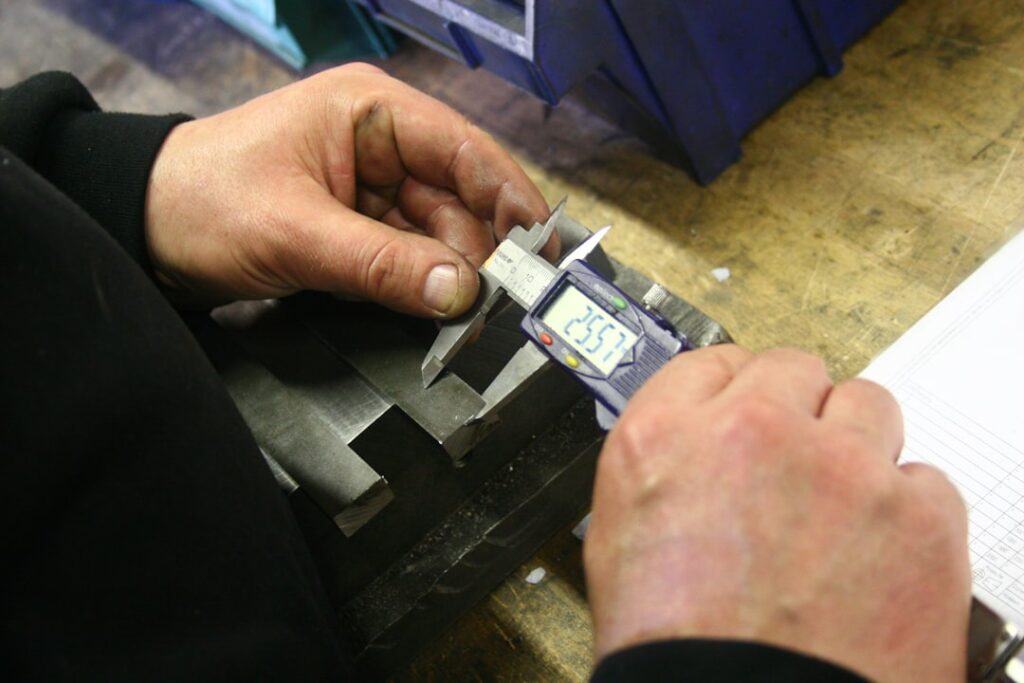
When a gearbox is obsolete or OEM parts are unavailable, a precision rebuilder uses reverse engineering to manufacture exact replacement parts. Technicians measure the worn parts using coordinate measuring machines and recreate the original specifications.
If you want to understand the full scope of professional gearbox restoration, you can read about our comprehensive Industrial Gearbox Repair capabilities.
Common Signs Your Industrial Gearbox Needs a Rebuild
The most common signs that an industrial gearbox requires a precision rebuild are elevated operating temperatures, excessive vibration, oil contamination, and unusual noises. Recognizing these symptoms early allows you to schedule maintenance before a catastrophic failure halts your production line.
Vibration analysis is one of the most effective ways to identify internal gearbox issues. When bearings begin to pit or gear teeth lose their precise profiles, they generate distinct vibration frequencies. Monitoring these frequencies allows maintenance teams to spot misalignment, imbalance, and gear wear before they cause visible damage.
Oil contamination is another clear warning sign. Regular oil analysis can detect the presence of microscopic metal particles, water, or process chemicals. Metal shavings in the oil indicate that gear teeth or bearing races are actively wearing down. Water contamination destroys the lubricating film, leading to rapid metal-on-metal wear.
Overheating is a direct indicator of internal friction. If a gearbox is running hotter than its rated operating temperature, it is often due to bearing failure, improper backlash, or lubrication breakdown. High temperatures accelerate the degradation of seals, leading to fluid leaks and further damage.
Unusual noises, such as high-pitched whining, grinding, or clunking, indicate that components are no longer mating correctly. Whining often points to gear wear or incorrect backlash, while grinding suggests advanced bearing failure.
Implementing a proactive monitoring strategy is the best way to catch these issues early. To learn more about how to set up an effective system, read our guide on How Gearbox Condition Monitoring Saves Your Machinery and Your Sanity.
The Step-by-Step Precision Gearbox Rebuild Process
A professional gearbox rebuild follows a structured, multi-stage engineering process. Each step is designed to identify failure modes, repair worn components, and verify performance before the unit is returned to service.
Teardown and Inspection
The process begins with a complete disassembly of the gearbox. Every component is cataloged, and technicians perform a root-cause failure analysis to determine why the unit failed. This step ensures that previous build shortcomings or operational stresses are identified and corrected.
Chemical Cleaning
All parts undergo thorough chemical cleaning to remove baked-on oil, grease, paint, and rust. Cleaning the components down to the bare metal is necessary for accurate inspection and non-destructive testing.
Non-Destructive Testing
Technicians perform non-destructive testing, such as magnetic particle or dye penetrant inspections, on gears and shafts. This testing reveals micro-cracks and structural defects that are invisible to the naked eye, preventing the reassembly of compromised parts.
Shaft and Housing Restoration
Worn shafts and damaged housings are restored using specialized machining and welding techniques. When shafts are worn at the bearing journals, technicians use specialized welding procedures to restore the metal. You can read about this in detail in The Art of the Weld: How to Build Up and Repair Worn Shafts.
If the gearbox casting is cracked or damaged, specialized housing welding services are used to restore structural integrity. Learn more about this process in How Gearbox Housing Welding Services Restore Damaged Castings.
To correct worn bearing bores in the housing, technicians use line boring to restore perfect concentricity and alignment. Read about this essential repair step in Bore No More: How Housing Line Boring Repairs Heavy Equipment.
Climate-Controlled Assembly
Reassembly occurs in a clean, climate-controlled environment to prevent dust, moisture, and airborne contaminants from entering the gearbox. Technicians install new bearings, seals, gaskets, and shims, setting the backlash and gear contact patterns to precise OEM specifications.
No-Load Testing
Once assembled, the gearbox undergoes rigorous no-load testing. The unit is run at operating speed to monitor vibration levels, noise, operating temperatures, and potential oil leaks. This testing ensures the gearbox is fully field-ready before it leaves the shop.
Rebuild vs. Replacement: Cost and Downtime Analysis
Choosing between a precision rebuild and a full replacement involves evaluating lead times, direct costs, and the impact of production downtime. For most heavy industrial applications, a rebuild is the most practical choice.
In terms of direct costs, a precision rebuild typically saves up to 60% compared to the price of purchasing a new OEM gearbox. These savings can be redirected to other maintenance priorities or facility upgrades.
Lead times are where the difference becomes most apparent. Specifying, ordering, and waiting for a new heavy-duty industrial gearbox can take several months, especially for custom or older units. A precision rebuild can be completed in 7 to 10 business days under normal schedules, and even faster during emergencies.
| Factor | Precision Rebuild Service | New OEM Replacement |
|---|---|---|
| Average Cost | Up to 60% savings compared to new | Full market price |
| Standard Lead Time | 7 to 10 business days | Weeks to months |
| Emergency Turnaround | 24 to 48 hours | Rarely available |
| Warranty Coverage | Multi-year operational warranty | Standard 1-year manufacturer warranty |
| Customization | Can upgrade materials and design | Standard factory specifications |
A rebuild also allows technicians to upgrade the gearbox. If a specific component fails repeatedly due to the demands of your application, a rebuilder can use stronger materials or modified gear profiles to increase the unit’s durability beyond its original factory design.
Selecting the Right Precision Gearbox Rebuild Service Provider
Selecting the right rebuild partner is critical to ensuring the longevity of your machinery. A high-quality rebuild requires specialized equipment, engineering expertise, and strict quality control.
First, look for a provider that adheres to American Gear Manufacturers Association (AGMA) standards. These standards govern gear tolerances, materials, and manufacturing practices, ensuring that any custom gears produced during the rebuild meet strict quality levels.
The provider should also have in-house manufacturing capabilities. When a gearbox has obsolete parts, the shop must be able to design and cut new gears to exact specifications. You can learn about these requirements in Custom Gear Manufacturing.
Logistics and location are also important factors. Shipping a multi-ton gearbox across the country adds significant cost and days of unnecessary transit time. Finding a regional provider reduces shipping delays and simplifies communication.
For tips on finding a local partner, check out Don’t Grind Your Gears and Find the Best Gearbox Repairing Near Me.
Additionally, managing transit costs is vital for keeping your maintenance budget in check. Read more about how to handle these logistics in Industrial Gearbox Repair – Don’t Let Shipping Costs Grind Your Gears.
Frequently Asked Questions
How long does a precision gearbox rebuild service take?
A standard precision gearbox rebuild typically takes 7 to 10 business days. This timeframe includes complete teardown, cleaning, inspection, parts sourcing or manufacturing, assembly, and testing. For critical situations where production has stopped, emergency services can complete repairs within 24 to 48 hours.
What is the warranty on a precision gearbox rebuild service?
At Specialty Gear Drives, we provide a 24-month warranty on our precision gearbox rebuilds. This warranty covers both parts and labor, giving you peace of mind that your rebuilt equipment will perform reliably under demanding industrial conditions.
Can obsolete gearboxes be rebuilt to OEM standards?
Yes, obsolete gearboxes can be rebuilt to OEM standards or better. By utilizing reverse engineering, advanced coordinate measuring machines, and custom gear cutting, technicians can recreate obsolete shafts, gears, and housings to match or exceed the original manufacturer specifications.
Conclusion
A precision gearbox rebuild service is a highly effective strategy for restoring failed industrial machinery, minimizing production downtime, and saving up to 60% compared to the cost of buying new equipment. By choosing a comprehensive rebuild over a quick patch repair, you ensure that every internal component is restored to precise tolerances, preventing recurring failures and extending the operating life of your system.
Specialty Gear Drives specializes in the repair, rebuild, and manufacturing of industrial gearboxes for demanding sectors, including oil and gas, nuclear power, mining, plastics, food processing, and pulp and paper. Based in Largo, Florida, we proudly serve industrial facilities throughout Florida, Georgia, South Carolina, Alabama, Mississippi, and Louisiana.
Our key advantages include:
- 24 to 48-Hour Emergency Service to get your critical operations back online quickly
- Free Pickup and Delivery across our entire southeastern service area to simplify your logistics
- Significant Cost Savings of up to 60% compared to purchasing a brand-new gearbox
- A 24-Month Warranty on parts and labor, ensuring long-term reliability
When you need dependable, high-precision engineering to restore your heavy machinery, contact our team to schedule a free inspection and receive a detailed diagnostic report. Visit our Industrial Gearbox Repair page to get started.