Custom Gear Manufacturing Imperial 101
What Is Custom Gear Manufacturing Imperial and When Do You Need It?
custom gear manufacturing imperial refers to the design and production of gears specified using the inch-based diametral pitch (DP) system, which remains the dominant standard across North American industrial equipment. If you’re sourcing replacement or new-build gears for heavy industrial machinery, here’s what you need to know upfront:
Quick reference: Custom imperial gear manufacturing at a glance
| Factor | Typical Range |
|---|---|
| Pitch range | 12 DP to 120 DP (fine precision) |
| Prototype lead time | 4 to 8 weeks |
| Production run lead time | 10 to 16 weeks |
| Prototype quantity | 1 to 10 pieces |
| Series production MOQ | 200 to 2,000 pieces |
| Tolerance cost impact | +15 to 35% per class step up |
| Common materials | Alloy steel, stainless steel, bronze, engineering plastics |
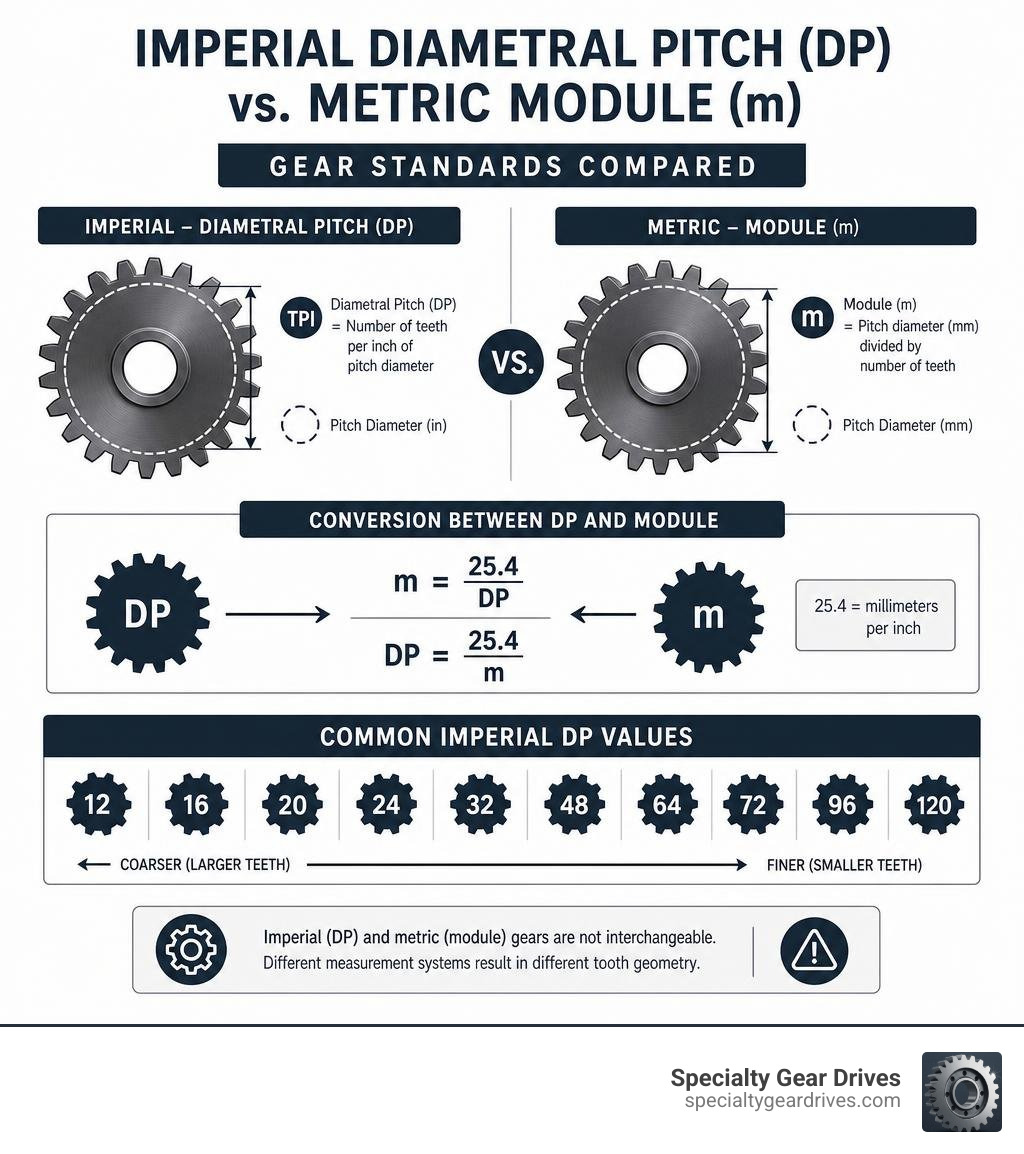
The difference between imperial and metric gearing comes down to how tooth pitch is measured. Imperial gears use diametral pitch (DP), which is the number of teeth per inch of pitch diameter. Metric gears use module (m), which is pitch diameter in millimeters divided by tooth count. The two systems are not interchangeable, and most legacy industrial equipment in North America was built around imperial DP standards.
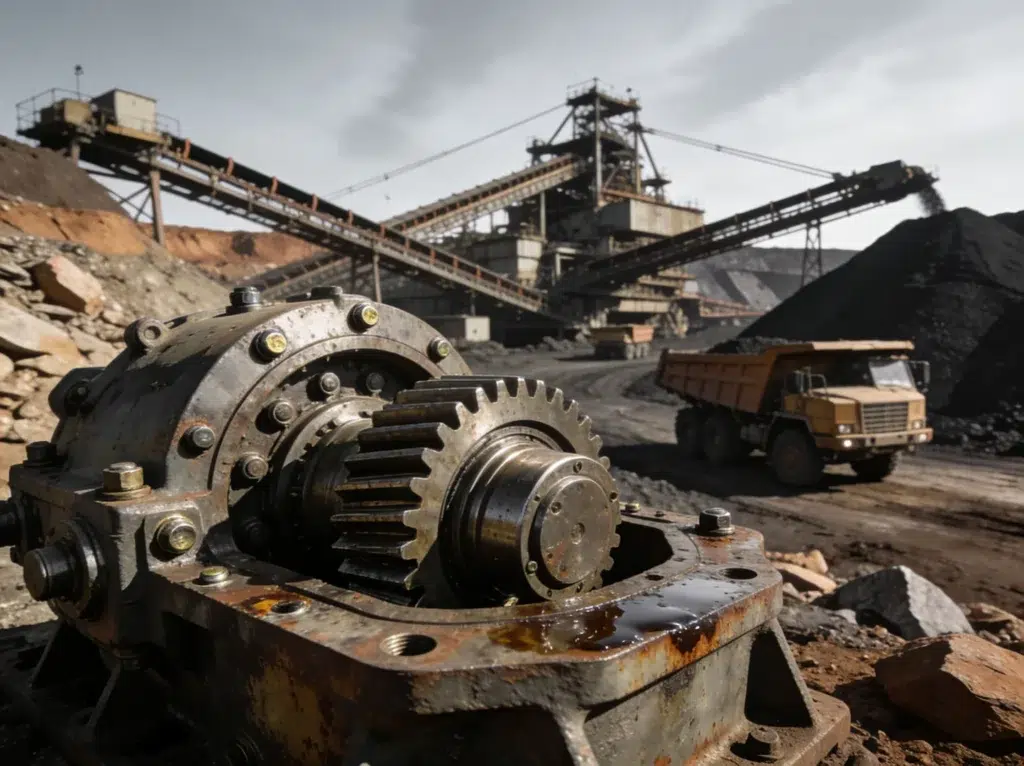
A single failed gear in a conveyor drive or a mining crusher can halt an entire production line. When OEM replacements are discontinued, backordered, or simply never catalogued for your exact configuration, custom imperial gear manufacturing is often the only path back to full operation.
The sections below cover gear types, materials, tolerance classes, profile shifting for non-standard center distances, quality documentation requirements, and how to structure an RFQ that gets you an accurate quote the first time.
Imperial vs. Metric Gear Systems: Diametral Pitch vs. Module
The fundamental difference between imperial and metric gears lies in how tooth sizes are calculated. Imperial gears use diametral pitch, which represents the ratio of the number of teeth to the pitch diameter in inches. Metric systems use the module, which is the direct ratio of the pitch diameter in millimeters to the number of teeth.
Because of this mathematical difference, you cannot run an imperial gear and a metric gear together. Even if the outer diameters look similar, the tooth geometry and pressure angles will not mesh correctly. Attempting to run them together will cause rapid tooth wear, extreme noise, and eventual mechanical failure.
To convert between the two systems, engineers use a simple conversion formula:
$$\text{Module} = \frac{25.4}{\text{Diametral Pitch}}$$
This conversion is rarely a perfect integer. For example, a common 10 DP imperial gear converts to a module of 2.54. Because standard metric cutters are made in integer or common fractional modules like 2.5 or 3.0, a converted gear requires custom tooling to cut the teeth accurately.
| Imperial Standard (DP) | Exact Metric Equivalent (Module) | Nearest Standard Metric Module |
|---|---|---|
| 4 DP | 6.350 | 6.0 or 6.5 |
| 6 DP | 4.233 | 4.0 |
| 8 DP | 3.175 | 3.0 |
| 10 DP | 2.540 | 2.5 |
| 12 DP | 2.117 | 2.0 |
| 16 DP | 1.588 | 1.5 |
When managing old machinery in pulp mills, chemical plants, or mining facilities, replacing an imperial gear with a metric counterpart usually requires replacing the entire gear train. Choosing custom manufacturing for the exact imperial DP component saves you from rebuilding the whole system.
Common Types of Custom Gear Manufacturing Imperial Components

Industrial gearboxes rely on several distinct gear styles depending on the required torque, speed, and shaft orientation. Selecting the correct gear type during the custom manufacturing process ensures the drive system operates reliably under high loads.
- Spur Gears: These are the most common imperial gears, featuring straight teeth cut parallel to the shaft axis. They are highly efficient and easy to manufacture, making them ideal for low-to-medium speed applications in paper mills and packaging plants.
- Helical Gears: These gears have teeth cut at an angle to the shaft. This helix angle allows the teeth to engage gradually, resulting in smoother, quieter operation and higher load capacity. They are widely used in heavy-duty conveyor drives and high-speed industrial reducers.
- Worm Gears: Consisting of a threaded screw mating with a gear wheel, worm sets offer high gear ratios in a compact space. They are inherently quiet and can provide self-locking capabilities, which is useful for hoisting and elevator systems.
- Bevel Gears: These cone-shaped gears transmit power between intersecting shafts, typically at a 90-degree angle. They are crucial for heavy mixers, right-angle drives, and marine propulsion systems.
- Internal Gears: Featuring teeth cut on the inside of a ring, internal gears mate with external spur pinions. They provide high contact ratios and short center distances, making them ideal for planetary gear systems in heavy machinery.
- Anti-Backlash Gears: These specialized split-gear designs eliminate the play or backlash between mating teeth. They are used in low-torque, high-precision applications such as rotary encoders and instrumentation.
For specialized industrial systems, we offer comprehensive Custom Gear Manufacturing services to produce all of these gear styles to your exact dimensional specifications.
Solving Fixed Center Lineups with Custom Gear Manufacturing Imperial Methods

Industrial maintenance often presents a difficult challenge: replacing gears inside a gearbox housing where the shaft center distance is completely fixed. If the original tooth counts or pitch standards cannot be replicated, standard gear designs will not fit. Custom manufacturing solves this through profile shifting and addendum modification.
Profile shifting involves adjusting the position of the gear cutting tool during manufacturing. By shifting the cutter slightly closer to or further from the gear center, we can alter the tooth thickness and pitch diameter without changing the number of teeth or the base diametral pitch.
This technique allows us to accomplish several design goals:
- Adjust Center Distance: We can increase or decrease the operating center distance of a gear pair to fit an existing, unalterable gearbox housing.
- Eliminate Undercutting: On small pinions with low tooth counts, profile shifting strengthens the tooth roots by preventing the cutter from removing material at the base of the tooth.
- Optimize Tooth Strength: We can balance the wear and bending strength between a small pinion and a large mating gear.
When a standard integer DP cutter cannot achieve the exact gear ratio needed for a fixed center distance, manufacturers can use fractional DP values, such as 7.5 DP or 6.25 DP. Producing these gears requires specialized gear shaping machines or custom hobs. While custom tooling can extend lead times, it is often the only way to restore a proprietary or highly specialized industrial drive system.
Materials, Heat Treatment, and Quality Standards in Precision Gearing
Selecting the right material and heat treatment is critical for ensuring the longevity of a custom gear. Industrial environments subject gears to extreme torque, shock loads, and abrasive debris.
Alloy steels such as 8620 and 4140 are the standard choices for high-torque applications. Carburized and ground 8620 steel gears offer exceptional surface hardness while maintaining a ductile core, which provides up to five times the surface fatigue life of through-hardened steels. For corrosion-prone environments, such as food processing or chemical plants, stainless steel is preferred. Phosphor bronze is the standard material for worm wheels due to its low coefficient of friction and excellent wear resistance when mating with steel worm shafts.
Heat treatment is the single largest variable in gear durability and manufacturing lead times. Carburizing, nitriding, and induction hardening are used to achieve the necessary surface hardness. However, heat treatment introduces thermal distortion. Precision gears often require post-heat-treat grinding to restore the tooth profile to the correct tolerance class.
When rebuilding a damaged gearbox, gear failure is often accompanied by wear on surrounding components. If a gear failure has damaged the supporting shafts, you can learn about repair options in our guide on The Art of the Weld: How to Build Up and Repair Worn Shafts.
Additionally, worn bearing bores in the gearbox housing must be addressed to keep the new gears properly aligned. For on-site repair of these housings, read about how we correct alignment issues in Bore No More: How Housing Line Boring Repairs Heavy Equipment. If the cast housing itself has cracked or suffered structural damage during a failure, you can see how we salvage these expensive components in our overview of How Gearbox Housing Welding Services Restore Damaged Castings.
Quality Standards and Documentation for Custom Gear Manufacturing Imperial Projects
Critical industries like aerospace, nuclear power, and chemical processing require strict quality documentation before any custom gear can be installed. This documentation ensures the gear meets the exact metallurgical and dimensional specifications required for safe operation.
The standard quality package for custom gears includes several key documents:
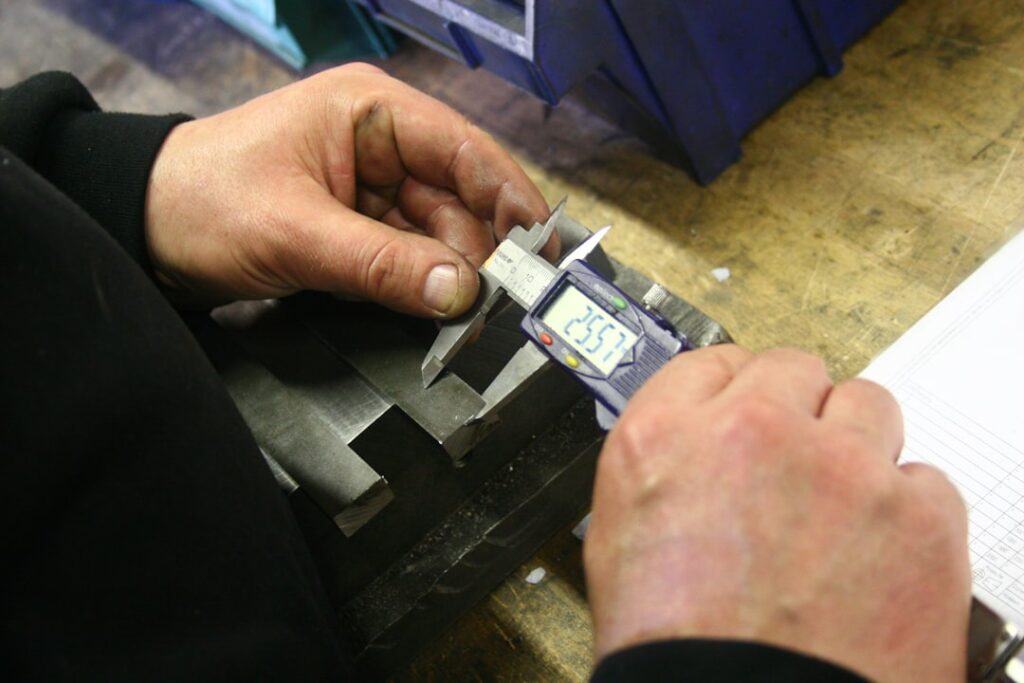
- First Article Inspection (FAI): A comprehensive dimensional audit of the first completed part from a production run to verify tool setup accuracy.
- Production Part Approval Process (PPAP): A structured framework used to prove that the manufacturing process can consistently produce parts of the required quality.
- Material Certifications: Mill test reports verifying the chemical composition and physical properties of the raw steel or bronze alloy.
- Heat Treat Traceability: Documentation of the furnace temperature cycles and hardness testing results.
High-precision custom gear manufacturing is typically governed by quality systems such as ISO 9001 and AS9100D. These standards ensure that every step of the manufacturing process is documented, repeatable, and traceable back to the raw material lot.
Managing Lead Times, MOQs, and RFQs for Industrial Gear Sourcing
Acquiring custom imperial gears requires careful planning around lead times and minimum order quantities (MOQs). Unlike off-the-shelf components, custom gears must be scheduled into a machine shop production queue.
Typical lead times for custom gear manufacturing range from 4 to 8 weeks for small prototype lots of 1 to 10 pieces. For bridge production, expect 6 to 10 weeks, while full series production with complete PPAP documentation can take 10 to 16 weeks. Heat treatment and precision tooth grinding are the primary drivers of these lead times, as parts must often queue between different specialized machines.
MOQs are generally structured around setup costs. Setting up a gear hobber or shaper requires significant labor and alignment time. For prototypes, manufacturers will often accept orders of 1 to 10 pieces, but the unit price will reflect the full setup cost recovery. For production runs, MOQs typically range from 200 to 2,000 pieces to distribute the setup costs across a larger volume.
To receive an accurate quote quickly, your Request for Quote (RFQ) package should contain:
- A detailed 2D engineering drawing with complete GD&T and a gear data block.
- A 3D CAD model.
- Exact material and heat-treatment specifications.
- The required AGMA or DIN tolerance class.
- Clear inspection and documentation requirements.
If your machinery is down and you cannot wait weeks for a custom gear to be manufactured from scratch, professional maintenance services can often rebuild your existing equipment much faster. You can learn more about our rapid overhaul options on our Industrial Gearbox Repair page.
Conclusion
Custom imperial gear manufacturing is a highly technical process that keeps legacy and specialized North American industrial machinery running smoothly. By understanding the differences between diametral pitch and metric modules, choosing the right materials, and utilizing profile shifting for fixed center distances, plant managers can successfully source replacement gears that meet or exceed original OEM specifications.
At Specialty Gear Drives, based in Largo, Florida, we specialize in custom gear manufacturing and complete industrial gearbox rebuilds. We serve key industrial sectors, including oil and gas, nuclear, mining, plastics, food processing, and pulp and paper across Florida, Georgia, Alabama, South Carolina, Mississippi, and Louisiana.
We offer 24-to-48-hour emergency services, free pickup and delivery, and up to 60% savings compared to buying a brand-new gearbox, all backed by our industry-leading 24-month warranty. If you need a custom gear or a complete gearbox overhaul, contact us today through our Custom Gear Manufacturing page to request a quote.