How Much Does a 3D Scanner for Reverse Engineering Actually Cost?
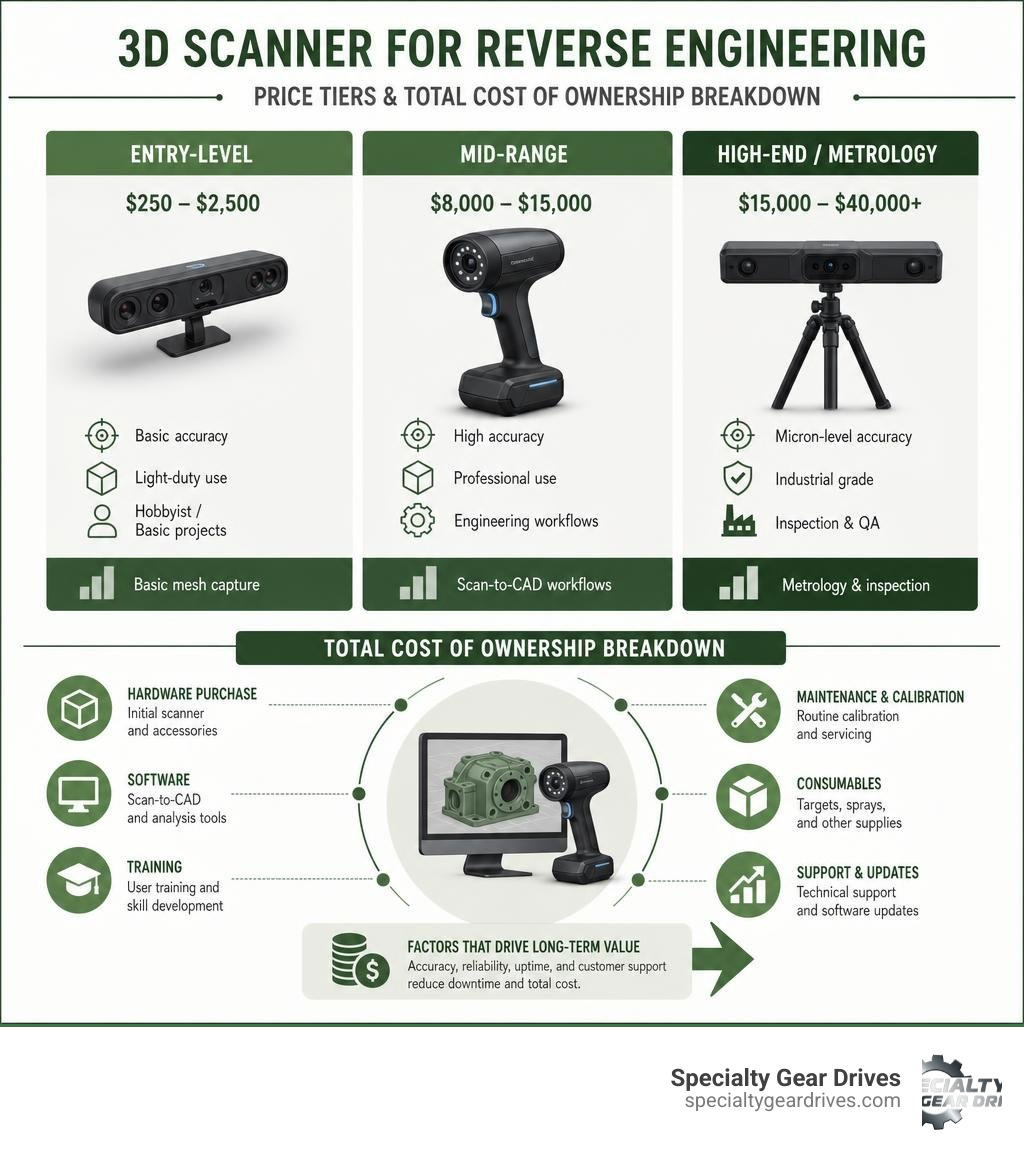
3D scanner for reverse engineering price ranges from under $1,000 for entry-level consumer models to well over $40,000 for metrology-grade industrial systems. Here is a quick breakdown:
| Tier | Price Range | Typical Use |
|---|---|---|
| Entry-level | $250 to $2,500 | Basic mesh capture, hobbyist, light-duty |
| Mid-range | $8,000 to $15,000 | Professional scan-to-CAD, engineering workflows |
| High-end / Metrology | $15,000 to $40,000+ | Micron-level accuracy, industrial inspection |
For most plant maintenance and MRO applications, the mid-range tier offers the best fit between accuracy and cost.
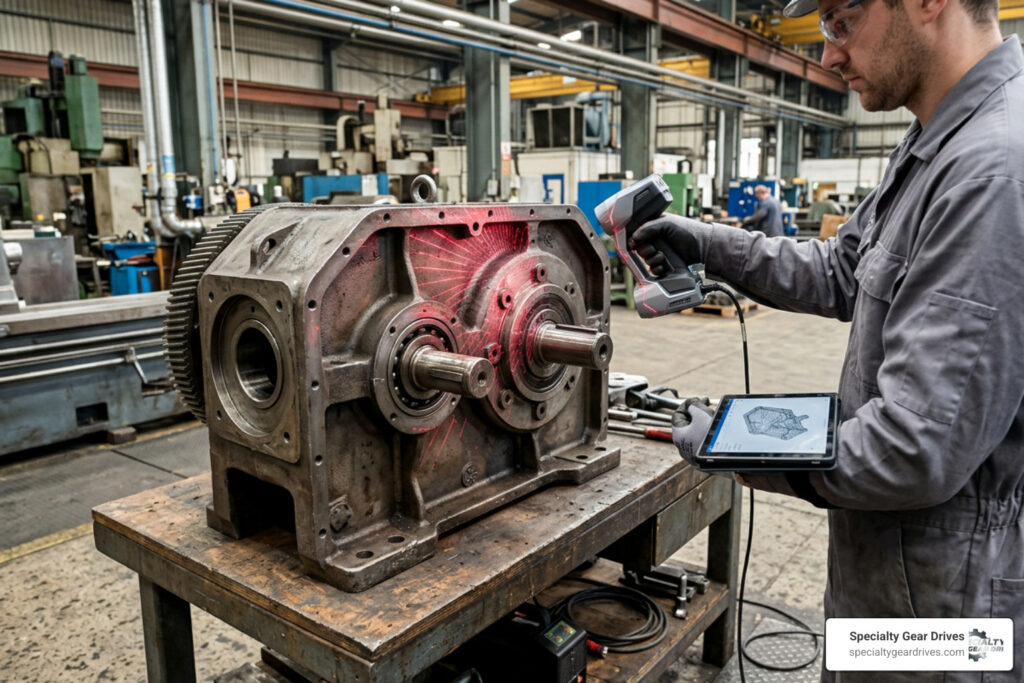
A single failed gearbox on a conveyor line or a processing system with no OEM documentation can shut down an entire production shift. When a legacy part is discontinued or a casting drawing no longer exists, reverse engineering from a physical part is often the fastest path back to operation. That is where 3D scanning earns its keep.
But the hardware price tag is only part of the picture. Scan-to-CAD software, accessories, training, and ongoing calibration all add to what you actually spend. This guide breaks down the full cost structure so you can evaluate what makes sense for your facility, whether you are a maintenance engineer in a phosphate plant in Florida, a procurement manager at a pulp mill in Alabama, or a mining operations team trying to source a discontinued gear reducer component.
Understanding the 3D Scanner for Reverse Engineering Price Spectrum
Evaluating a 3D scanner requires looking beyond the initial capital expenditure. The true return on investment comes from reducing downtime and avoiding the high cost of ordering custom replacement parts from overseas OEMs.
To make sense of the market, we group these tools into three distinct hardware tiers based on their accuracy, reliability, and software integration.

Entry-Level Scanners under $8,000
Entry-level systems are designed for budget constraints where extreme precision is not the primary concern. Devices like the Revopoint POP 4 and the Revopoint MIRACO Plus offer portable, lightweight designs that work well for basic mesh generation.
These units typically use infrared structured light or blue light technology to capture surface geometry. While they are useful for capturing rough shapes or large, non-critical castings, they often struggle with the tight tolerances required for mating mechanical components.
If you need to digitize a simple bracket or a non-load-bearing cover, an entry-level scanner can get the job done. However, they lack the volumetric accuracy needed to capture complex gear teeth or shafts where a fraction of a millimeter makes the difference between a smooth-running drive system and a catastrophic failure.
Mid-Range 3D Scanner for Reverse Engineering Price Points ($8,000 to $15,000)
The mid-range tier is where we find the sweet spot for most industrial maintenance and repair operations. Tools in this category, such as the Peel 3.CAD and various Shining 3D EinScan or FreeScan Combo units, are built specifically to bridge the gap between physical parts and CAD software.
These scanners provide a reliable scan-to-CAD bridge by pairing capable hardware with dedicated processing software. They offer the accuracy and resolution needed to capture machined surfaces, keyways, and bolt patterns on industrial equipment.
For a deeper look at how these systems operate in industrial environments, you can read our In-Depth Guide to Reverse Engineering 3D Scanner. This tier is highly popular among engineering teams in Georgia and South Carolina who need to recreate worn components without spending a fortune on specialized metrology services.
High-End and Metrology-Grade 3D Scanner for Reverse Engineering Price Ranges (Over $15,000)
High-end systems are precision instruments designed for demanding industrial environments. Scanners like the Artec Spider II, Artec Eva, ZEISS ATOS Q, and GOM Scan 1 are engineered to deliver micron-level accuracy under challenging conditions.
These devices are common in aerospace, nuclear power generation, and heavy manufacturing facilities where deviation is not tolerated. They use advanced blue light projection, high-speed cameras, and rigid calibration frames to eliminate thermal drift and measurement noise.
When you are dealing with large, multi-stage helical gearboxes or high-torque speed reducers in Mississippi paper mills, these metrology-grade tools ensure that every bearing bore and shaft centerline is captured exactly as it sits. The high investment is justified when even a minor dimensional error could lead to thousands of dollars in wasted machining time or premature gear wear.
Key Technical Specifications That Drive Equipment Costs
The cost of a 3D scanner is directly tied to its internal components and optical capabilities. Understanding these technical specifications helps you see why some systems command a premium.

Accuracy and Volumetric Precision
Single-frame accuracy refers to how precisely a scanner can measure a single point from a specific distance. Volumetric precision is different because it accounts for how that accuracy scales as you scan larger objects.
As you move the scanner along a large housing, small errors accumulate. This is known as cumulative error. High-end systems use superior optics and advanced tracking algorithms to keep this error to a minimum.
For critical machinery, such as a large bevel gearbox used in a Louisiana chemical plant, high volumetric accuracy ensures that the output data matches the physical part over its entire length. This level of precision requires high-quality calibration boards and sensitive sensors, which increases the manufacturing cost of the scanner.
Scanning Speed and Data Density
The measurement rate of a scanner determines how many points it can capture per second. High-speed scanners can capture millions of points in seconds, reducing the time a technician spends on the plant floor.
Blue laser technology and structured light arrays allow scanners to capture fine details on dark or reflective metal surfaces without losing tracking. A higher data density means the scanner can resolve sharp edges, thin ribs, and the complex geometry of worn gear teeth.
Slower scanners require the operator to move with extreme care, and they often struggle to capture data in hard-to-reach areas. Speed and high data density require more processing power and better sensors, which naturally drives up the equipment cost.
Software Licensing and the Total Cost of Ownership
Hardware is only half of the reverse engineering equation. To turn a point cloud into a usable CAD model, you need specialized software, and the licensing structure for these programs can significantly impact your total cost of ownership.
For a detailed look at the complete digital workflow, check out our article on The Ins and Outs of 3D Laser Scanner Reverse Engineering.
Standalone Scan-to-CAD Software Costs
Standalone reverse engineering software, such as Geomagic Design X or QUICKSURFACE, provides the most powerful toolsets for converting raw scan data into parametric CAD models. These programs allow you to extract geometric primitives, align coordinate systems, and build clean surfaces directly over the scan mesh.
Some software providers offer permanent licenses, which require a larger upfront payment but eliminate recurring fees. Others rely on annual subscriptions, which lower the initial cost but require ongoing payments to keep the software active.
These standalone programs are highly sophisticated and require a investment that often rivals the cost of the scanner itself. For facilities that perform reverse engineering on a weekly basis, the time saved during the CAD conversion process easily justifies the software cost.
Plugin and Budget Software Alternatives
For operations that only need to reverse engineer parts occasionally, plugins and budget software packages offer a sensible alternative. Programs like Mesh2Surface for Rhino or the mesh-to-solid tools in Autodesk Fusion provide basic conversion capabilities at a fraction of the cost of standalone suites.
These tools allow you to import mesh data and use basic sketch-fitting tools to recreate simple geometry. While they lack the automated surfacing and advanced deviation analysis of high-end software, they provide a significant cost reduction for straightforward projects.
Using a plugin is a practical way to manage expenses if your primary goal is to recreate simple shafts, flanges, or brackets rather than complex, organic castings.
Hidden and Ongoing Costs of Industrial 3D Scanning
The purchase price of the scanner and software is not the final number on the balance sheet. Several ongoing costs must be factored into your budget to keep the system operational.
Accessories and Consumables
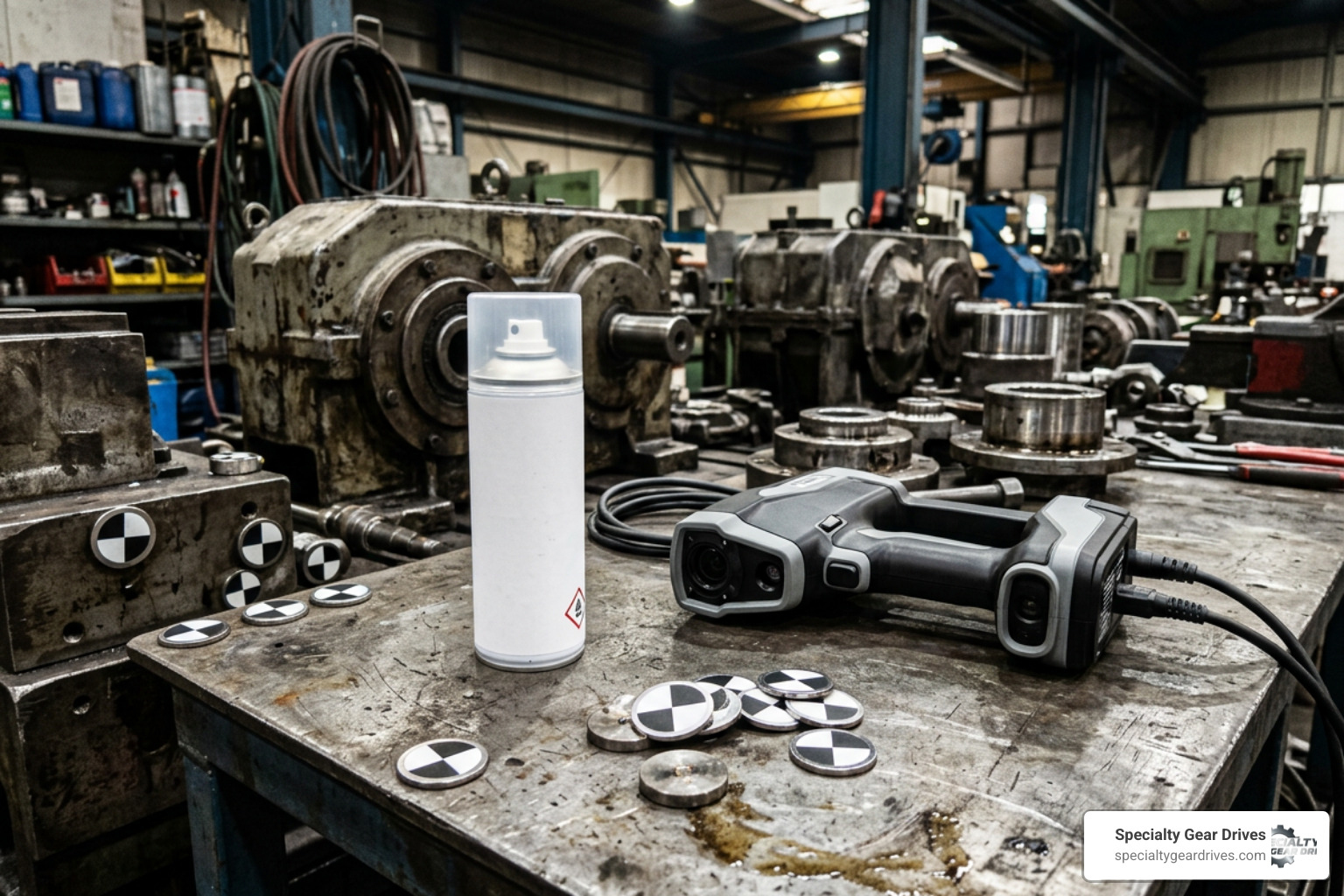
Many 3D scanners require positioning targets to maintain tracking on flat or featureless surfaces. These targets are adhesive stickers that must be replaced regularly during large projects.
For shiny or dark metal components, such as polished gear teeth or machined shafts, you will need anti-reflective scanning spray. This spray leaves a thin, white powder coating on the metal that allows the scanner’s light source to bounce back accurately.
Other accessories, like heavy-duty cases, battery grips for mobile scanning, and automated turntables for small parts, also add to the initial setup cost.
Maintenance, Warranties, and Training
Industrial environments are dusty, hot, and damp, especially in Gulf Coast facilities where humidity is high. Hardware calibration is essential to keep the scanner within its specified tolerances, and professional calibration services often require an annual fee.
Extended warranties and hardware protection plans help safeguard your investment against accidental drops or sensor damage on the shop floor.
Finally, operator training is critical. A 3D scanner is only as good as the person using it. Investing in proper training ensures your team can capture clean data quickly, reducing the time spent cleaning up noisy meshes in the office.
Frequently Asked Questions About Reverse Engineering Scanner Costs
Can a cheap 3D scanner directly output a CAD model for manufacturing?
No, 3D scanners do not produce CAD models. They generate point clouds or polygonal mesh data, which are simply collections of points in 3D space.
To turn this data into a STEP or IGES file that a machine shop can use, an engineer must manually reconstruct the geometry using scan-to-CAD software. Cheap scanners often produce noisy mesh data, which actually increases the time required to create a clean CAD model.
How does volumetric accuracy affect the price of a 3D scanner?
Volumetric accuracy measures how well a scanner maintains its precision over a distance. On small parts, a minor deviation is negligible, but on a large industrial gearbox housing, a small tracking error can compound into a significant mismatch.
Scanners with high volumetric accuracy use superior optics and are certified to meet strict metrology standards. This certification and the high-grade components required to achieve it are major drivers of the equipment’s price.
Is it more cost-effective to buy a scanner or outsource reverse engineering?
If your facility only needs to reverse engineer a part once or twice a year, outsourcing is generally more cost-effective. It eliminates the need for capital allocation, software subscriptions, and specialized operator training.
However, if you manage a large plant with frequent maintenance needs, owning a scanner allows you to react instantly to failures, reducing lead times and keeping production lines running.
Conclusion
Investing in a 3D scanner for reverse engineering is a proven way to reduce downtime and regain control over your facility’s spare parts supply chain. By understanding how accuracy, software, and ongoing maintenance impact the overall cost, you can select a system that matches your operational needs and budget.
For heavy industrial gearboxes, you do not always need to buy expensive equipment and train your own team. At Specialty Gear Drives, we handle the entire process for you. Based in Largo, Florida, we repair and rebuild industrial gearboxes for facilities across Georgia, Alabama, South Carolina, Mississippi, and Louisiana.
Our team uses advanced reverse engineering methods to manufacture precise replacement gears and shafts, offering up to 60% savings compared to buying a new gearbox. We back our work with a 24-month warranty and provide 24–48 hour emergency service with free pickup and delivery.
If you are dealing with a worn-out speed reducer or a discontinued drive system, contact us today to see how we can get your operations back up and running. To learn more about the technical side of the process, read our detailed guide on The Ins and Outs of 3D Laser Scanner Reverse Engineering.