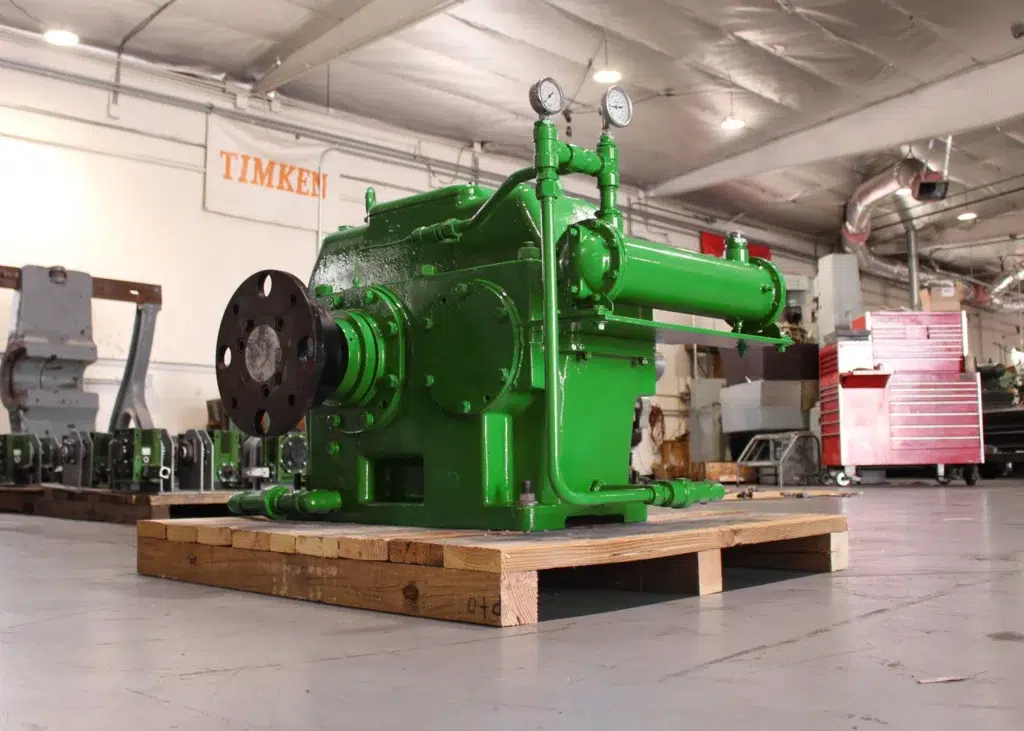
How to Get Rid of These Emergency Gear Repair Challenges for Industrial Gearboxes
Emergency Gear Repair Starts With Fast, Accurate Diagnosis
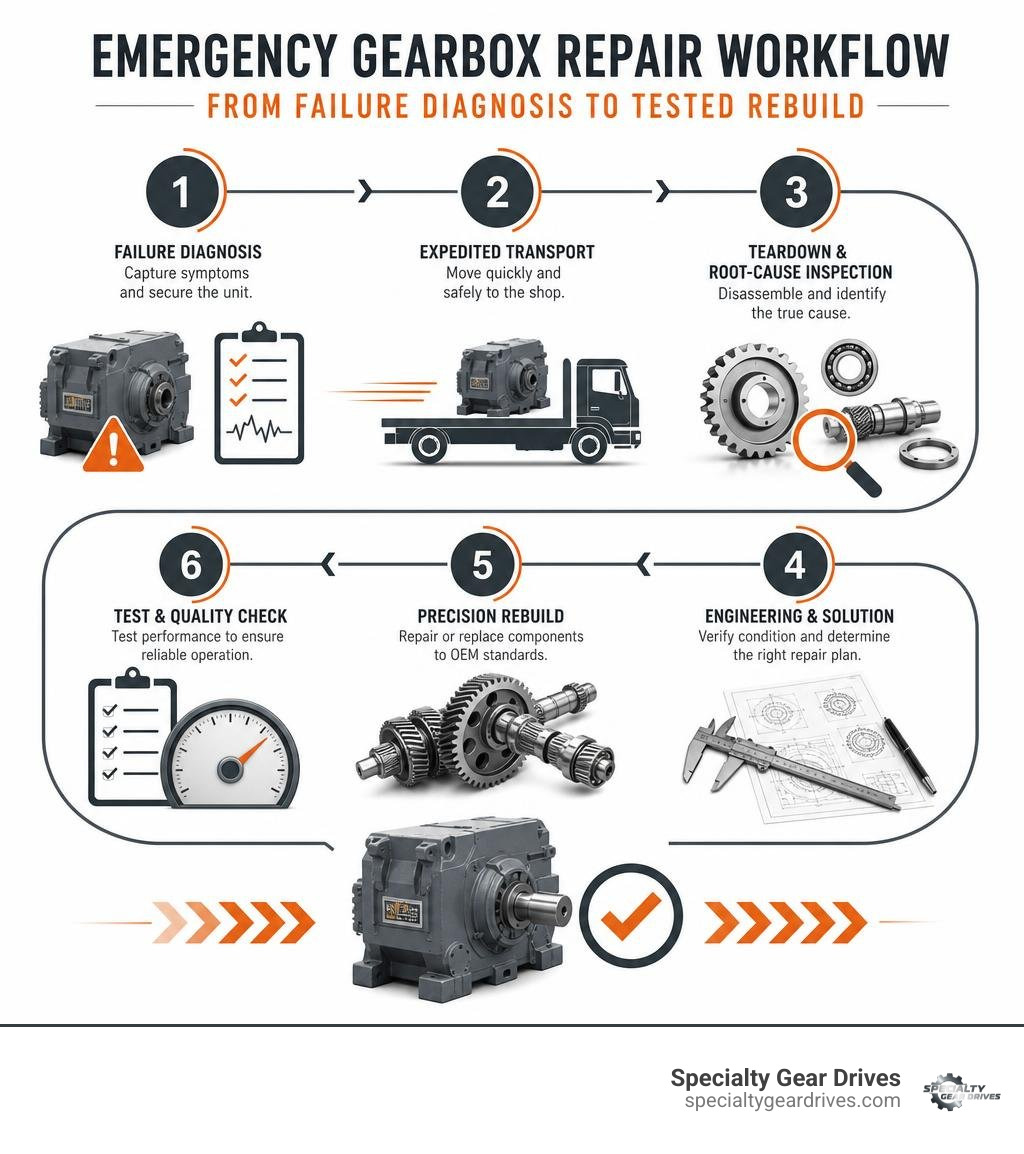
When a critical industrial gearbox fails, emergency gear repair should begin with three steps:
- Stop the affected drive safely and document symptoms such as noise, heat, vibration, or oil contamination.
- Arrange expedited transport to a qualified repair facility for teardown and root-cause inspection.
- Rebuild or replace damaged components only after verifying gear tooth condition, bearings, shafts, bores, and housing alignment.
This approach limits unplanned downtime without relying on temporary field fixes that can create a larger failure later. Specialty Gear Drives repairs gear reducers, speed reducers, and helical, bevel, and worm gearboxes used on conveyors, mining equipment, cement plants, marine systems, wind turbines, and heavy manufacturing lines.
A fast repair depends on more than replacing broken parts. It requires accurate measurements, reverse engineering when OEM parts are delayed or obsolete, precision machining, and testing before the unit returns to service. Specialty Gear Drives provides rapid response, expedited logistics, and fast shop turnaround; all repair and line boring work is completed in-house at our Florida facility.
I’m Peter Clark, owner of Specialty Gear Drives, where I oversee emergency gear repair, gearbox rebuilding, reverse engineering, and manufacturing for heavy industrial drive systems. This guide explains how to remove the common delays and risks that keep a failed gearbox from getting back into service.
Understanding Emergency Gear Repair Across Critical Sectors
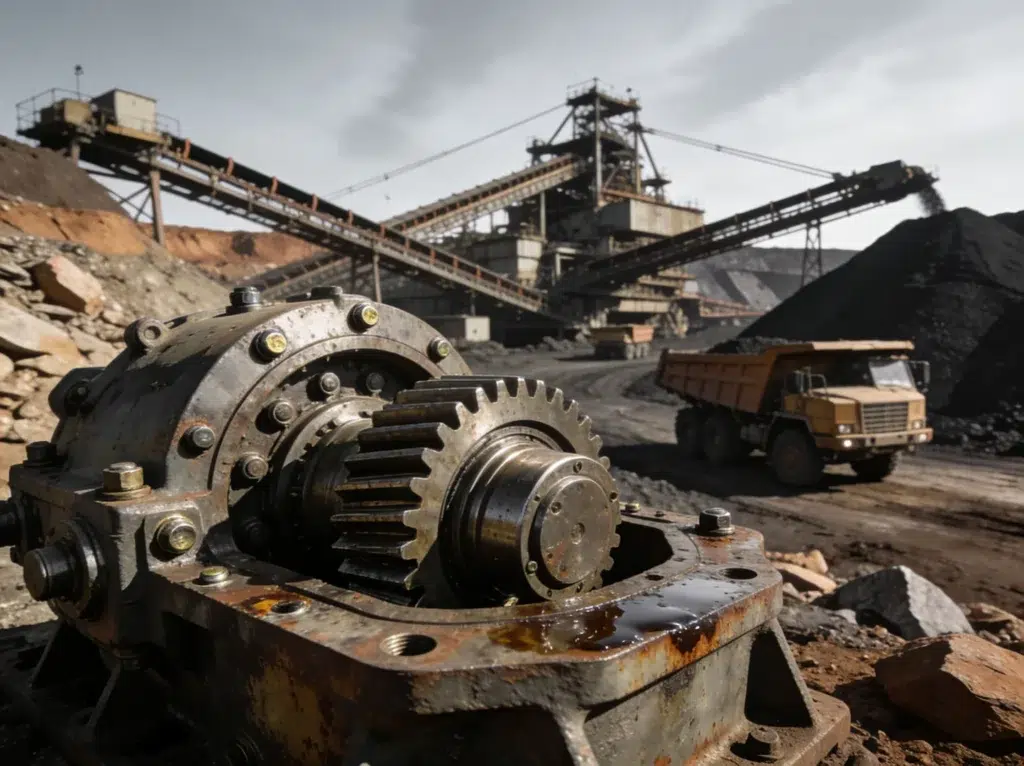
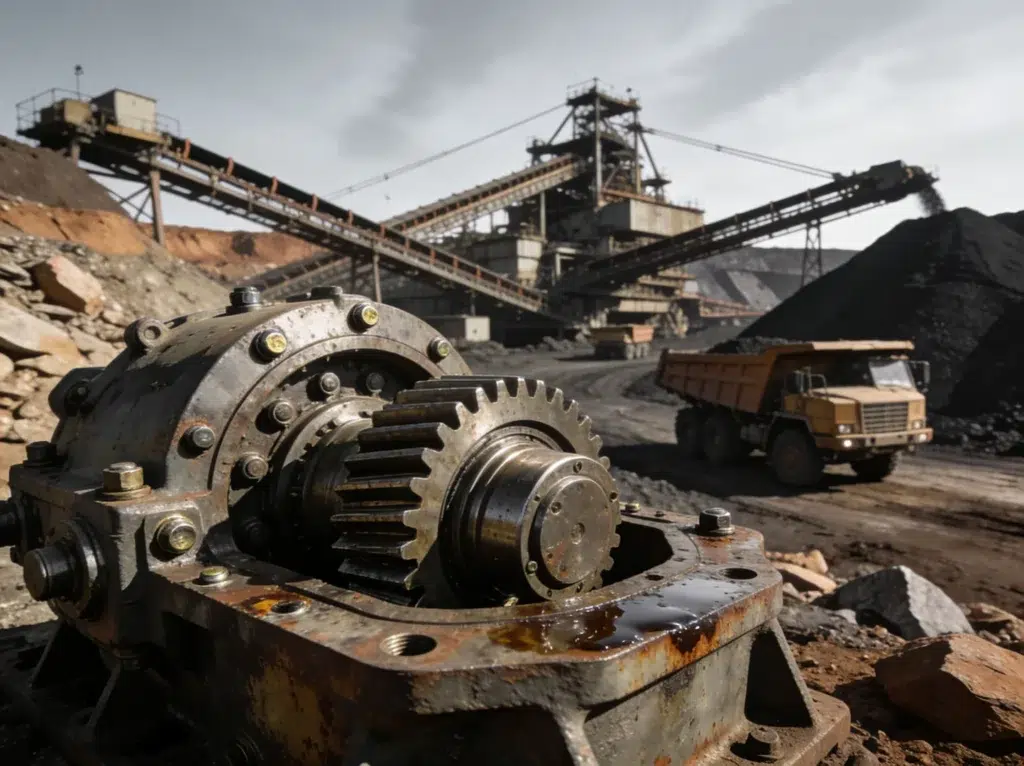
Heavy industrial drivetrains operate under severe continuous loads, high thermal stresses, and aggressive particulate contamination. When an unexpected breakdown strikes a primary drive, the financial toll accumulates by the minute. Unplanned downtime halts production lines across pulp and paper mills, chemical operations, and processing plants throughout Florida, Georgia, Alabama, South Carolina, Mississippi, and Louisiana. Maintaining mission-critical reliability requires a direct engineering response rather than guesswork.
Addressing mechanical failures quickly demands a clear protocol. Plant engineers can review The Definitive Guide to Fast Gearbox Repair with 48-Hour Service to understand how structured workflows prevent minor mechanical issues from escalating into complete plant shutdowns.

Critical Industrial Machinery and Gearbox Applications
Heavy industrial machinery relies on specialized gear architectures designed to handle immense torque multiplication and speed reduction:
- Conveyor Systems: Continuous bulk handling lines in mining, aggregate facilities, and ports depend heavily on parallel-shaft helical and right-angle bevel-helical speed reducers. Bearing degradation or tooth stripping here immediately halts material transport.
- Mining Equipment: Ball mills, crushers, and draglines utilize massive spur, helical, and planetary gear reducers exposed to cyclical shock loads and abrasive dust.
- Cement Plants: Rotary kilns and raw grinding mills run oversized girth gears and heavy-duty planetary gear drives subjected to extreme radiated heat and torsional strain.
- Marine Systems: Industrial winches, dredging drives, and heavy vessel deck equipment demand robust worm and bevel gearboxes capable of surviving corrosive, high-humidity marine conditions.
- Wind Turbines and Manufacturing Lines: Heavy extrusion presses, plastics compounding lines, and industrial wind turbine main drives rely on multi-stage planetary and helical gearing where microscopic misalignment leads to catastrophic fatigue.
Why Field Improvisation Fails Compared to Professional Facility Rebuilds
Attempting temporary field fixes on high-torque industrial gear drives introduces severe operational hazards. Backlash adjustment, shaft realignment, and housing bore repair cannot be executed reliably while a gearbox remains mounted on an unlevel plant deck or vibrating framework.
Shimming worn bearing pockets on-site or hand-dressing spalled gear teeth creates localized stress risers. When dynamic load hits the assembly, uneven tooth contact induces high bending stresses, accelerating tooth fracture and shaft deflection.
Precision tolerance verification requires a controlled environment. All repair and line boring work is performed in-house at our Florida facility, ensuring that housing geometries, bearing clearances, and tooth mesh patterns meet exact AGMA standards before the drive returns to production.
Common Industrial Gearbox Failure Modes and Urgent Diagnostics
Catastrophic gear failures rarely happen without warning signs. Recognizing the underlying physics of degradation allows maintenance teams to act before a shaft shears or a housing cracks. For a detailed breakdown of failure prevention, read our guide on Emergency Gearbox Repair: How to Never Worry About It Again.
| Failure Symptom | Probable Root Causes | Immediate Corrective Action |
|---|---|---|
| Pitting and Spalling | Subsurface fatigue, lubricant breakdown, localized stress risers | Teardown, complete gear tooth reprofiling, or custom gear manufacturing |
| Catastrophic Tooth Shearing | Extreme torque spikes, foreign object ingestion, severe shock loading | Metallurgical failure analysis, precision gear re-cutting, shaft inspection |
| Bearing Seizure & Overheating | Contaminated oil, loss of lubrication film, excessive pre-load | Precision in-house housing line boring, sleeve installation, bearing replacement |
| Excessive Vibration & Noise | Shaft misalignment, worn journal bearings, dynamic unbalance | Laser alignment checks, precision shaft grinding, dynamic rotor balancing |
| Housing Bore Ovality | Continuous cyclic loading, fretting corrosion, soft foot mounting | Complete in-house line boring, bore sleeving, precision CNC re-machining |
Advanced Diagnostic Protocol for Emergency Gear Repair
When an emergency gearbox arrives at our shop, technicians begin a rigorous diagnostic sequence. Identifying the precise cause of failure prevents the newly rebuilt drive from suffering the same fate upon reinstallation. Reviewing Emergency Gearbox Repair Florida: 5 Common Mistakes You Can’t Afford to Make helps plants avoid initial triage errors.
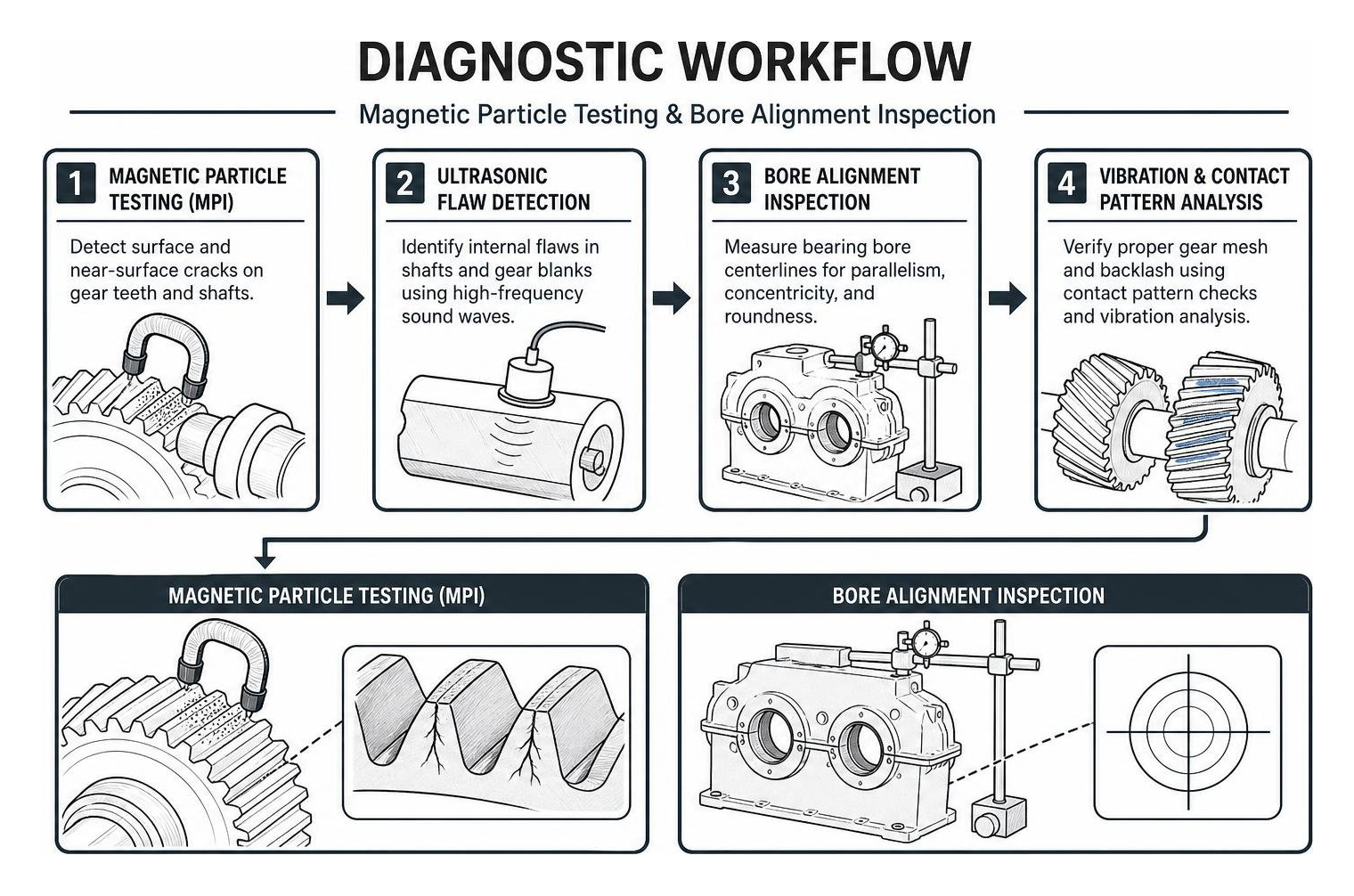
- Non-Destructive Testing (NDT): We use wet fluorescent magnetic particle inspection (MPI) and dye penetrant testing across all gear teeth, root fillets, and high-stress shaft transitions to locate microscopic fatigue cracks invisible to the naked eye.
- Ultrasonic Flaw Detection: High-frequency sound waves evaluate internal shafting and forged gear blanks to confirm that subsurface inclusions or structural voids will not cause sudden shear under load.
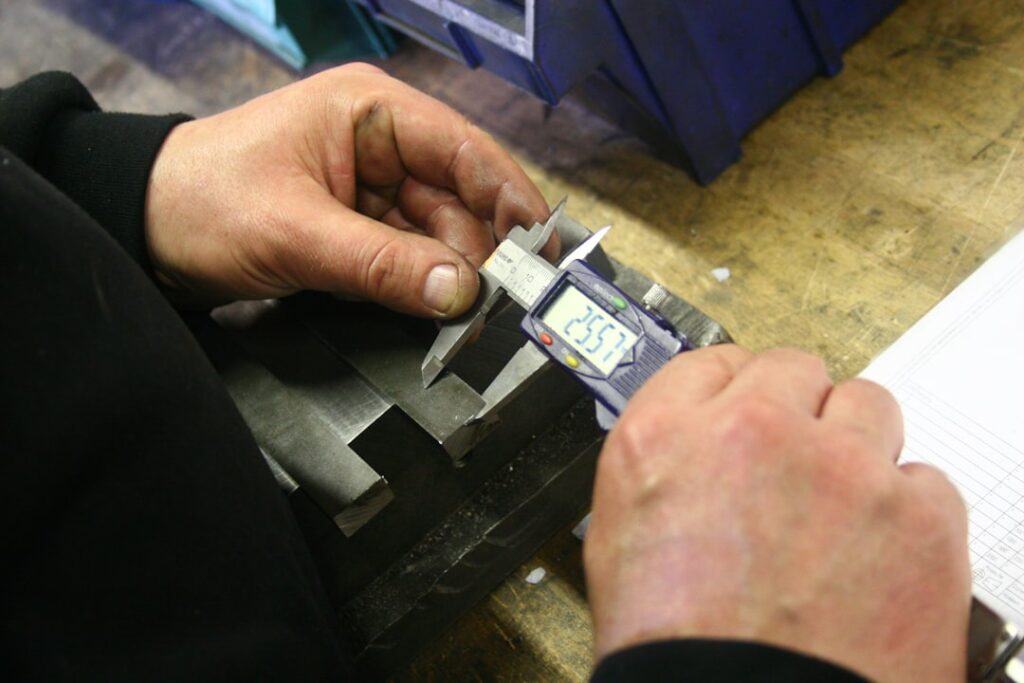
- Bore Alignment and Housing Metrology: Laser measurement systems and precision coordinate measuring tools map out bearing bore centerlines to verify parallelism, concentricity, and roundness.
- Vibration and Contact Pattern Analysis: Static and dynamic backlash checks verify proper tooth contact across the entire face width using engineer’s blue compound.
Overcoming Supply Chain Delays with Precision Machining
Original Equipment Manufacturers (OEMs) often quote lead times of 16 to 36 weeks for replacement gear sets, shafts, or complete speed reducers. For plants losing thousands of dollars every hour of unplanned downtime, waiting on overseas supply chains is unacceptable.
We solve this issue through comprehensive in-house reverse engineering and Custom Gear Manufacturing. By taking high-precision coordinate measurements of damaged gearing—even if parts are fractured—our engineers determine exact tooth profiles, module sizing, pressure angles, and helix configurations.
Using multi-axis CNC gear hobbing, shaping, and precision grinding machinery, we manufacture custom spur, helical, double helical, bevel, and worm gearing in-house. We source certified alloy steels such as 4140, 4340, and 8620, applying carburizing, induction hardening, or through-hardening heat treatments to deliver gears that meet or exceed original OEM load ratings without long lead-time delays.
Proven Strategies to Overcome Industrial Gear Repair Bottlenecks
Restoring a multi-ton industrial speed reducer under emergency conditions requires streamlined internal processes. From the moment equipment leaves your facility in Alabama, Mississippi, or South Carolina to its final testing phase, every handling step must be coordinated.
To prevent recurring shutdown crises, plant leadership can implement the processes outlined in How to Never Worry About 48-Hour Gearbox Emergency Again.
In-House Rebuilding vs Risky Field Improvisation
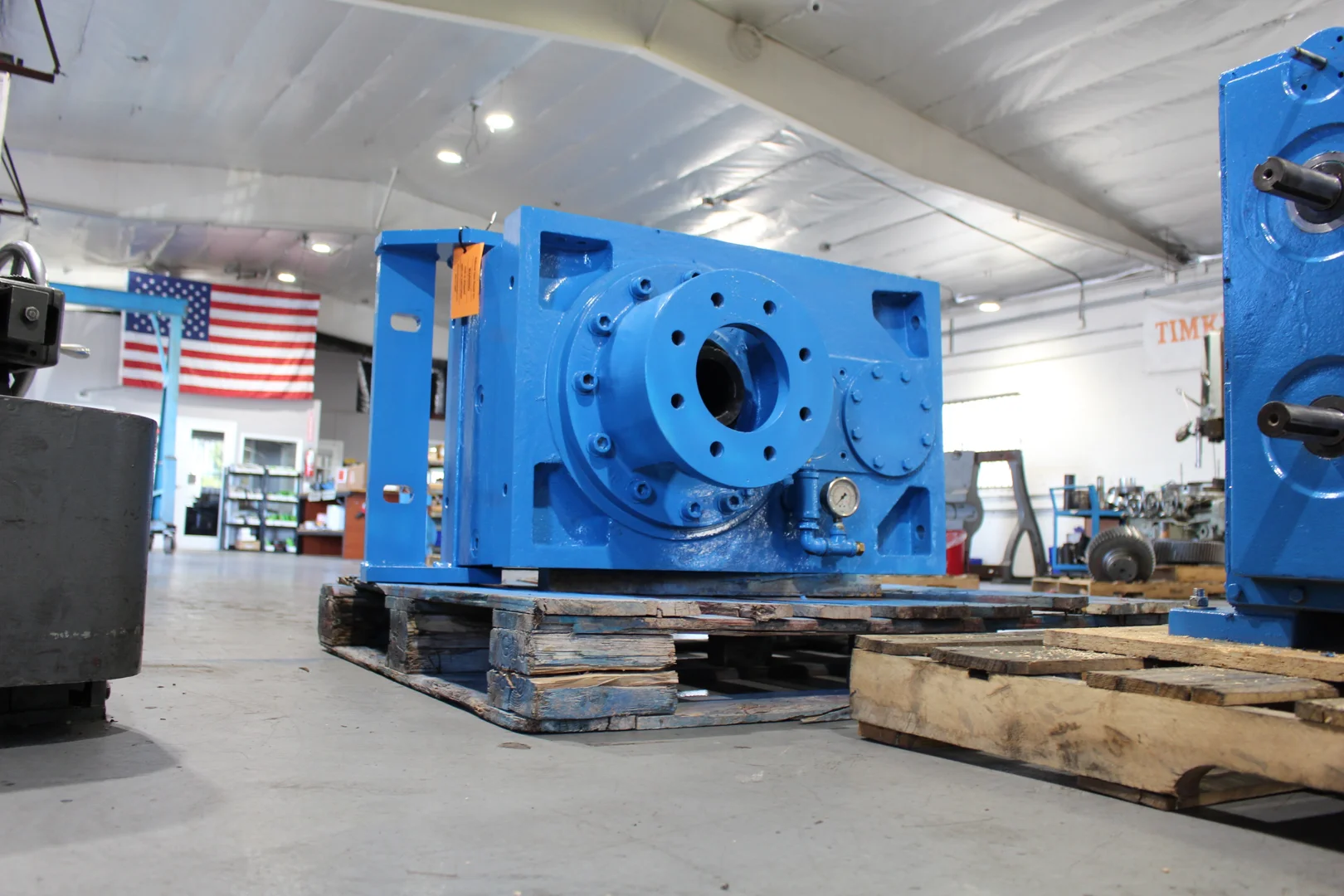
Executing repairs within a dedicated, climate-controlled facility eliminates environmental contamination and mechanical inaccuracies. When gearboxes are torn down in active plant areas, airborne grit, moisture, and chemical vapors settle on open bearing races and freshly cleaned gears, leading to rapid abrasive wear after startup.
At our Florida facility, all work follows controlled technical protocols:
- Heavy Machining and Line Boring: Worn or distorted bearing bores are restored directly on large-capacity horizontal boring mills, installing precision interference sleeves to re-establish true factory centerlines.
- Shaft Straightening and Grinding: Deflected or scored shaft journals are brought back to concentricity using cylindrical grinders and dynamic balancing equipment.
- Clean-Room Assembly: Sub-assemblies are built in clean environments to ensure zero particulate contamination enters sealed bearing cavities.
- Full-Speed Spin Testing: Rebuilt units undergo spin testing on full-speed test stands. Technicians monitor bearing temperatures, verify smooth tooth mesh acoustics, measure shaft runout, and record baseline vibration spectrum data across all operating frequencies.
Key Criteria for Selecting an Emergency Gear Repair Provider
Selecting the right partner for emergency gear rebuilding protects your facility from recurring failures, unexpected costs, and prolonged shutdowns. When evaluating a service provider, verify the following core capabilities:
- True In-House Capabilities: Ensure the shop handles heavy line boring, CNC gear cutting, shaft machining, and assembly under one roof without relying on third-party machine shops.
- Expedited Logistics Support: Free pickup and delivery coordination with dedicated heavy freight transport minimizes transit downtime across regional corridors.
- Comprehensive Engineering Documentation: Look for complete teardown and inspection reports detailing failure root causes, metallurgical data, and post-repair test logs. You can submit details directly through our Gearbox Repair Form.
- Comprehensive Warranty Coverage: Industrial rebuilds should be backed by a strong operational guarantee, such as our 24-month warranty coverage on all fully rebuilt industrial gear units.
Frequently Asked Questions About Emergency Gear Repair
Which industrial gearbox types and applications qualify for emergency gear repair?
We service large-scale industrial drive units across all major manufacturing, extraction, and processing sectors. This includes single-stage and multi-stage parallel helical gearboxes, bevel-helical speed reducers, worm drives, heavy planetary gearboxes, continuous-duty conveyor drives, kiln drives, and extruder gearboxes built to AGMA standards, all rebuilt with rapid in-house capabilities.
How quickly can a catastrophic industrial gearbox failure be restored?
For critical emergency breakdowns, our shop utilizes rapid 24-to-48 hour turnarounds. We prioritize expedited transit, run multi-shift in-house machining schedules, and perform rapid reverse engineering to cut replacement gearing, true up bearing bores, assemble, and test the gearbox for fast dispatch back to your facility.
Can damaged gears be rebuilt instead of purchased new to reduce downtime?
Yes. In many cases, damaged industrial gears can be restored through precision gear tooth reprofiling, journal grinding, or complete in-house re-manufacturing. Rebuilding an existing drive system typically yields up to 60% savings compared to purchasing a brand-new gearbox, while cutting lead times from months down to days.
Conclusion
When a heavy drive fails, your facility cannot afford weeks of waiting or unverified field patches that compromise production safety. Specialty Gear Drives delivers rapid response, expedited logistics, and fast shop turnaround for industrial plants across Florida, Georgia, South Carolina, Alabama, Mississippi, and Louisiana. All repair, gear cutting, and line boring work is completed in-house at our Largo, Florida facility, providing up to 60% savings compared to the cost of purchasing new units, accompanied by free pickup and delivery and a 24-month warranty.
For rapid assistance with an offline drive system, submit your technical specifications through our industrial gearbox repair portal or contact our engineering team to schedule urgent transport today.