What Is a Cooling Tower Drive in Alabama and Why Does It Matter?
Cooling tower drive Alabama facilities depend on is the mechanical system that spins the fan inside a cooling tower, controlling airflow across the heat exchange media to reject heat from chillers, process equipment, and HVAC systems. If that drive fails, cooling stops. And in Alabama’s industrial corridor, from the pulp and paper mills in the Black Belt to the petrochemical operations along the Gulf Coast, that means production stops too.
Here is a quick breakdown of what you need to know:
- What it does: Transfers power from a motor to the cooling tower fan, controlling fan speed and airflow
- Main types: Gearbox (right-angle gear reducer), belt drive (V-belt), and direct drive (permanent magnet motor)
- Why it fails: Oil starvation, misalignment, bearing wear, moisture ingress, and vibration in humid Gulf Coast environments
- Who needs this: Facility managers, plant engineers, and maintenance teams at industrial sites running water-cooled systems
- Key decision: Repair/rebuild the existing drive, retrofit to a modern direct drive system, or full replacement
Alabama’s climate makes this topic especially relevant. High humidity, heavy summer heat loads, and the corrosive air near coastal and river-basin facilities accelerate wear on drive components faster than in drier regions. A cooling tower gearbox that might last years in a controlled environment can degrade much faster here without the right maintenance intervals and monitoring.
This guide breaks down every part of the cooling tower drive picture: how the technology works, how the main drive types compare, where modern direct drive motors change the math on energy and maintenance, and how to make a sound repair-versus-replace decision for your specific facility.
Understanding the Cooling Tower Drive Alabama Facilities Rely On
An industrial cooling tower drive system must handle massive torque and high inertia to keep large fan blades spinning reliably under heavy load. The mechanical drive must maintain a precise fan speed to achieve the target thermal efficiency in the tower. If the drive fails to deliver the correct torque rating, the heat transfer process stalls, forcing upstream equipment like chillers or steam condensers to work harder or shut down completely.

In Alabama, where heavy industries like pulp and paper mills, chemical plants, and municipal utilities operate around the clock, these drives are subjected to non-stop mechanical stress. Our team regularly sees how the humid, chemically aggressive environment of a paper mill or petrochemical plant speeds up the destruction of internal components. When a drive begins to slip, leak, or vibrate, plant managers must act quickly to schedule professional Industrial Gearbox Repair to avoid catastrophic secondary damage.
Key Components of a Cooling Tower Drive Alabama System
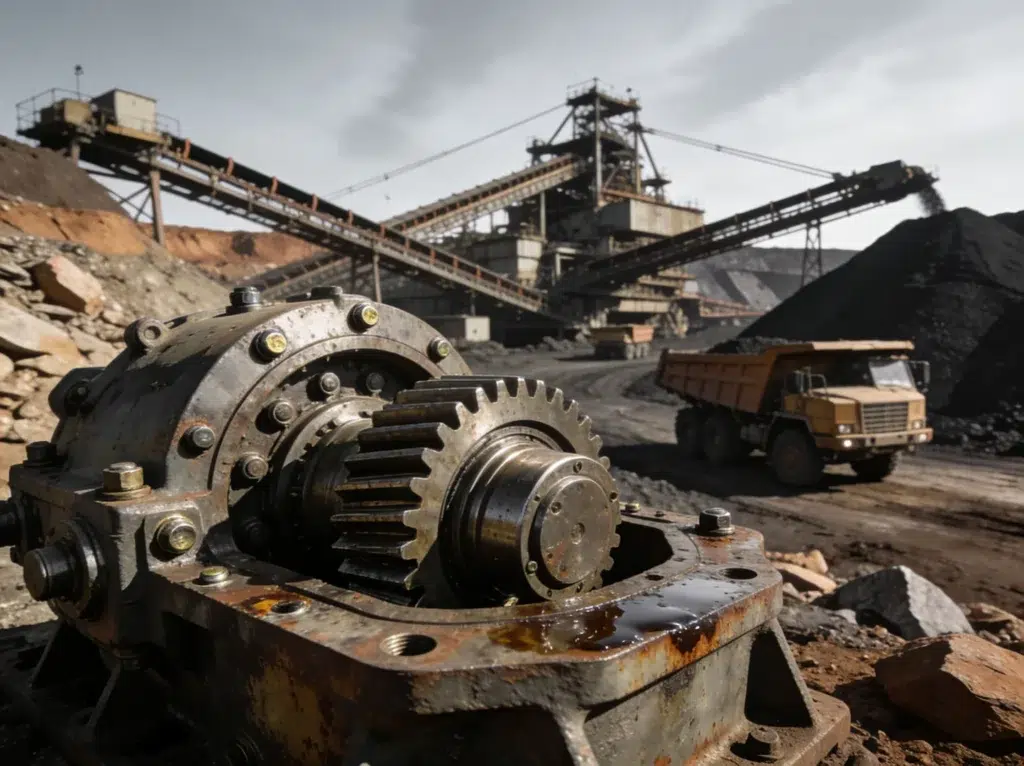
A standard right-angle cooling tower drive relies on a precise gear ratio to reduce the high-speed rotation of the input motor down to the slow, high-torque rotation required by the fan hub. The primary mechanical parts include:
- The Speed Reducer: Typically a right-angle gearbox utilizing spiral bevel or helical gears to redirect and step down the motor speed.
- The Input Shaft: Receives power directly from the motor, often located outside the wet air stream of the tower.
- The Drive Shaft: Connects the motor to the input shaft of the gear reducer, running horizontally across the deck of the tower.
- Disc Couplings: Flexible elements at each end of the drive shaft that absorb minor misalignment and damp vibration.
- The Output Shaft: The heavy-duty vertical shaft that holds and rotates the massive fan hub.
Each of these parts must remain perfectly aligned. A tiny fraction of an inch of misalignment between the drive shaft and the input shaft will destroy the input shaft bearings and ruin the gear teeth in a matter of weeks.
Why Drive Reliability Matters for Alabama Industrial Operations
The combinations of high humidity and intense heat loads in the Deep South place extreme operational stress on industrial cooling tower drives. When ambient temperatures climb during a typical Southern summer, your cooling towers must run at maximum capacity to reject heat. If a drive system goes offline during a peak production run, the entire plant can become cooling-limited, forcing a costly reduction in output or an unscheduled shutdown.
Unplanned downtime in a chemical refinery or a paper mill can cost thousands of dollars per hour. Beyond the lost production, mechanical failures in the wet air stream of a cooling tower can lead to structural damage or environmental contamination if gearbox oil leaks into the process water. Utilizing rapid Emergency Gearbox Repair: How to Never Worry About It Again is the best way to restore operations when a critical speed reducer fails unexpectedly.
Comparing Gearbox, Belt, and Direct Drive Technologies
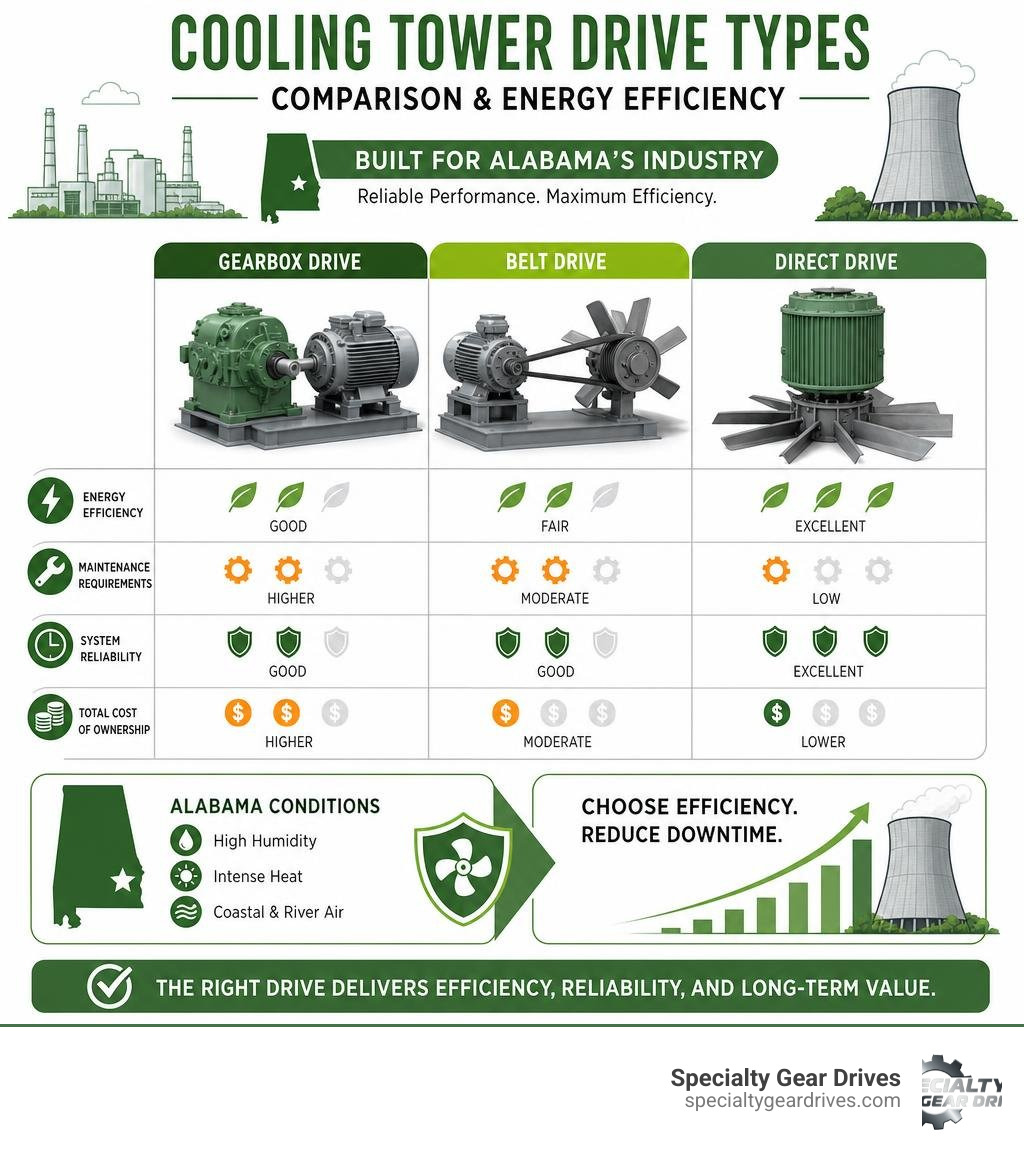
Cooling tower fan drives generally fall into three categories: traditional gearboxes, belt drives, and modern direct drive permanent magnet motors. Each technology has distinct characteristics regarding mechanical efficiency, maintenance costs, noise reduction, and initial capital investment.
| Feature | Right-Angle Gearbox | Belt Drive System | Direct Drive PM Motor |
|---|---|---|---|
| Mechanical Efficiency | 94% to 97% | 90% to 94% (drops with wear) | 98%+ |
| Maintenance Requirements | Oil changes, shaft alignment, seal replacement | Belt tensioning, belt replacement, bearing greasing | Annual bearing lubrication only |
| Primary Failure Modes | Oil leaks, bearing wear, gear tooth breakage | Belt slippage, belt breakage, pulley wear | Bearing wear (rare) |
| Noise Levels | Moderate to High (82+ dBA) | Low to Moderate | Very Low (under 75 dBA) |
| Vibration Risk | High (due to shafts and couplings) | Moderate | Minimal |
| Best Suited For | High-horsepower, heavy industrial towers | Small to medium commercial HVAC towers | High-efficiency, low-maintenance retrofits |
Managing mechanical wear across these systems requires a proactive approach. Implementing How Gearbox Condition Monitoring Saves Your Machinery and Your Sanity helps operators track vibration and temperature anomalies before a failure occurs, regardless of which drive technology is installed.
Traditional Gearbox and Belt Drive Systems
Traditional right-angle gear reducers are the workhorses of heavy industrial cooling towers, while V-belt drive systems dominate smaller commercial HVAC installations. Gearboxes are highly durable and can handle massive horsepower, but they require regular oil changes, shaft realignments, and seal inspections to prevent catastrophic bearing wear. The wet, corrosive air inside the tower deck is a constant threat, often finding its way past input shaft seals and contaminating the lubricating oil with water.
Belt drive systems are cheaper to install initially, but they suffer from belt slippage and rapid wear in humid conditions. As belts stretch and wear, their mechanical efficiency drops, leading to higher power bills and reduced airflow. They also require frequent maintenance shutdowns to adjust tension or replace worn belts and pulleys, making them less suitable for critical, continuous industrial processes.
Modern Direct Drive Permanent Magnet Motors
Direct drive technology replaces the entire mechanical train—including the gearbox, drive shaft, couplings, and V-belts—with a single, low-speed, high-torque permanent magnet motor coupled directly to the fan hub. This gearless reliability eliminates the most common failure points in the system. The motor is controlled by a matched variable speed drive, allowing it to run at optimal efficiency across a wide range of operating conditions.
These motors are built with high-pole permanent magnet rotor designs, allowing them to deliver massive torque at slow speeds without needing a gear reduction system. With IP66 protection ratings, these motors are completely sealed against moisture ingress and corrosive chemicals. Maintenance is reduced to a simple annual lubrication of the motor bearings, completely eliminating the need for oil changes, belt tensioning, or driveshaft alignment.
Energy Efficiency and Water Conservation in Alabama Cooling Systems
Upgrading to variable speed control and modern drive systems directly reduces both power consumption and water usage in cooling tower operations. Because cooling towers are designed to handle the absolute worst-case summer heat and humidity, they are oversized for the rest of the year. Running fans at full speed when the ambient temperature is mild wastes massive amounts of electricity and accelerates water evaporation.

Maximizing Cycles of Concentration and Water Savings
Increasing the cycles of concentration in your cooling tower is the most effective way to reduce make-up water demand and blowdown volume. Many industrial systems operate at two to four cycles of concentration, but with proper water chemistry monitoring and drive control, six or more cycles are achievable.
According to federal water management data, increasing cycles of concentration from three to six reduces cooling tower make-up water by 20% and slashes cooling tower blowdown by 50%. By maintaining precise control over fan speed and water temperature, operators can stabilize water chemistry, minimize scale potential, and achieve significant environmental compliance benefits.
Variable Speed Control and Power Reduction
Operating a cooling tower fan with a variable frequency drive (VFD) leverages the affinity laws of fluid mechanics, where fan power consumption varies with the cube of the motor speed. Running a fan motor at 70% speed reduces the airflow to 70%, but it cuts the power draw by more than half. Running at 50% speed reduces the power consumption to approximately 12.5% of full-load power.
In the variable Southeast climate, where temperatures swing widely between day and night, VFDs allow cooling towers to run at partial load for most of the year. This variable speed control not only slashes energy bills but also reduces mechanical stress on the entire drive system, extending the life of bearings, gears, and shafts.
Overcoming Operational Challenges and Retrofit Decisions
Alabama facilities face tough choices when legacy cooling tower drives begin to fail or show signs of severe wear. Corrosion from high humidity, shaft wear, and structural degradation can make simple repairs difficult. In some high-rise or tightly packed industrial settings, replacing a complete cooling tower is incredibly complex, sometimes requiring specialized heavy-lift helicopters like the Sikorsky S-64 Sky Crane used at the Birmingham-Shuttlesworth International Airport, or complex rigging setups on tall structures like the Southern Natural Gas Company (SoNat) building in Birmingham.
Evaluating a Cooling Tower Drive Alabama Retrofit
When evaluating a cooling tower drive Alabama retrofit, facility managers must weigh the initial capital cost against the long-term return on investment (ROI). Upgrading to a direct drive permanent magnet motor requires a compatible variable frequency drive and may require minor structural modifications to the motor support beams inside the tower. However, the elimination of gearboxes, driveshafts, and oil maintenance often yields a rapid payback.
For example, a field test at Clemson University compared a traditional geared system to a direct drive permanent magnet solution on identical cooling towers. The direct drive system reduced system losses by approximately 50%, provided a measured input power savings of 11.8%, and reduced high-speed fan noise from 82.3 dBA down to 74.4 dBA. Similarly, industrial installations globally have documented up to 35% annual energy savings after making the switch.
Rebuilding vs. Replacing Your Cooling Tower Gearbox
For many heavy industrial plants, rebuilding the existing right-angle gearbox is the most cost-effective and fastest way to restore operations. A professional gearbox rebuild can save up to 60% compared to the cost of purchasing a brand-new replacement unit, while delivering the same reliability and warranty protection. During a rebuild, worn gear teeth can be replaced, housings can be machined, and damaged shafts can be restored to original factory tolerances.
When a shaft is severely worn or grooved by failed seals, specialized repair techniques are required to restore the component without the high cost of custom fabrication. Understanding Why Shaft Repair Services Can Help You Today and utilizing The Art of the Weld: How to Build Up and Repair Worn Shafts allows skilled technicians to build up worn areas with high-quality weld overlays and machine them back to precise dimensions, saving your plant weeks of lead time.
Frequently Asked Questions About Cooling Tower Drives
How often do cooling tower gearboxes require maintenance?
Cooling tower gearboxes require oil level checks and visual inspections for leaks weekly, with oil analysis and vibration monitoring performed quarterly. Complete oil changes should occur at least once per year or after 2,500 hours of operation, whichever comes first. In highly humid climates like Alabama, more frequent oil analysis is recommended to detect water contamination before it destroys the gears and bearings.
What are the primary causes of cooling tower drive failure?
The primary causes of cooling tower drive failure are moisture contamination of the lubricating oil, shaft misalignment, and bearing fatigue. The wet, corrosive environment inside the tower deck constantly tries to bypass shaft seals. Once water mixes with the gear oil, the lubricating film breaks down, leading to rapid gear tooth pitting, excessive heat generation, and eventual bearing seizure.
Can a traditional gearbox system be retrofitted with a direct drive motor?
Yes, most traditional right-angle gearbox systems can be retrofitted with a low-speed direct drive permanent magnet motor. The retrofit involves removing the old motor, driveshaft, and gearbox, and mounting the new direct drive motor directly onto the existing structural support beams. A matched variable frequency drive must be installed in the electrical room to control the permanent magnet motor, as these motors cannot run directly across the line.
Conclusion
A reliable cooling tower drive is essential for maintaining production efficiency and preventing costly downtime in Alabama’s demanding industrial sector. Whether you choose to maintain and rebuild your traditional right-angle gearboxes or transition to modern direct drive technology, proactive maintenance and rapid repair support are your best defenses against unplanned shutdowns.
Specialty Gear Drives is your trusted partner for heavy industrial gearbox repair and rebuilding across the Southeast, including Florida, Georgia, Alabama, South Carolina, Mississippi, and Louisiana. We understand the high stakes of plant downtime, which is why we offer 24-to-48-hour emergency service, free pickup and delivery, and up to 60% savings compared to the cost of buying new. All of our rebuilds are backed by a comprehensive 24-month warranty to give your team total peace of mind.
When your cooling tower drive or industrial speed reducer shows signs of wear, contact us for expert Industrial Gearbox Repair to get your operations back up and running quickly.