10 Reasons Why You Will Love Top Mining Companies in the US
Why Mining Companies in the United States Matter
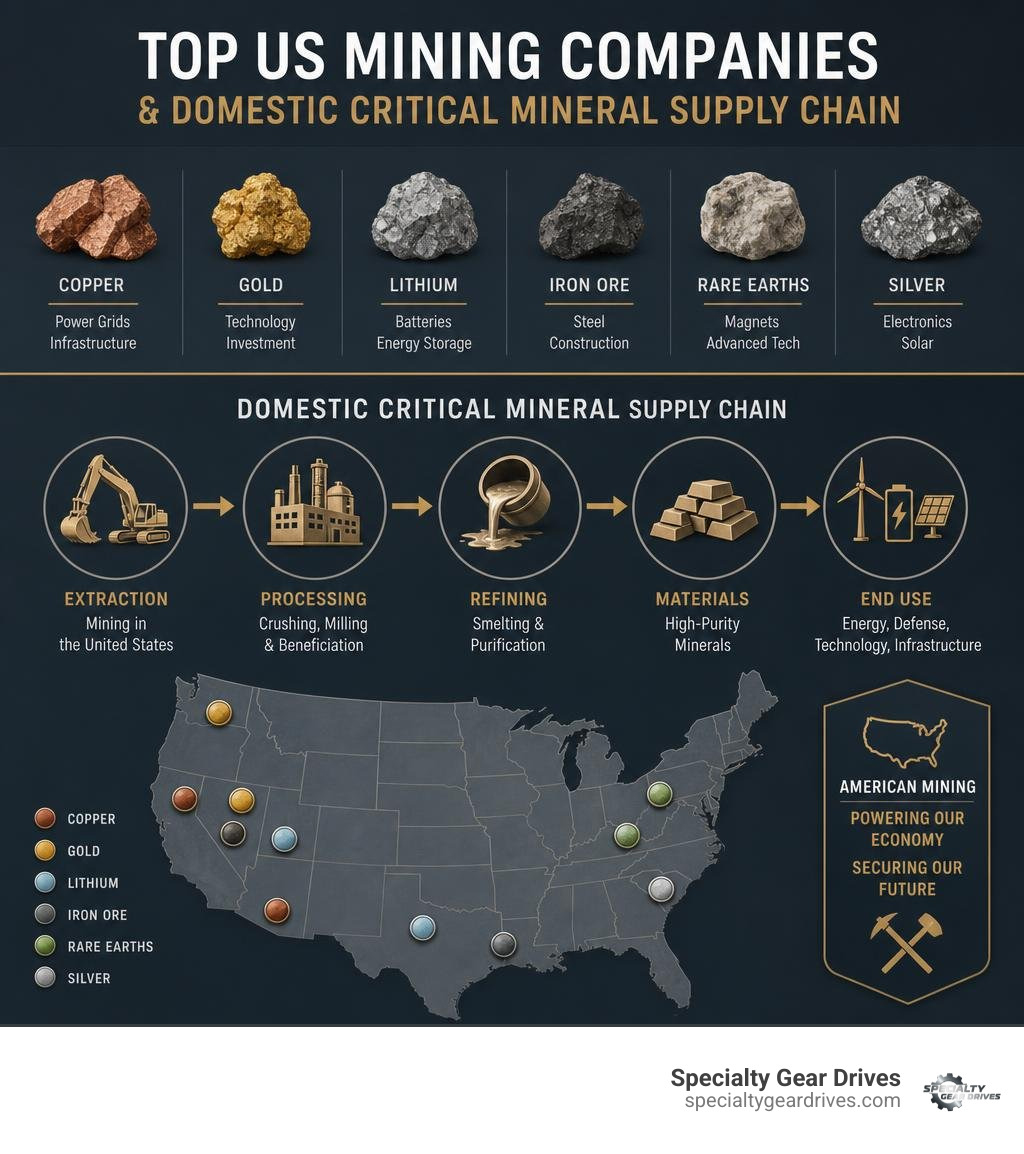
The largest mining companies in the United States include Freeport-McMoRan, Southern Copper, Newmont, Albemarle, Cleveland-Cliffs, MP Materials, Hecla Mining, and other major producers of copper, gold, lithium, iron ore, rare earths, and silver. Their mines and processing plants supply materials needed for power grids, buildings, defense equipment, batteries, wind turbines, and solar projects.
US mining contributes about $82.3 billion to GDP and supports more than 500,000 direct and indirect jobs. The sector is also shifting toward critical minerals: USGS projects lithium demand could rise by as much as 500% by 2050. That puts new focus on domestic extraction, refining capacity, and reliable mineral-processing equipment.
For plant teams, this growth makes uptime a practical concern. Crushers, mills, conveyors, and hoists depend on heavy-duty gear reducers, speed reducers, and helical, bevel, and worm gearboxes to move ore without interruption.
I am Peter Clark, owner of Specialty Gear Drives, and I work with heavy-industry teams that rely on industrial drive systems. Our experience supporting mining companies in the United States includes in-house gearbox repair, reverse engineering, and manufacturing for mining equipment, conveyors, cement plants, marine systems, wind turbines, and heavy manufacturing lines.
10 Reasons Behind the Excellence of Mining Companies in the United States
The American mining sector operates at massive industrial scale, balancing resource extraction with modern engineering, high-efficiency mineral processing, and stringent environmental certifications.
| Company | Primary Commodities | Operational Footprint | Key Asset Highlights |
|---|---|---|---|
| Freeport-McMoRan | Copper, Gold, Molybdenum | North America, South America, Indonesia | Major open-pit copper operations in Arizona and New Mexico |
| Southern Copper | Copper, Molybdenum, Zinc, Silver | Americas | Massive integrated open-pit mines, smelters, and refineries |
| Newmont Corporation | Gold, Copper, Silver, Zinc | Global | World’s largest gold producer with extensive domestic joint ventures |
| Albemarle Corporation | Lithium, Specialty Chemicals | Global | Domestic lithium brine operations and advanced chemical processing |
| Cleveland-Cliffs | Iron Ore, Pellets, Direct Reduced Iron | North America | Great Lakes iron ore mining and steel supply chain integration |
| MP Materials | Rare Earth Elements (Neodymium, Praseodymium) | California | Mountain Pass open-pit mine supplying materials for magnets and defense |
| Hecla Mining | Silver, Lead, Zinc, Gold | Alaska, Idaho, Montana | Largest domestic silver producer; major operations in Greens Creek and Lucky Friday |
| Americas Gold and Silver | Silver, Antimony, Copper, Zinc | Idaho | Galena Complex, Crescent Mine; premier domestic antimony producer |
1. Economic Scale and Market Power of Mining Companies in the United States
Market capitalization across the top 10 domestic extraction corporations exceeds $206 billion, demonstrating the financial foundation underpinning domestic resources. Market leaders like Freeport-McMoRan generate roughly $22 billion in annual revenue, while gold majors like Newmont produce around $12 billion annually. These companies maintain thousands of high-wage industrial jobs that power regional equipment suppliers, mechanical machine shops, and specialized heavy engineering services.
Industrial extraction assets require expansive regional logistical networks. Heavy mineral production in the Arizona copper basins and gold mining corridors in Nevada demands around-the-clock supply continuity. Moving hundreds of thousands of tons of ore daily relies on high-torque mechanical equipment running continuously under extreme shock loads.
2. Critical Mineral Security Driven by Mining Companies in the United States
According to projections by the US Geological Survey, domestic demand for battery-grade lithium could increase by 500% by 2050. American producers are scaling up exploration and refining projects to supply raw materials for battery storage, electric transport, and defense hardware.
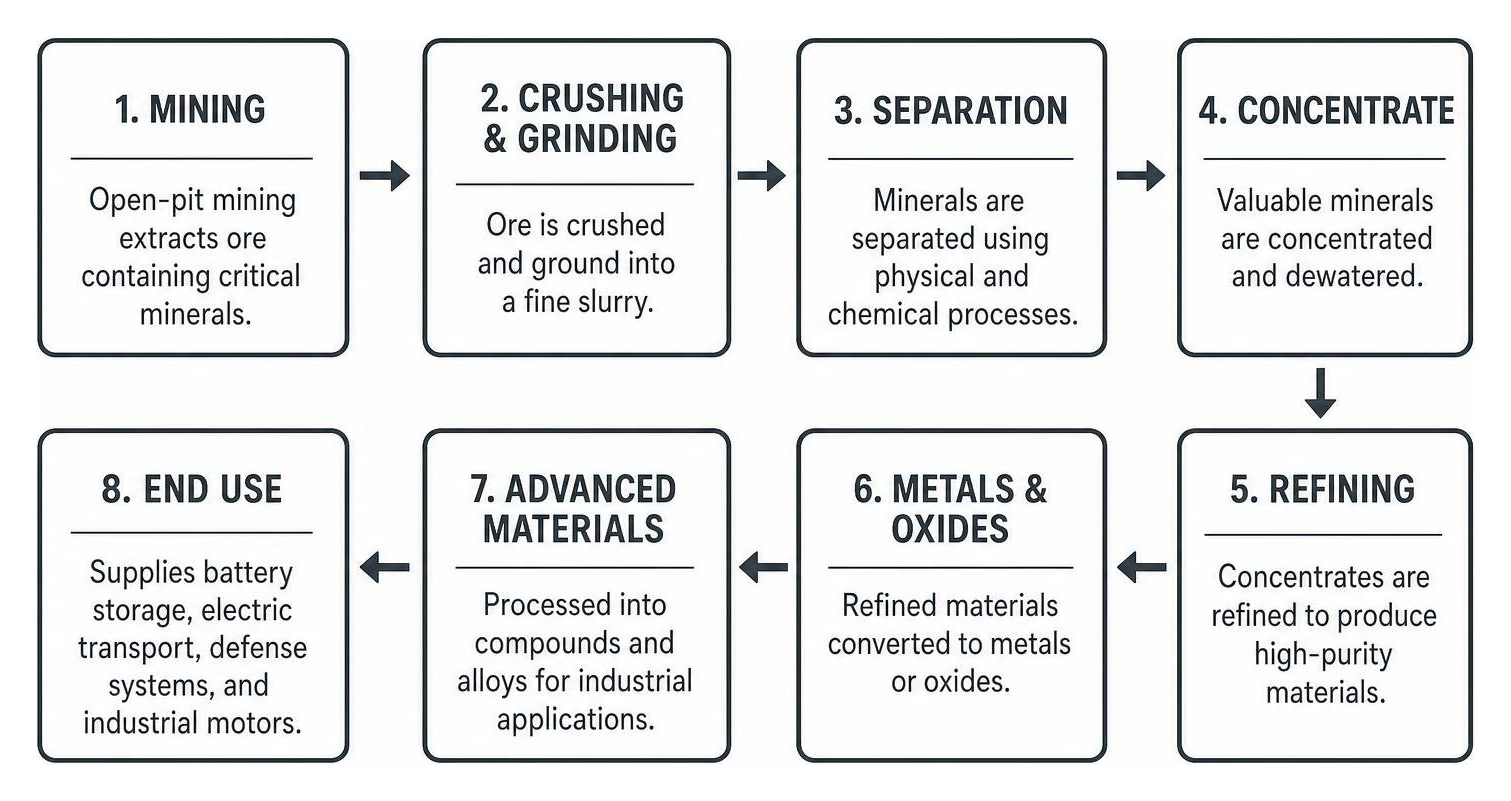
Domestic mining companies reduce reliance on foreign supply monopolies. At sites like the Mountain Pass open pit, specialized operators extract and refine critical rare earths, including neodymium and praseodymium. These elements are essential for high-strength permanent magnets, advanced wind turbine generators, guidance systems, and industrial electric motors.
3. Rapid Domestic Antimony and Strategic By-Product Extraction
Strategic security depends on by-product extraction. A clear example is the Galena Complex in Idaho’s Silver Valley, which has produced more than 240 million ounces of silver and 20 million pounds of antimony over five decades. Historical processing often treated antimony as a smelter penalty element, but recent hydrometallurgical innovations achieved an antimony recovery efficiency exceeding 99%.
By forming a 51/49 joint venture with United States Antimony Corporation, Americas Gold and Silver established an integrated domestic supply chain to extract, refine, and monetize antimony. This metal is critical for military munitions, flame-retardant industrial coatings, and grid storage technologies. Simultaneously, base-metal copper refining yields tellurium—a byproduct essential for thin-film photovoltaic solar cell manufacturing.
4. Pioneering Decarbonization and Renewable Energy Integration
Domestic extraction operators are reducing operational emissions by modernizing their power generation infrastructure. The historic Bingham Canyon operation outside Salt Lake City, which has produced copper, gold, silver, and molybdenum since 1903, demonstrates this transition.
- Solar Power Generation: Commissioned 30 megawatts of combined on-site solar installations consisting of over 83,000 panels.
- Emissions Mitigation: Reduces Scope 2 emissions by roughly 6%, eliminating 20,000 tonnes of carbon dioxide equivalent per year.
- Thermal Cogeneration: Deploys combined heat and power (CHP) systems at mineral refineries to supply up to half of their electrical needs.
- Fleet Electrification: Introduces battery-electric underground hauling units to eliminate diesel emissions in confined shafts.
- Base Load Transition: Retired on-site coal power generation in 2019, cutting the facility’s carbon footprint by more than 65% (over 1 million tonnes of CO2e annually).
5. Multi-Billion Dollar Deep Underground Mine Modernization
As open-pit deposits mature, major operators are investing in deep underground extraction. The Resolution Copper project in Arizona represents a multi-billion-dollar development extending underground workings nearly 7,000 feet below the surface.

Modernization relies heavily on mechanization. At the Galena Complex, transitioning from traditional cut-and-fill mining to narrow-vein long hole stoping lowered extraction costs by 60% per ton while maintaining dilution control. Upgraded hoisting systems doubled skipping throughput from 40 to 80 tons per hour, proving that targeted capital upgrades maximize ore delivery to the processing mill.
6. Rigorous Third-Party Environmental and Social Governance Assurance
American mining companies adhere to rigorous environmental and social standards. Independent auditing frameworks, such as the Copper Mark and Molybdenum Mark, evaluate operating sites against 32 criteria covering emissions, water conservation, community engagement, and labor rights.
These programs translate into tangible conservation efforts. Over two decades, operators around the Great Salt Lake restored more than 10,000 acres of historic industrial ground, creating a 3,670-acre shorebird reserve that hosts roughly 120,000 birds annually across 200 species. Operators also protect local waterways through substantial long-term water donations to preserve saline wetland ecosystems.
7. Circular Mineral Refining and Secondary Resource Recovery
Advanced smelting and refining assets allow industrial operations to capture high-value elements that would otherwise be lost in waste tailings.
During copper electro-refining, heavy anode slimes settle at the bottom of the electrolytic cells. These slimes are processed to recover tellurium, selenium, gold, and silver. Domestic tellurium is converted into semiconductor components for utility-scale solar panels, creating a circular loop where copper byproducts generate clean energy for ongoing extraction. Recovered molybdenum strengthens structural steel alloys for heavy transport machinery and wind turbine towers.
8. Long-Term Community Stewardship and Tribal Partnerships
Modern resource developers prioritize long-term local partnerships. The Resolution Copper project established a $54 million perpetual Tribal Trust endowment supporting eleven regional Tribal Nations across Arizona and New Mexico, funding educational initiatives, language preservation, and workforce training.
Local economic integration extends beyond philanthropy:
- Procurement: Allocating more than 35% of ongoing project budgets directly to local vendors and contractors.
- Water Reclamation: Treating deep underground mine water to deliver over 8 billion gallons of clean, recycled water to regional agricultural irrigation districts since 2009.
- STEM Development: Awarding academic scholarships and funding technical trades education for rural communities.
9. Precious Metals Dominance and High-Grade Silver Reserves
The US maintains massive precious metals output, with companies like Hecla Mining producing more than 40% of all domestic silver from operations like Greens Creek in Alaska and Lucky Friday in Idaho. Together with Coeur Mining, these producers yield primary silver, lead, and zinc essential for electronics, industrial brazing alloys, and monetary reserves.
The restart of historical assets, including the Crescent Mine in Idaho’s prolific Silver Valley, adds 1.4 to 1.6 million ounces of annual silver production. High-grade vein systems provide mineral assets that protect industrial supply chains against commodity volatility and inflation.
10. Advanced Infrastructure and Processing Synergies
Maximizing production efficiency requires sharing regional mill capacity across adjacent mining assets. Consolidating processing infrastructure eliminates the need to construct duplicate surface facilities, reducing both capital expenditures and environmental footprints.
The Galena Complex processes ore through a 750-ton-per-day flotation mill while maintaining the nearby 500-ton-per-day Coeur concentrator on care-and-maintenance for future expansion. Integrating ore feeds from nearby satellite deposits into centralized processing hubs ensures that large mineral processing facilities operate at peak capacity.
Heavy Drive Reliability in US Mineral Processing Infrastructure
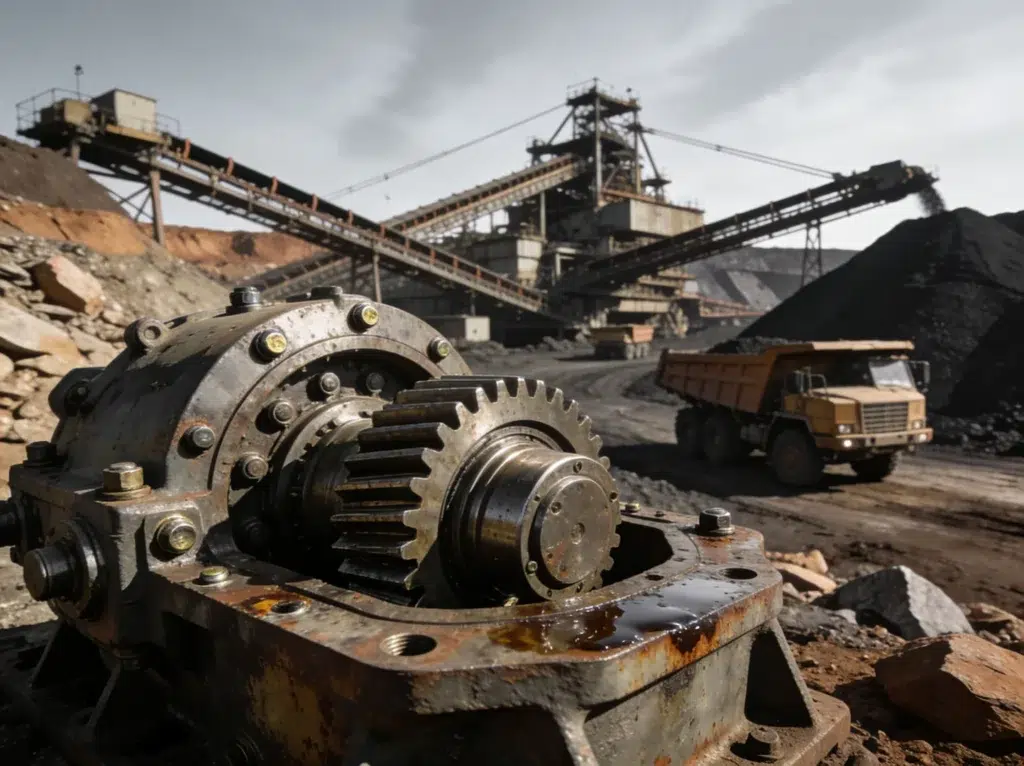
Processing raw ore into concentrated slurry, refined cake, or finished metal places severe mechanical demands on industrial drive systems. Autogenous grinding mills, ball mills, rod mills, primary gyratory crushers, and overland belt systems operate under continuous shock loads, abrasive dust, and vibration.

A sudden mechanical breakdown inside a grinding circuit can halt an entire milling line, costing tens of thousands of dollars per hour in lost throughput. Ball mill pinions, ring gears, and primary speed reducers endure constant torsional deflection. When gear teeth pit, spall, or lose proper contact patterns, specialized ball mill pinion gearbox repair becomes necessary to re-establish exact tooth mesh geometry and prevent complete shaft failure.
Extreme torque demands in high-reduction processing equipment often rely on planetary arrangements. Maintaining high torque density within compact housings requires precision gear tooth grinding and bearing clearance management. When bearing seats lose tolerance, planetary gearbox repair restores internal planetary carriers, sun gears, and output shafts to original operating specifications.
Over time, continuous cyclical loading can cause heavy drive housings to warp or ovalize at the bearing bores. Restoring worn housing geometry requires precision machining. Following the complete guide to line boring housing machining ensures that bearing bores are aligned parallel to the gear centerlines, preventing localized edge loading on newly cut gear sets.
For obsolete drives or imported European and Asian machinery, replacement components can take months to arrive from original manufacturers. Engineering teams utilize custom gear manufacturing to reverse-engineer and cut helical, double-helical, spur, and bevel gears with hardened surfaces to keep plants running.
Preventing catastrophic equipment failure requires proactive asset tracking. Implementing how gearbox condition monitoring saves your machinery and your sanity gives maintenance teams real-time data on vibration spectra, oil contamination, and thermal spikes, allowing them to schedule shop rebuilds before a mechanical failure damages the gear housing.
Future Outlook for Domestic Extraction and Refining
The future of American mining focuses on deep underground expansions, automated haulage systems, and enhanced domestic processing. Projects like the Apex expansion at Bingham Canyon aim to unlock 1.5 million additional tonnes of refined copper through 2040, extending the operational lifespan of domestic assets.
Federal incentives, including clean energy manufacturing credits and critical mineral procurement mandates, are accelerating private capital investment in processing plants across the country. Overcoming smelting bottlenecks remains critical, as the nation currently operates only two primary copper smelters. Modernizing mechanical extraction equipment, rebuilding high-torque drives, and expanding smelting assets will ensure that domestic mining operations continue to power the nation’s energy grid and heavy manufacturing sectors.
Frequently Asked Questions About US Mining
Which US mining companies hold the largest market valuation?
Freeport-McMoRan ranks as the largest US-based mining company with a market capitalization approaching $60 billion, driven by its extensive copper, gold, and molybdenum assets. Southern Copper holds a comparable valuation through large-scale integrated mining and smelting operations, while Newmont Corporation represents the largest gold mining producer globally, generating roughly $12 billion in annual revenues.
How are US mining operations contributing to the clean energy transition?
Domestic producers supply raw materials required for clean energy systems. Mining companies extract lithium from continental brines and hard rock, refine tellurium for photovoltaic solar panels, produce copper for electrical distribution networks, and process rare earths for high-efficiency wind turbine generators and industrial drive motors.
What environmental standards regulate modern US mineral extraction?
American mining companies comply with federal National Environmental Policy Act (NEPA) requirements, state-level environmental protections, and voluntary international frameworks like the Copper Mark and Molybdenum Mark. These standards mandate comprehensive groundwater recycling, rigorous tailings dam management, biodiversity restoration, and verified Scope 1 and Scope 2 carbon reduction programs.
Conclusion
Mining companies in the United States provide the foundation for modern infrastructure, industrial manufacturing, and critical mineral independence. Maintaining maximum operational uptime in heavy mineral processing demands reliable drive equipment that can withstand severe loads and harsh operating environments.
When heavy drive systems show wear, Specialty Gear Drives delivers comprehensive industrial gearbox rebuilds and manufacturing. All repair and line boring work is performed in-house at our Florida facility, supporting operations across Florida, Georgia, South Carolina, Alabama, Mississippi, and Louisiana. We understand the high cost of unscheduled downtime, which is why we provide rapid response, expedited logistics, free pickup and delivery, and fast 24–48 hour emergency shop turnaround.
Every fully rebuilt unit is backed by a 24-month warranty. Whether your facility operates gear reducers, speed reducers, or helical, bevel, and worm gearboxes across conveyors, mining equipment, cement plants, marine systems, wind turbines, or heavy manufacturing lines, our team restores your mechanical equipment to original tolerances. Contact us today to schedule your next drive overhaul through our complete industrial gearbox repair services.