The Ultimate Guide to Philadelphia Gearbox Repair Services
When a Philadelphia Gearbox Goes Down, the Whole Operation Stops
Philadelphia gearbox repair is a specialized field, and if you’re here, you likely need answers fast. Here’s what you need to know upfront:
Quick Answer: How Philadelphia Gearbox Repair Works
- Teardown and inspection using magnetic particle and dye penetrant testing to find hidden damage
- Reverse engineering of worn or obsolete components using advanced metrology
- In-house gear manufacturing to replace parts with no available supply chain
- Bore restoration and reassembly to OEM clearance tolerances
- Dynamic spin testing under load before the unit ships back to your facility
These are not off-the-shelf gearboxes. Philadelphia Gear units are custom-engineered for specific applications, built to run 24/7 under continuous heavy load in places like power generation plants, municipal water treatment facilities, cement kilns, and cooling towers. When one fails, a generic repair shop won’t cut it.
The consequences are immediate. A single drive going down can halt an entire production line, and OEM replacement parts, when they’re even available, can carry lead times that stretch into months. For facilities across the Southeast, from Louisiana refineries to South Carolina paper mills, that kind of delay is simply not an option.
Specialty Gear Drives repairs and overhauls Philadelphia Gear units entirely in-house at our Florida facility, including manufacturing replacement gears up to 20 feet in diameter when original parts are obsolete or unavailable. Every rebuilt unit ships with a 24-month in-use warranty.
I’m Peter Clark, and in this guide I’ll walk you through exactly how the restoration process works, what causes these drives to fail, and how to get your unit back online as fast as possible.
Why Philadelphia Gearbox Repair Demands Specialized Engineering
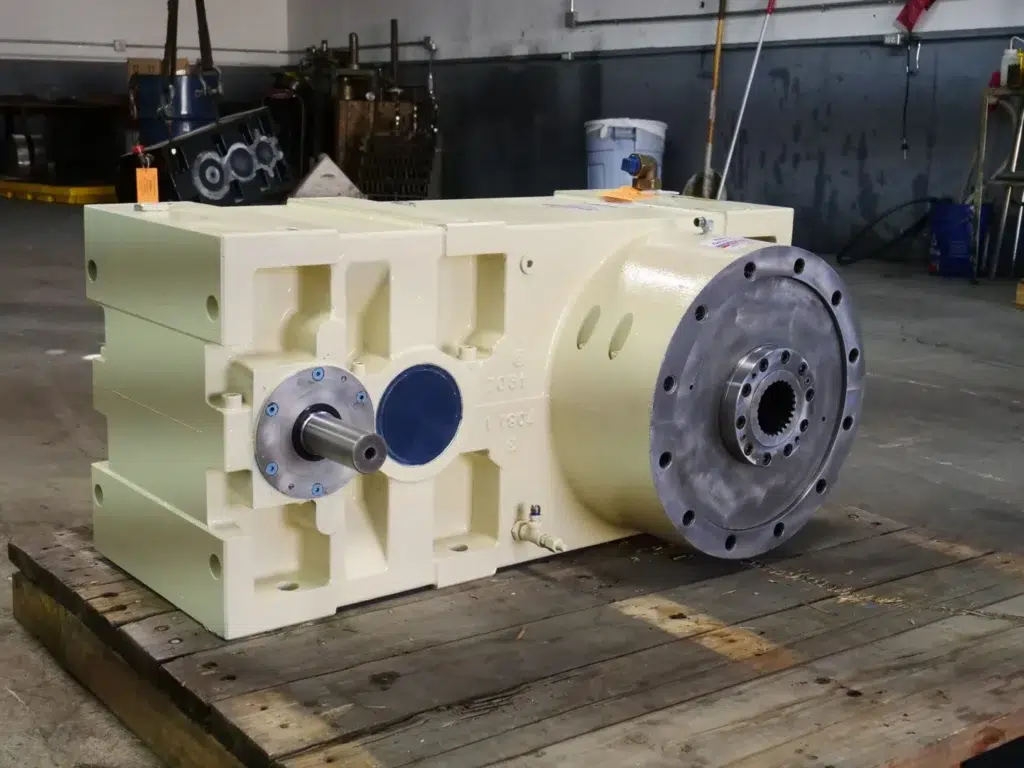
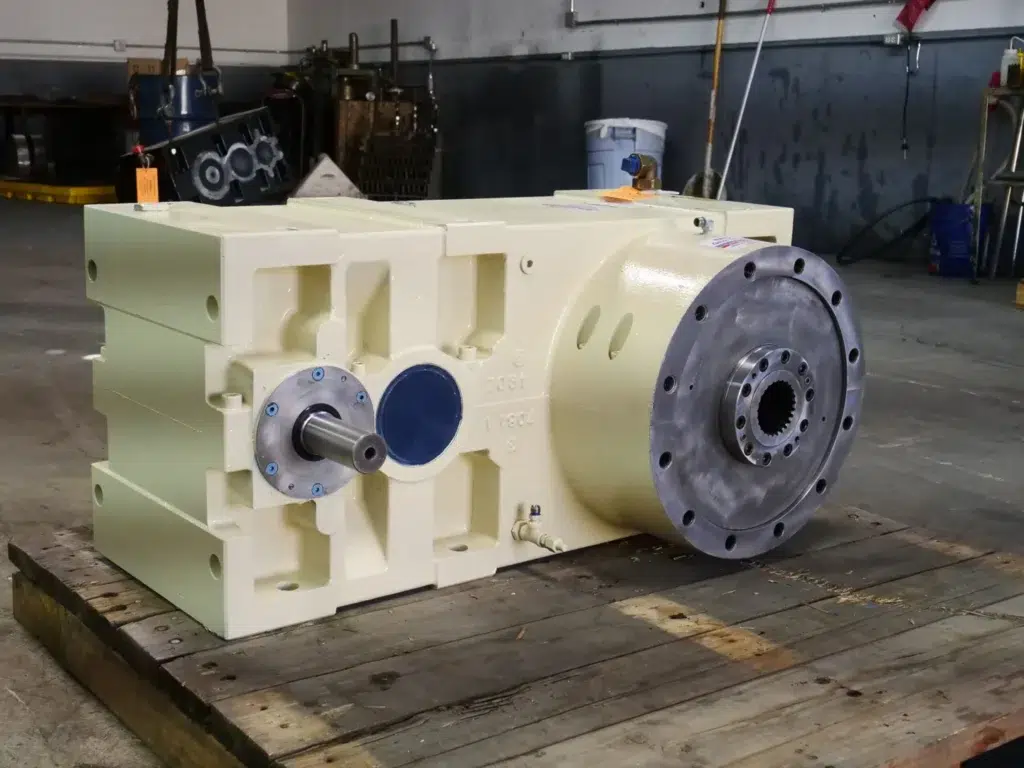
Philadelphia Gear drives dominate heavy industry because they are custom-engineered for specific, high-torque industrial drives rather than being selected from a catalog of standard reducers. For over a century, Philadelphia Gear, now part of the Timken family, has engineered enclosed gear drives with massive cast-iron or fabricated steel housings. These housings contain highly specialized gear geometries designed to withstand continuous shock loads and extreme rotational forces.

Standard repair shops often treat every gearbox like a simple speed reducer. This approach fails when dealing with a massive parallel shaft reducer driving a cement kiln, or a high-speed right-angle drive in a cooling tower. These applications feature custom-ground helical, spiral bevel, or double-helical gears with proprietary tooth profiles designed to minimize noise and maximize mechanical efficiency under load.
Attempting to repair these units without understanding their specific metallurgical properties, bearing preloads, and shaft alignments will result in rapid failure. To understand what goes into a successful rebuild, you can read our comprehensive article on Everything You Need to Know About Gearbox Repair. Precision engineering is the only way to restore these drives to their original operating specifications.
Common Failure Modes in Heavy-Duty Industrial Drives
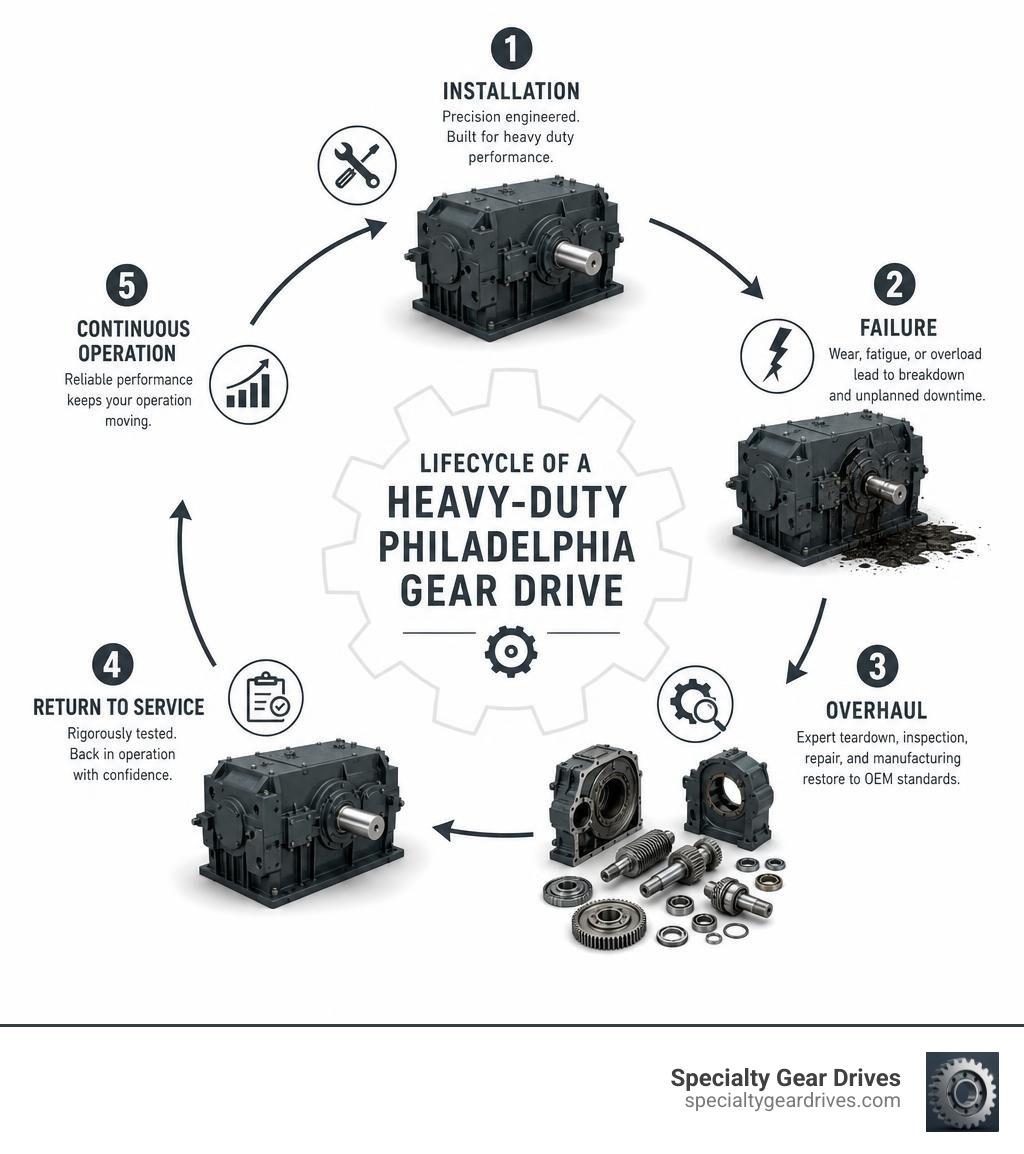
Industrial gearboxes fail in predictable ways under continuous duty cycles, but the scale of these failures is amplified in high-torque Philadelphia drives. Identifying these failure modes early prevents catastrophic housing damage and minimizes unplanned downtime.
The table below outlines the most common issues we encounter during inspections, their underlying causes, and how we correct them at our Largo, Florida facility.
| Failure Mode | Primary Cause | Corrective Action |
|---|---|---|
| Lubrication Breakdown | Thermal stress, contaminated run-in oil, blocked cooling lines | Flush system, replace bearings, restore thermal clearances |
| Gear Tooth Pitting | Metal fatigue, continuous high torque transfer | Reverse engineer and manufacture new gears in-house |
| Spalling | Advanced fatigue, micro-cracks spreading across tooth face | Cut replacement gears, restore exact gear geometry |
| Housing Deflection | Structural stress, shaft misalignment | Line-bore housings, reset internal clearances to OEM spec |
To avoid making critical errors when a failure occurs, review our guide on Emergency Gearbox Repair Florida – 5 Common Mistakes You Can’t Afford to Make.
Lubrication Breakdown and Thermal Stress
Lubrication failure is the leading cause of premature bearing and gear failure in high-speed drives. When oil quality degrades or cooling lines become restricted, the operating temperature inside the housing rises rapidly.
This thermal stress causes thermal expansion of the shafts and gears, reducing internal clearances below design limits. Without a sufficient oil film, metal-to-metal contact occurs, leading to rapid heat generation and eventual bearing seizure.
Gear Tooth Pitting and Spalling
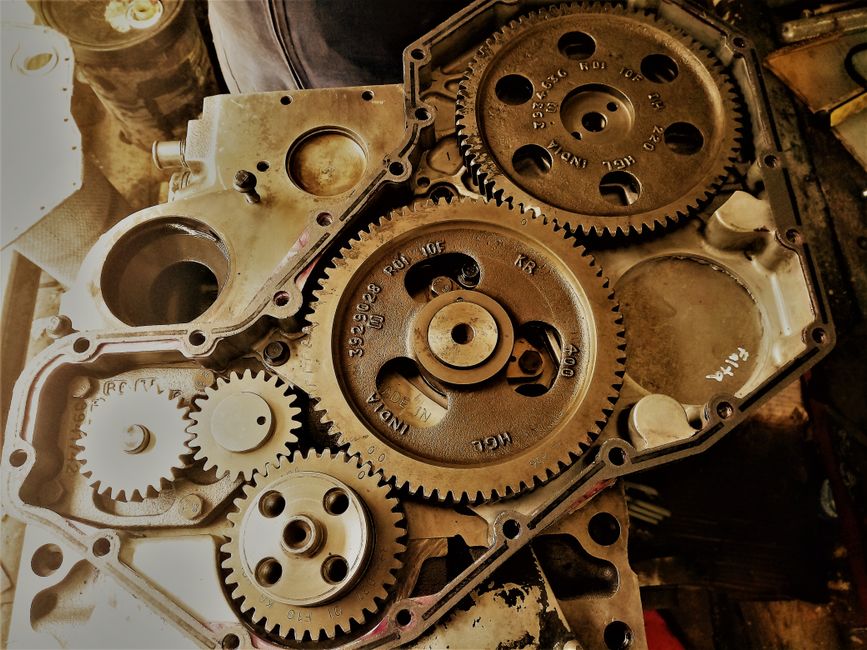
Years of massive torque transfer cause metal fatigue along the pitch line of the gear teeth. This fatigue manifests first as micro-cracks on the tooth surface.
As these micro-cracks grow under continuous cyclic loading, small chunks of metal flake off, a process known as pitting. Left unchecked, pitting progresses to spalling, where large sections of the tooth face break away. This distributes destructive metal debris throughout the oil reservoir, damaging bearings and adjacent gears.
Housing Deflection and Shaft Misalignment
Heavy shock loads can cause the gearbox housing to deflect, permanently altering the alignment of the shafts. Even a fraction of a millimeter of misalignment changes the contact pattern of the gear teeth, concentrating all the load on a small portion of the tooth face.
To correct this, we line-bore housings in our shop to restore parallel alignment. This process allows us to reset internal clearances to exact OEM tolerances and ensures even load distribution across the entire face width of the gears.
The Step-by-Step Restoration and Overhaul Process
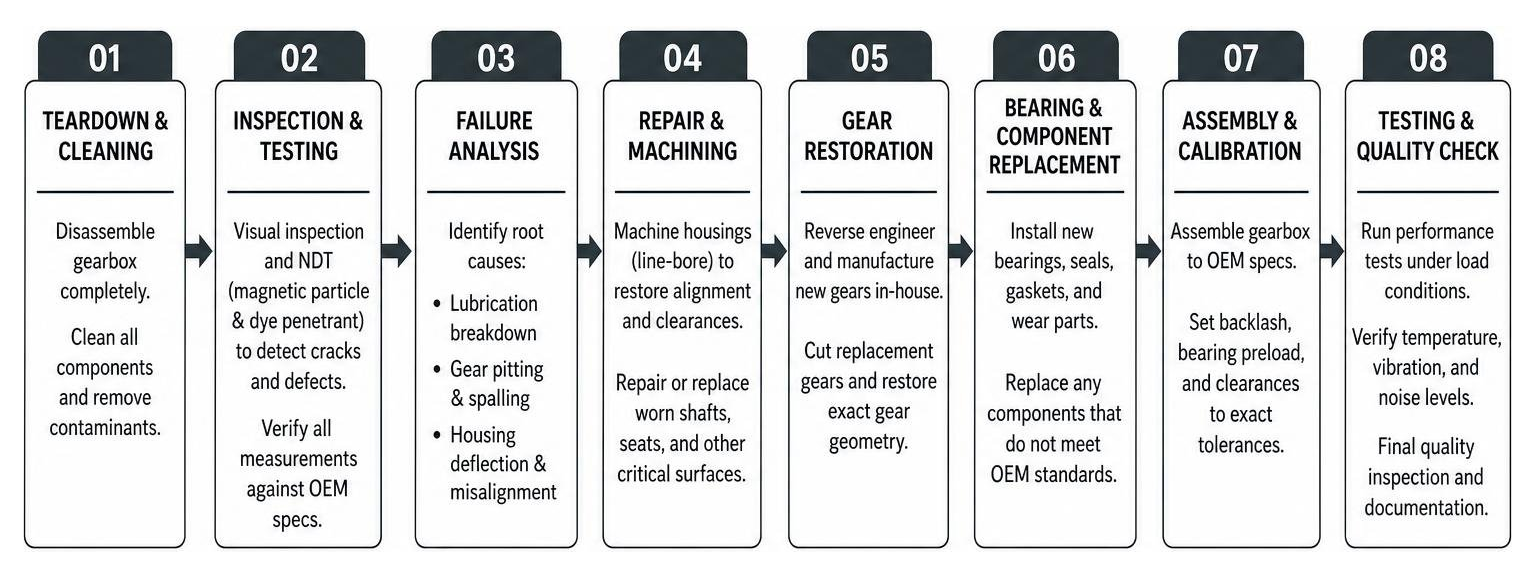
Restoring a heavy-duty Philadelphia Gear drive requires a structured, highly technical approach. We perform every step of this process in-house at our Florida facility to maintain strict quality control.
Non-Destructive Teardown and Inspection
Every rebuild begins with a complete teardown of the unit. We perform a visual inspection of all components, followed by a thorough cleaning to remove all residual oil and debris.
We use non-destructive testing, including magnetic particle testing and dye penetrant testing, to locate hidden micro-fractures in the shafts and gear teeth. Our technicians then perform a complete dimensional analysis to compare shaft journals, housing bores, and gear profiles against original manufacturing specifications.
Precision Reverse Engineering and In-House Manufacturing
When a Philadelphia Gear unit is several decades old, finding replacement parts from the OEM is often impossible or comes with a lead time of several months. We solve this problem through precision reverse engineering.
Using advanced metrology tools, we map the exact gear geometry of the worn components. Our in-house gear manufacturing department can cut precision helical, spur, and bevel gears up to 20 feet in diameter. We match or exceed the original metallurgical specifications, ensuring the new parts are tougher than the originals. Learn more about our specialized Industrial Gearbox Repair capabilities.
The Critical Steps in Philadelphia Gearbox Repair
Restoring the housing is just as critical as manufacturing the gears. We perform in-house bore restoration to correct any ovality or wear in the bearing bores, ensuring the outer races of the new bearings are held securely.
Once the housing is restored, we assemble the unit with new bearings and seals, setting the shaft alignment and gear backlash to precise tolerances. For detailed insights into our process for this specific brand, visit our dedicated Philadelphia Gearbox Repair page.
Dynamic Spin Testing and Quality Assurance
Before any gearbox leaves our shop, it undergoes rigorous quality assurance testing. We fill the unit with run-in oil and run it on our test stand to monitor its performance.
During this dynamic spin testing, we use specialized sensors to track vibration levels, acoustic signatures, and operating temperatures across all bearing points. This testing ensures that the gearbox is fully sealed, properly aligned, and ready to return to continuous service.
Minimizing Downtime with Rapid Turnaround and Logistics
In heavy industry, every hour of unplanned downtime represents lost production and revenue. We structure our entire operation to minimize this disruption for facilities throughout the Southeast.

Bypassing Supply Chain Delays with In-House Gear Cutting
Waiting for OEM replacement parts is often the longest part of a rebuild project. By maintaining complete in-house gear cutting and manufacturing capabilities, we eliminate this waiting period entirely.
We do not rely on external machine shops or overseas supply chains to source gears. Whether your unit requires a small pinion or a massive gear up to 20 feet in diameter, we can manufacture it directly on our shop floor, cutting lead times from months to days.
Choosing a Partner for Philadelphia Gearbox Repair in the Southeast
We provide specialized repair services for industrial facilities located in Florida, Georgia, Alabama, South Carolina, Mississippi, and Louisiana. All repair and manufacturing work is performed at our state-of-the-art facility in Largo, Florida.
To make the process as simple as possible, we provide free regional pickup and delivery of your heavy gearboxes. Our team will pick up your damaged unit, transport it to our shop, and return it fully restored. To get started, you can access our A Comprehensive Guide to Trusted Gearbox Repair Florida or fill out our online Repair Form to request a pickup.
Frequently Asked Questions About Industrial Gearbox Overhauls
How long does a typical industrial gearbox rebuild take?
A standard rebuild typically takes one to two weeks, depending on the extent of the damage and whether we need to manufacture new gears. For critical failures, we offer expedited rapid shop turnaround, working around the clock to complete the overhaul in a matter of days.
Can obsolete gear components be manufactured without original drawings?
Yes. We use advanced coordinate measuring machines and metrology tools to reverse engineer the exact gear geometry of your worn or broken parts. We can recreate the original tooth profiles, backlash clearances, and shaft fits without needing the original OEM engineering drawings.
What is the cost difference between repairing and replacing a heavy-duty drive?
Rebuilding a heavy-duty Philadelphia gearbox typically yields savings of up to 60% compared to purchasing a brand-new replacement unit. Additionally, rebuilding bypasses the long lead times associated with ordering new industrial drives, saving your facility from weeks of lost production.
Conclusion
A Philadelphia Gear drive is a major capital investment, and maintaining it requires specialized engineering expertise. At Specialty Gear Drives, we have the tools, experience, and in-house manufacturing capabilities to rebuild these complex units to match or exceed original OEM standards.
Every repair we perform at our Largo, Florida facility is backed by our 24-month in-use warranty, giving you confidence in the long-term reliability of your equipment. If you are facing an unplanned shutdown or want to schedule preventative maintenance on a critical drive, Contact Us today to speak with an application engineer. For more information on our specific capabilities for these heavy-duty units, please visit our Philadelphia Gearbox Repair page.