How to Never Worry About 48 Hour Gearbox Emergency Again
When a Gearbox Fails, You Have Hours, Not Days, to Act
A 48 hour gearbox emergency is exactly what it sounds like: a critical drive system goes down, your production line stops, and you have a hard window of roughly two days to either restore the equipment or face compounding losses that ripple across your entire operation.
If you’re dealing with one right now, here’s what matters most:
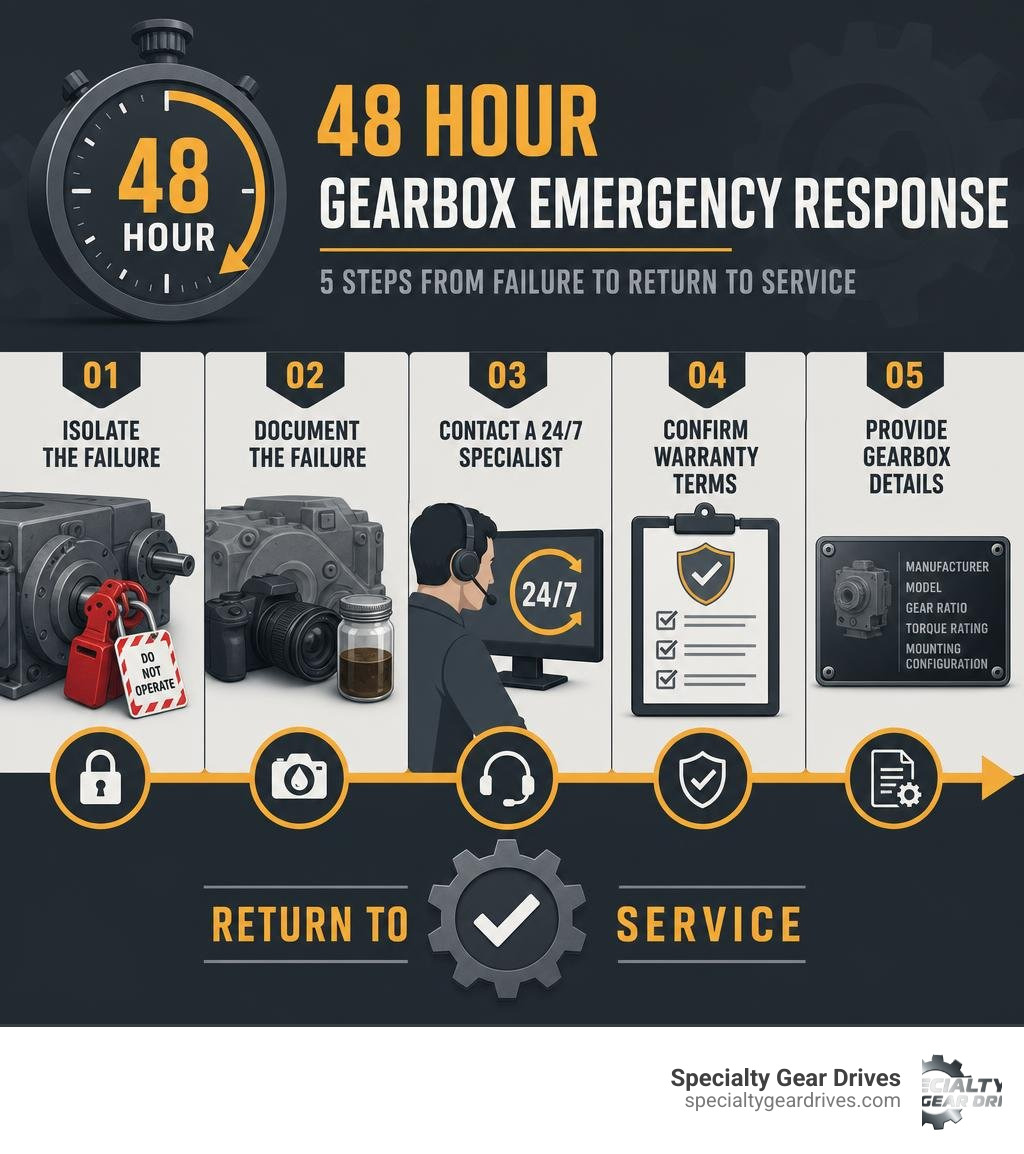
- Isolate the failed unit immediately using lock-out tag-out procedures to prevent secondary damage.
- Document the failure with photos and fluid samples before any disassembly begins.
- Contact a specialist with 24/7 emergency capability who can perform teardown inspection, source or machine replacement components, and return the unit to OEM specifications within 48 hours.
- Confirm the repair shop’s warranty terms before authorizing work, a reputable provider should cover parts and labor for at least 24 months.
- Have your gearbox nameplate data ready (manufacturer, model, gear ratio, torque rating, mounting configuration) to avoid delays in parts identification.
A single failed reducer on a conveyor line, a ball mill, or a plastics extruder can idle an entire shift. In industries like mining, pulp and paper, and oil and gas, that kind of unplanned downtime doesn’t just cost money in lost output. It triggers penalty clauses, delays downstream processes, and puts maintenance teams under enormous pressure to make fast decisions that carry real risk.
The difference between a two-day recovery and a two-week one almost always comes down to one thing: whether you had the right repair partner lined up before the failure happened.
What Triggers a 48 Hour Gearbox Emergency in Heavy Industry?
Mechanical failures in heavy-duty speed reducers rarely happen without warning, but when the final breakdown occurs, it often feels instantaneous. Understanding the physical mechanisms behind these failures helps plant operators identify warning signs before a catastrophic shutdown forces an emergency response.
Gear Tooth Wear and Fatigue
Gear teeth endure immense contact stress during normal operation. Over time, repetitive loading cycles cause micro-cracks to form beneath the surface of the tooth flanks. This leads to progressive pitting, where small chunks of metal flake away from the active tooth profile. If left unaddressed, pitting develops into spalling, which significantly reduces the load-bearing area of the tooth. Under high-torque conditions, a severely spalled tooth can shear off completely, sending metal debris through the gear mesh and causing immediate, catastrophic lockup of the entire drive system.
Bearing Failure and Shaft Displacement
Bearings maintain the precise axial and radial alignment of the shafts inside the gearbox housing. Spherical and tapered roller bearings are subject to fatigue, electrical pitting, and cage damage. When a bearing fails, the rollers lose their dimensional consistency, allowing the shaft to displace from its nominal centerline. Even a fraction of a millimeter of shaft movement alters the gear tooth contact pattern, concentrating the load on the edges of the teeth rather than distributing it evenly across the face width. This uneven loading accelerates gear wear and can break teeth within a few operating hours.
Shaft Misalignment
Misalignment between the gearbox input shaft and the prime mover, or between the output shaft and the driven equipment, introduces parasitic bending moments. These forces bend the shafts slightly during every rotation, causing cyclic fatigue. Misalignment also forces the shaft seals to run eccentrically, which quickly ruins the sealing lip and allows abrasive contaminants to enter the housing while letting vital lubricant escape.
Lubrication Breakdown
Lubricant is the lifeblood of any industrial gear drive. It forms a microscopic hydrodynamic film that prevents direct metal-to-metal contact between sliding and rolling surfaces. When the oil level drops due to a slow leak, or when the oil loses its viscosity due to running at extreme temperatures, this protective film collapses. Without lubrication, friction increases exponentially, causing rapid thermal expansion of the gears. The teeth can actually weld themselves together in a failure mode known as scuffing or galling. To prevent these mechanical issues from escalating, plant managers can implement proactive monitoring protocols, as explained in our guide on How Gearbox Condition Monitoring Saves Your Machinery and Your Sanity.
The True Cost of Unplanned Industrial Reducer Downtime
The financial impact of a failed industrial gearbox extends far beyond the invoice for the repair itself. When a primary drive system on a conveyor, extruder, or mill stops working, the entire facility suffers a cascade of operational losses.
Idle Labor and Operational Overhead
When a line goes down, the operators assigned to that production area are left without work. You still have to pay for their shifts, along with the electrical and facility overhead required to keep the rest of the plant running. If a repair takes several days instead of hours, these labor costs quickly accumulate without generating any corresponding revenue.
Missed Delivery Deadlines and Contractual Penalties
Industrial supply chains operate on tight schedules. A delay in producing a batch of plastic resins, paper rolls, or processed food can cause your customers to miss their own production windows. Many industrial contracts contain strict clauses that penalize suppliers for late deliveries. In severe cases, a prolonged shutdown can damage long-term business relationships or result in the cancellation of lucrative supply agreements.
Repair versus Replacement Costs
Many plant managers assume that buying a brand-new gearbox is the fastest and most reliable way to resolve a failure. In reality, lead times for new industrial gearboxes from original equipment manufacturers can range from several weeks to many months, especially for large, custom, or obsolete units. Opting for a rapid rebuild not only gets your equipment back online in a fraction of the time, but it also delivers substantial cost savings.
| Cost Factor | OEM Replacement Gearbox | Emergency Rebuild & Overhaul |
|---|---|---|
| Initial Purchase Cost | 100% (Full retail price) | 40% to 60% savings compared to new |
| Lead Time | 8 to 24+ weeks (depending on model) | 24 to 48 hours for emergency rush |
| Shipping & Logistics | High freight costs, long distances | Free regional pickup and delivery |
| Modifications Needed | May require piping or mounting changes | Restored exactly to existing footprint |
| Warranty Coverage | Typically 12 months from purchase | 24-month comprehensive warranty |
How to Handle a Sudden Gearbox Failure on the Factory Floor
When a gearbox suddenly stops, makes a loud grinding noise, or begins smoking, the actions taken by your maintenance team in the first thirty minutes will dictate the speed and cost of the recovery.

Rapid Isolation and Safety First
The immediate priority is to secure the area and ensure worker safety. Turn off the power to the motor driving the gearbox and perform a complete lock-out tag-out procedure. Verify that all stored energy in the system, such as tension on a conveyor belt or gravity loads on a hoist, is safely discharged before anyone approaches the machinery.
Damage Assessment and Documentation
Once the system is safe, conduct a visual inspection of the exterior of the gearbox. Look for cracked housings, broken mounting feet, displaced shafts, and large pools of oil. Take clear, high-resolution photographs of the unit from multiple angles, focusing on the shaft seals, coupling connections, and the manufacturer nameplate. This nameplate contains the model number, serial number, and gear ratio, which are vital for sourcing parts.
Gathering Critical Spare Parts
Maintaining an organized inventory of critical spare parts can save precious hours during an emergency. While you may not keep entire spare gearboxes on hand, having specific high-wear components in your warehouse allows repair technicians to work much faster. If you do not have these parts on hand, you can search for local support by reading our article on how to Don’t Grind Your Gears and Find the Best Gearbox Repairing Near Me.
- Replacement shaft seals matching the exact shaft diameters.
- High-quality input and output shaft bearings from reputable manufacturers.
- A set of shim packs for adjusting bearing endplay and gear backlash during reassembly.
- Replacement gaskets or high-strength liquid sealants rated for industrial gear oils.
- A spare set of coupling inserts or elements to replace worn components during alignment.
Steps to Take During a 48 Hour Gearbox Emergency
If your plant is facing a critical shutdown in Florida, Georgia, Alabama, South Carolina, Mississippi, or Louisiana, follow this step-by-step protocol to initiate an emergency repair.
- Perform Lock-Out Tag-Out: Ensure the drive motor is completely de-energized and locked out according to OSHA regulations.
- Collect an Oil Sample: Draw a sample of the remaining gear oil from the drain plug. If the oil is dark, smells burnt, or contains visible metal flakes, it confirms severe internal wear. Keep this sample for the repair technicians to analyze.
- Do Not Disassemble the Housing: Avoid opening the gearbox housing on the factory floor. Opening the unit in a dusty plant environment can introduce airborne contaminants that make a precision rebuild much more difficult.
- Call the Emergency Specialists: Contact us immediately to arrange for a rapid response team to handle the logistics. You can reach our dispatch team directly through our Contact Us page to initiate the pickup process.
- Prepare for Free Pickup: Clean the exterior of the unit of heavy grime so that the nameplate is clearly legible, and secure the gearbox to a heavy-duty shipping pallet.
Choosing the Right Partner for Rapid Industrial Overhauls
When you are in the middle of a 48 hour gearbox emergency, you cannot afford to send your equipment to a general machine shop that lacks specialized gear-cutting and testing capabilities. You need a partner that understands the rigorous engineering standards required for heavy-duty industrial power transmission.
Our repair facility in Largo, Florida, is fully equipped to handle every stage of the rebuilding process in-house. This independence from third-party machine shops is what allows us to deliver turnaround times of 24 to 48 hours for qualifying emergency jobs.
Reverse Engineering of Obsolete Components
One of the biggest hurdles in repairing older industrial machinery is the lack of replacement parts from the original manufacturer. Many gearboxes running in pulp mills, chemical plants, and mining operations have been in service for decades, and the original OEMs may no longer exist.
Our engineers can reverse-engineer worn or broken gears, shafts, and pinions. By taking precise measurements of the damaged parts and utilizing our extensive archive of gear blueprints, we can manufacture brand-new, high-strength replacement gears in-house. This capability eliminates the weeks of waiting typically associated with sourcing parts from overseas manufacturers.
Adherence to AGMA Standards
Every gear we manufacture and every rebuild we perform complies with the strict guidelines set by the American Gear Manufacturers Association. We ensure that gear tooth profiles, surface finishes, and heat-treatment processes meet or exceed the original design specifications. This commitment to quality ensures that your rebuilt gearbox will perform reliably under the heavy shock loads and continuous duty cycles of your plant floor.
Rigorous Load Testing
A repair is only complete when we can verify that the gearbox operates perfectly under load. After reassembling the unit with new bearings, seals, and gears, we mount it on our test stand for a multi-hour run test. We monitor shaft vibration, check for thermal spikes near the bearing carriers, and inspect the shaft seals for even the slightest hint of oil leakage. This testing process ensures that when the gearbox is returned to your facility, it is ready to go straight back to work without any break-in issues. To learn more about how we minimize transport delays and manage shipping logistics throughout the Southeast, read our article on Industrial Gearbox Repair – Don’t Let Shipping Costs Grind Your Gears.
What to Expect from a 48 Hour Gearbox Emergency Repair Service
When you trust us with your emergency repair, we follow a highly structured, expedited workflow designed to eliminate wasted time.
- Free Pickup and Transport: We dispatch a truck to your facility in Florida, Georgia, Alabama, South Carolina, Mississippi, or Louisiana to collect the failed unit at no cost to you.
- Immediate Teardown and Inspection: As soon as the gearbox arrives at our Largo facility, our technicians perform a complete teardown. We clean all components using chemical wash systems to remove old grease, oil, and debris.
- Detailed Diagnostic Report: We inspect every gear tooth, bearing race, and shaft journal. We take photos and videos of the damage and send you a detailed diagnostic report along with a firm quote for the repair.
- Custom Machining and Rebuilding: Once you approve the work scope, our machinists begin restoring the housing bores, turning new shafts, or cutting new gears on our vertical hobbing machines.
- Quality Assurance and Delivery: After successful run-testing, we apply a protective industrial coating to the exterior of the housing, secure the unit on a pallet, and transport it back to your plant.
Frequently Asked Questions About Emergency Reducer Repairs
Can an industrial gearbox be rebuilt instead of replaced?
Yes, almost any industrial gearbox can be rebuilt, regardless of its age, brand, or physical condition. Rebuilding a unit involves replacing all bearings, seals, and gaskets, re-machining worn shaft journals, and restoring the bearing bores inside the cast-iron housing through line boring. If any gears are broken or severely worn, we can manufacture exact replacements in our shop. Rebuilding your existing unit typically saves up to 60% compared to the cost of purchasing a brand-new gearbox, and it eliminates the long lead times associated with factory orders.
How does lubrication breakdown cause sudden gear failure?
Lubrication breakdown occurs when the oil inside the gearbox loses its ability to separate the moving metal components. This can be caused by oil contamination from water or dust, running the unit at temperatures above the oil’s thermal limit, or simply skipping scheduled oil changes. When the oil film thins or disappears, the resulting friction causes rapid heat generation. The gear teeth experience localized thermal expansion, which destroys the tooth geometry, increases noise and vibration, and can lead to the gears welding together and seizing the entire drive system.
What industries are most vulnerable to sudden drive system failures?
Industries that run continuous, high-torque, or highly contaminated processes are the most vulnerable to sudden gearbox failures.
- Mining and Quarrying: Ball mills, sag mills, and heavy conveyors run under extreme dust and shock-load conditions, which accelerates bearing and gear wear.
- Pulp and Paper Mills: Gearboxes operating in paper machines and pulpers are constantly exposed to high moisture, heat, and chemical washdowns, which can quickly ruin shaft seals and contaminate the lubricant.
- Plastics and Rubber Extrusion: Extruder drive systems operate under continuous high thrust and torque, making them susceptible to thrust bearing failures and gear scuffing.
- Food Processing: High-pressure washdowns can force water past standard shaft seals, leading to oil emulsification and rapid bearing corrosion.
Conclusion
A 48 hour gearbox emergency does not have to result in days of lost production and astronomical replacement costs. By partnering with a dedicated regional specialist, you can restore your critical drive systems to OEM specifications quickly and reliably.
Specialty Gear Drives specializes in the repair, rebuilding, and custom manufacturing of industrial gearboxes for heavy industries across the Southeast. From our state-of-the-art facility in Largo, Florida, we proudly serve plant operators, maintenance managers, and facilities throughout Florida, Georgia, Alabama, South Carolina, Mississippi, and Louisiana.
Our emergency service model is built around your need to minimize downtime. We provide:
- 24 to 48 hour turnaround on emergency repairs to get your lines running fast.
- Free pickup, delivery, and inspection across our entire southeastern service region.
- Up to 60% savings compared to the cost of purchasing a brand-new replacement unit.
- An industry-leading 24-month warranty on all parts and labor, ensuring your peace of mind long after the repair is complete.
If you are facing an active equipment failure or want to establish a relationship with a reliable repair partner before the next emergency strikes, visit our Industrial Gearbox Repair page to learn more about our capabilities, or contact our team today to schedule a free inspection.