When a Gearbox Fails in Florida, Every Hour Costs You
Emergency gearbox repair in Florida is available 24 hours a day, 7 days a week, with rush turnaround times as fast as 24 to 48 hours for qualifying jobs, free pickup and delivery across the state, and savings of 40% to 60% compared to buying new equipment.
Quick answers for Florida facility managers:
- Response time: 24/7 emergency service, 24-48 hour rush turnaround
- Cost vs. replacement: Repair typically saves 40-60% over new unit cost
- Pickup & delivery: Free across Florida and the continental US
- Warranty: Up to 24 months on repairs and remanufactured gears
- Brands serviced: Falk, Dodge, Flender, SEW-Eurodrive, Philadelphia Gear, Lufkin, and more
- Certifications to look for: AGMA standards compliance, ISO 9001, Timken-certified technicians
A single failed gearbox on a conveyor line, extruder, or processing mill can shut down an entire production shift. In industries like pulp and paper, food processing, mining, and oil and gas, that kind of unplanned downtime doesn’t just cost hours. It costs contracts, throughput, and sometimes equipment that wasn’t even the original problem.
The frustrating part is that most emergency situations in Florida facilities aren’t caused by sudden catastrophic failure. They’re caused by avoidable mistakes: warning signs that got ignored, a repair vendor chosen for the wrong reasons, or a post-repair shortcut that put the unit back into service before it was ready.
This guide covers the five most common and most costly mistakes plant managers and maintenance engineers make when dealing with an emergency gearbox failure, and what to do instead.
The 5 Costly Mistakes in Emergency Gearbox Repair Florida
Unplanned downtime in heavy industrial operations can quickly accumulate thousands of dollars in losses every hour. When a critical drive system fails, the pressure to restore operations often leads to hurried decisions. These rushed choices frequently result in recurring mechanical failures, extended delays, and inflated capital expenditures.
Choosing to rebuild or repair an existing industrial speed reducer is almost always the most efficient path forward. The financial comparison between rebuilding a damaged unit and purchasing a brand-new replacement from the original equipment manufacturer highlights why specialized repair is the preferred industry standard.
| Cost Factor | Professional Gearbox Rebuild | Full OEM Replacement |
|---|---|---|
| Average Initial Cost | 40% to 60% savings compared to new | 100% list price plus high freight fees |
| Typical Lead Time | 24 to 48 hours for emergency rush | 12 to 24 weeks or longer for new builds |
| Warranty Coverage | 24-month warranty on repairs and parts | 12-month standard manufacturer warranty |
| Shipping Logistics | Free pickup and delivery across Florida | Paid freight shipping from distant factories |
| Engineering Support | Reverse engineering of obsolete components | Limited support for older, discontinued models |
Understanding these baseline differences helps explain why rushing into a replacement or choosing a generalist machine shop can be a major setback. Below are the five most common mistakes made during an industrial gearbox emergency and how to prevent them from disrupting your operations.
Mistake 1: Ignoring Early Warning Signs Before Needing Emergency Gearbox Repair Florida
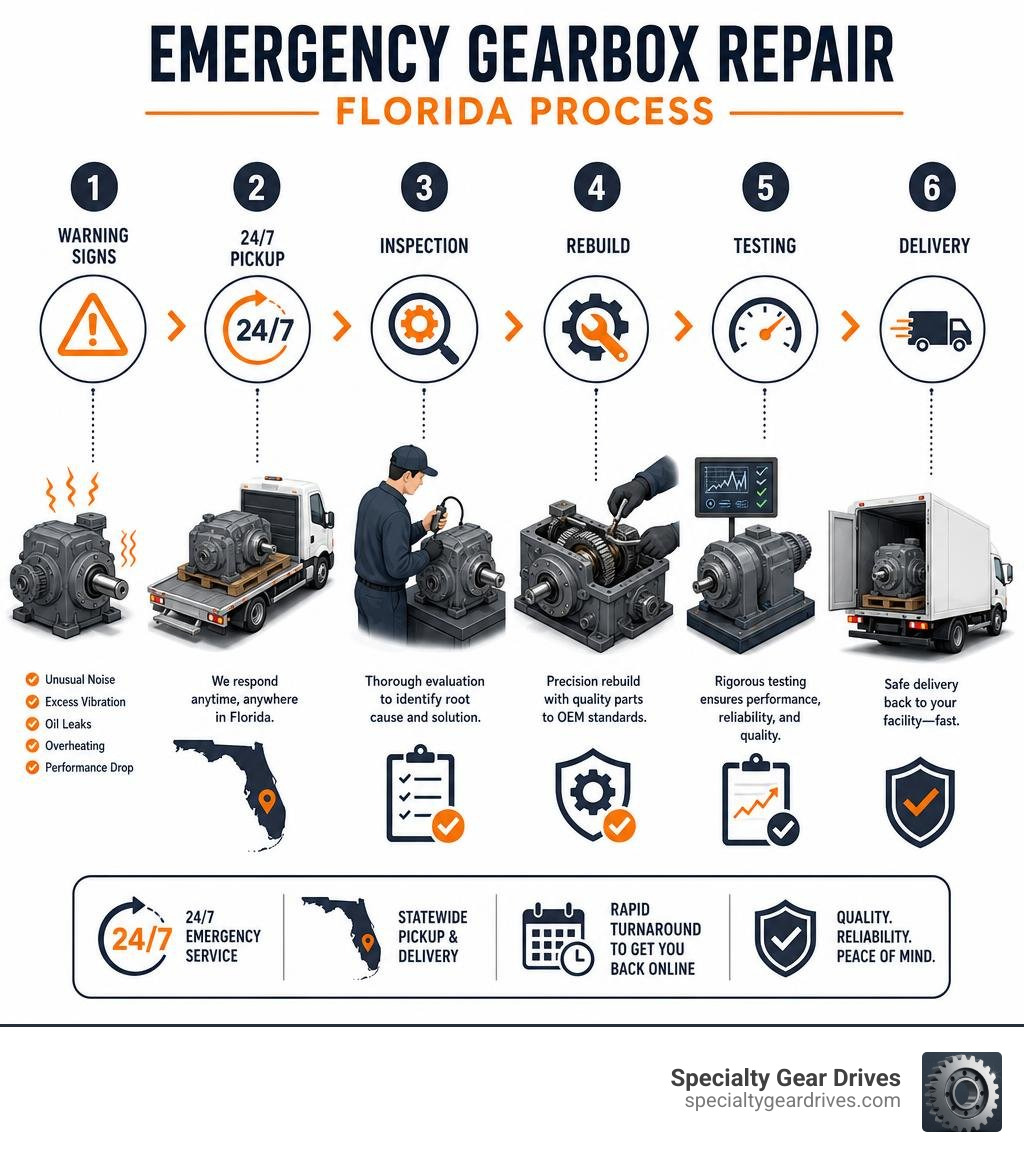
Early warning signs of industrial gearbox failure include unusual noise, excessive vibration, oil leaks, and high operating temperatures. Recognizing these signs before a hard shutdown prevents catastrophic damage to gears and shafts. When maintenance teams ignore these subtle indicators, a simple bearing swap escalates into a complete mechanical overhaul.
Abnormal noise is often the first indicator that internal components are wearing out. A high-pitched whine usually points to gear tooth wear or incorrect backlash settings, while a low-frequency rumbling indicates bearing race pitting. Utilizing vibration analysis allows technicians to identify these frequencies early, pinpointing exactly which gear set or bearing is beginning to degrade.
Overheating is another critical symptom that requires immediate attention. When internal friction increases due to lubrication breakdown or shaft misalignment, the housing temperature rises. If the paint on your gearbox housing begins to discolor, blister, or release a burnt odor, the internal oil has likely lost its viscosity. This lack of lubrication causes metal-on-metal contact, which rapidly destroys gear profiles.
Fluid leaks around shaft seals are more than just a housekeeping issue on the plant floor. A leaking seal allows vital lubrication to escape while permitting environmental contaminants like water, dust, and abrasive particulates to enter the gear housing. To understand how to implement a proactive strategy to catch these issues early, read about How Gearbox Condition Monitoring Saves Your Machinery and Your Sanity.
Mistake 2: Delaying Action and Escalating Downtime Costs
Delaying gearbox repair leads to secondary component damage, turning a simple bearing replacement into a total housing and gear rebuild. Prompt action immediately halts the propagation of internal mechanical damage. When a facility continues to run a compromised speed reducer, the internal clearances shift, causing catastrophic structural damage.
A minor defect in a single roller bearing can quickly cause the bearing cage to disintegrate. Once the cage fails, the rollers bunch up, causing the shaft to deflect under load. This shaft deflection alters the gear tooth contact patterns, leading to uneven gear tooth wear, chipped teeth, or completely sheared gear shafts. What could have been fixed in a afternoon now requires a multi-day custom gear manufacturing project.
In heavy-duty applications like pulp paper processing or phosphate mining, a delayed response can also damage the connected driven equipment. Misaligned output shafts put immense stress on couplings, electric motor bearings, and conveyor drive pulleys. Shutting down the system at the very first sign of trouble is the only way to protect your broader capital assets.

Mistake 3: Choosing a Provider Without Verifiable Certifications
A certified industrial gearbox repair provider must employ technicians trained to AGMA standards and maintain ISO 9001 quality compliance. Uncertified shops often lack the specialized tools and engineering expertise required for heavy-duty industrial reducers. Sending a high-torque industrial drive to a generalist repair shop often results in incorrect assembly tolerances and premature field failure.
Our industry relies on strict standards established by the American Gear Manufacturers Association. These standards dictate precise tolerances for gear geometry, backlash, and shaft alignment. A repair shop operating without these certifications may rely on guesswork, leading to poorly meshing gears that wear out within months of reinstallation.
Technician training is another critical differentiator. Our team features Timken-certified technicians with Falk School training, ensuring that every bearing installation and gear alignment matches original OEM specifications. When researching local service options, it helps to understand what makes a qualified partner. You can learn more by reading Don’t Grind Your Gears and Find the Best Gearbox Repairing Near Me.
Mistake 4: Assuming Obsolete Parts Require Full Replacement
Obsolete or hard-to-find industrial gearbox parts can be manufactured from scratch using reverse engineering and custom gear cutting. Facility managers do not need original OEM blueprints to get a replacement gear or shaft made. Many legacy gearboxes built decades ago are still highly durable, but the original manufacturers are no longer in business.
Specialized repair facilities utilize advanced coordinate measuring machines and reverse engineering software to recreate exact physical profiles of worn components. Whether your system uses spur, helical, bevel, or worm gears, we can manufacture replacement parts from raw steel forgings. This includes applying advanced heat treatment options like carburizing, induction hardening, and nitriding to increase wear resistance beyond the original factory specifications.
In many cases, we can even reuse your existing gears by performing a process called kiss grinding. By lightly grinding the worn gear teeth to restore their profile and manufacturing an oversized mating pinion, we can return the gear set to perfect operating condition. This approach eliminates the need to scrap an entire cast iron housing simply because a single gear is no longer stocked by the OEM.
Mistake 5: Skipping Post-Repair Load Testing and Quality Standards
Post-repair load testing involves running the rebuilt gearbox under operational stress for at least six hours to verify temperature stability and vibration levels. Skipping this validation step risks immediate infant mortality of the rebuilt unit. A simple spin test without load is insufficient to confirm that a high-torque industrial drive is ready for continuous duty.
During our mandatory six-hour test run, we monitor the gearbox using infrared thermography and vibration sensors. This testing confirms that the bearings are seated correctly, the gear contact patterns are optimal under load, and the shaft seals are holding pressure without leaking. We also verify that the internal lubrication system is circulating oil effectively to all critical contact points.
If a repair shop cannot provide documented proof of load testing, leak checks, and vibration analysis, you are essentially using your plant floor as their testing ground. A failure during re-commissioning can set your production schedule back by weeks and cause severe damage to your electric motors and driven machinery.
Step-by-Step Emergency Response Protocol for Facility Managers
When an industrial gearbox fails, the facility manager must immediately isolate the power source, document the failure conditions, and contact a qualified emergency repair partner. This structured response minimizes secondary damage and accelerates the rebuild timeline. Having a clear protocol in place prevents panic and ensures worker safety.
Immediate Actions to Take After a Gearbox Failure
The first step after a gearbox failure is lock-out, tag-out to ensure worker safety before any physical inspection begins. Once the machinery is safely isolated from all energy sources, the maintenance team should document the physical state of the unit. Take high-resolution photographs of the gearbox housing, shaft couplings, and any visible external damage.
Next, pull a sample of the gear oil from the drain plug. Inspect the oil for signs of water contamination, which often appears as a milky or foamy texture, and check for visible metal shavings or bronze particles. Save this sample for laboratory analysis, as the wear debris inside the oil provides critical clues about which internal components failed first.
Once you have secured the area and documented the initial findings, contact our team to initiate the emergency response process. Providing us with the manufacturer nameplate data, model number, and a description of the failure symptoms allows our engineering team to prepare for the incoming rebuild. To get started immediately, visit our Contact Us page.
What to Expect During the Emergency Gearbox Repair Florida Process
The emergency gearbox repair process begins with free statewide pickup and a rapid teardown inspection to identify all worn or damaged components. Technicians then clean, inspect, repair or manufacture parts, reassemble, and test the unit before delivering it back to your site. We handle all logistics to make the process as straightforward as possible for your team.
Our structured rebuild sequence ensures complete transparency and technical accuracy from start to finish:
- Free Pickup and Logistics: We dispatch a truck to your facility in Florida, Georgia, Alabama, South Carolina, Mississippi, or Louisiana to transport the damaged gearbox to our Largo facility.
- Teardown and Cleaning: The unit is completely disassembled, and all grease, oil, and contaminants are removed using industrial wash systems.
- Nondestructive Testing: We perform magnetic particle and dye penetrant testing on all shafts and gears to identify hidden micro-cracks that could lead to future failures.
- Engineering Evaluation and Quote: We generate a detailed diagnostic report with photos of the damage, along with a firm quote for the rebuild.
- Precision Rebuild and Gear Cutting: Worn shafts are repaired, housings are line-bored if needed, and new gears are cut to exact specifications.
- Reassembly and Dynamic Testing: The gearbox is reassembled with new bearings and seals, followed by our standard six-hour load test run.
- Delivery and Warranty: The fully restored unit is delivered back to your facility, backed by our comprehensive 24-month operational warranty.
By maintaining complete control over both the machining and gear manufacturing steps under one roof, we eliminate the delays associated with outsourcing parts. To learn more about our full range of capabilities, read about our Industrial Gearbox Repair services.
Frequently Asked Questions About Industrial Gearbox Rebuilds
How much can a facility save by repairing instead of replacing an industrial gearbox?
Repairing an industrial gearbox typically saves a facility between 40% and 60% compared to the cost of purchasing a brand-new replacement unit. These savings are achieved by reusing high-value components like the cast iron housing and non-damaged gears.
Additionally, choosing a rebuild eliminates the long OEM lead times that can span several months, saving your business from catastrophic downtime losses. Rebuilding also allows us to upgrade internal components, such as installing modern high-performance seals or utilizing advanced heat-treated gears, providing a finished product that often outperforms the original factory unit.
What industries in Florida rely most on emergency gearbox services?
Heavy industries in Florida such as pulp and paper, mining, food processing, power generation, and chemical manufacturing rely most heavily on emergency gearbox services. These sectors run continuous processes where any drive failure halts major production output.
In the pulp and paper mills of North Florida, massive continuous digestors and paper machines run around the clock. In Central Florida, phosphate mining operations and citrus processing plants require high-torque gear reducers to handle heavy bulk materials. Our Largo-based facility is strategically positioned to support these diverse industrial operations with rapid, heavy-duty engineering solutions.
What is the typical turnaround time for an emergency gearbox rebuild?
The typical turnaround time for an emergency industrial gearbox repair is 24 to 48 hours for qualifying jobs. Standard, non-emergency rebuilds generally take 7 to 10 business days depending on parts availability.
Because we maintain an extensive inventory of high-quality bearing brands and have in-house gear cutting capabilities, we do not have to wait for overseas parts shipments to complete a rush job. Our shop operates 24/7 during emergency situations to ensure your equipment is back online as quickly as possible.
Conclusion
Partnering with a dedicated repair specialist like Specialty Gear Drives ensures your heavy machinery is restored to OEM specifications with minimal downtime. Our Largo, Florida facility provides rapid emergency support to keep Southern industries moving. We back our craftsmanship with a comprehensive 24-month warranty on all repairs and manufactured gears, giving you complete confidence in the reliability of your machinery.
Whether you are operating a chemical plant in Louisiana, a paper mill in Georgia, or a mining facility in Florida, we are ready to manage your emergency logistics with free pickup and delivery across our entire service area. Do not let an unexpected equipment failure disrupt your production schedules. Contact us today to secure a fast, reliable rebuild for your critical industrial drive systems through our Industrial Gearbox Repair portal.