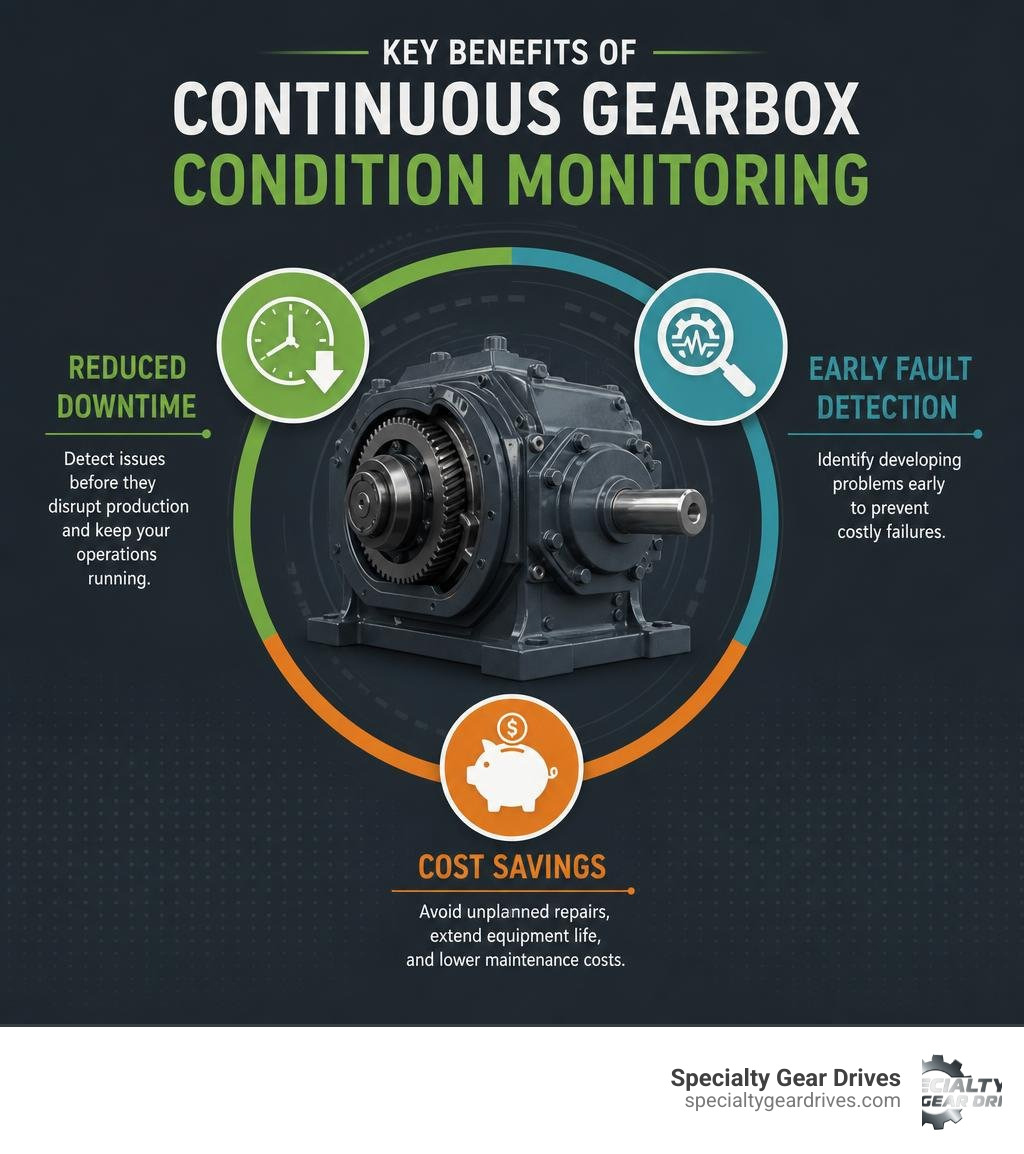
Gearbox condition monitoring is the practice of continuously tracking the health of your gearboxes, using vibration, oil analysis, temperature, and other signals, to catch faults before they cause unplanned shutdowns.
Quick answer: what does gearbox condition monitoring involve?
| Method | What It Detects | How Early |
|---|---|---|
| Vibration analysis | Tooth wear, bearing faults, misalignment | Weeks to months before failure |
| Oil-particle monitoring | Internal gear and bearing debris | Months, sometimes up to a year in advance |
| Temperature monitoring | Lubrication breakdown, overloading | Days to weeks before failure |
| Oil-quality sensors | Contamination, fluid degradation | Weeks to months before failure |
If you run a plastics extruder, a pulp mill digester, or any production line that depends on gearboxes, this matters directly to your bottom line.
Gearbox failures are not rare edge cases. In one steel company’s maintenance records, gearbox-related failures accounted for 38% of all single-equipment failures. And when a gearbox goes down without warning, you’re not just looking at a repair bill. You’re looking at halted production, OEM lead times measured in weeks, and the kind of scramble that ruins a quarter.
The good news? Research shows that 65% of all failures could be prevented through proper equipment inspection and monitoring. Predictive maintenance, the strategy that condition monitoring enables, has been shown to reduce unplanned shutdowns by 70% and cut overall maintenance costs by 25% compared to time-based preventive maintenance.
This guide walks you through exactly how to build a gearbox condition monitoring strategy that works in the real world: which sensors to use, which signals to trust, and how modern analytics can tell you what your gearbox is trying to say before it stops saying anything at all.
The Mechanics of Gearbox Failure and Vibration Analysis
To catch a gearbox failure early, we have to understand how it breaks. Industrial gearboxes are mechanical marvels, but they live in a world of high torque, heavy loads, and continuous stress. Over time, these forces take their toll.
Vibration analysis is the primary tool we use to peer inside a sealed metal casing. When a gear tooth is perfect, it rolls and slides against its partner with predictable, smooth forces. But when something goes wrong, whether it is tooth wear, misalignment, or a bearing starting to pit, those smooth forces turn into harsh, repetitive impacts. These impacts travel through the gears, shafts, and bearings, eventually vibrating the outer casing of the gearbox.
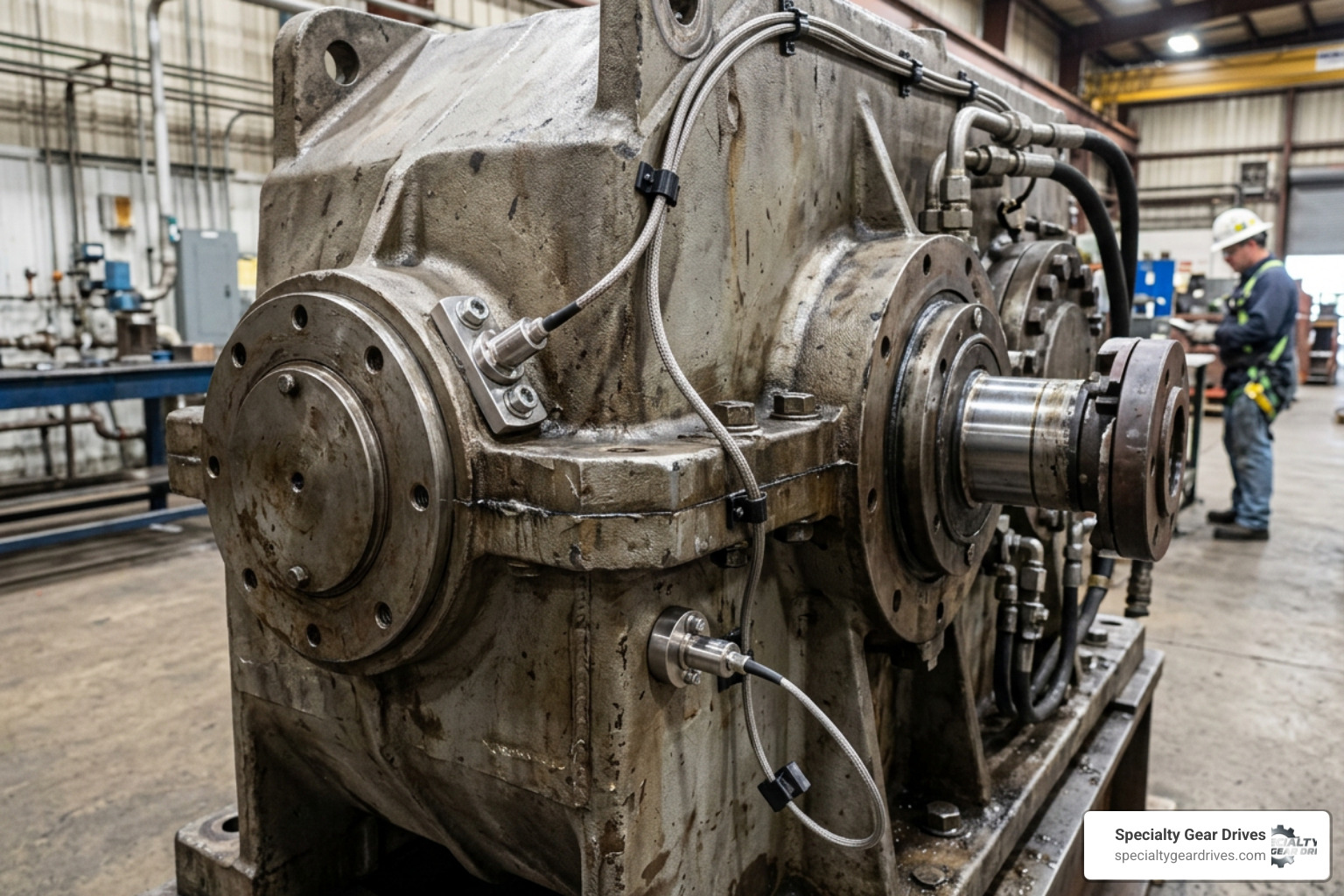
By mounting sensors called accelerometers directly to the gearbox casing, we can record these vibrations. The resulting signal is a messy mixture of overlapping waves. Our job is to isolate the specific frequencies within that signal to determine exactly which component is complaining.
Tracking Gear Mesh Frequency in Gearbox Condition Monitoring
Every time a pair of gears meshes together, it produces a vibration at a very specific frequency. This is called the Gear Mesh Frequency (GMF). Calculating it is straightforward:
GMF = Number of Teeth on the Gear × Shaft Rotational Speed
Unlike bearings, which only make noise when they are damaged, gear mesh frequencies are present even in a brand-new, perfectly healthy gearbox. The teeth are constantly coming into contact, so a baseline hum is completely normal.
However, as a gearbox degrades, the shape of this GMF signal changes. We look at three main indicators:
- GMF Harmonics: These are multiples of the base GMF (2x GMF, 3x GMF). As tooth profiles wear down, the energy shifts into these higher harmonics.
- Sidebands: These are peaks that appear on either side of the GMF peak in a frequency spectrum. They are spaced at intervals equal to the rotational speed of the shafts. When a gear is misaligned or has a local defect, it modulates the GMF, causing these sidebands to grow.
- Side Band Energy Ratio (SER): This metric compares the energy in the sidebands to the energy of the main gear mesh frequency. A rising SER is one of the most reliable indicators of localized gear damage.
For a deeper dive into the specific mathematical indicators used to track gear degradation, you can refer to the guide on Condition Indicators for Gear Condition Monitoring – MathWorks.
Common Failure Modes and Their Vibration Signatures
Different physical problems leave different fingerprints in the vibration data. Here are the three most common failure modes we encounter:
- Tooth Breakage and Cracks: A cracked or broken tooth causes a sudden, sharp impact once per revolution of the affected gear. In the frequency spectrum, this manifests as a dramatic increase in the shaft running speed harmonics and a broad family of sidebands around the GMF. In the time domain, you will see distinct, periodic spikes.
- Pitting and Spalling: This is surface fatigue where small chunks of metal flake off the gear teeth. As the pitted surface rolls through the mesh, it creates high-frequency noise. This causes the GMF harmonics to rise and generates a dense cluster of sidebands.
- Bearing Wear: Rolling element bearings (REBs) have their own unique fault frequencies based on their geometry (inner race, outer race, cage, and ball spin frequencies). As a bearing wears out, it generates high-frequency vibrations that can eventually modulate the gear mesh frequencies.
A comprehensive look at how these signatures manifest in large-scale industrial assets is detailed in the Vestas V90-3MW Wind Turbine Gearbox Health Assessment Using a Vibration-Based Condition Monitoring System.
Designing the Sensor Suite: High-Speed vs. Low-Speed Gearboxes
There is no one-size-fits-all sensor package for gearbox condition monitoring. A massive, slow-turning kiln drive requires a completely different approach than a high-speed turbo-compressor gearbox.
Sensor Selection and Mounting Configurations
The choice of sensor depends entirely on the operating speed and the type of bearings inside the gearbox:
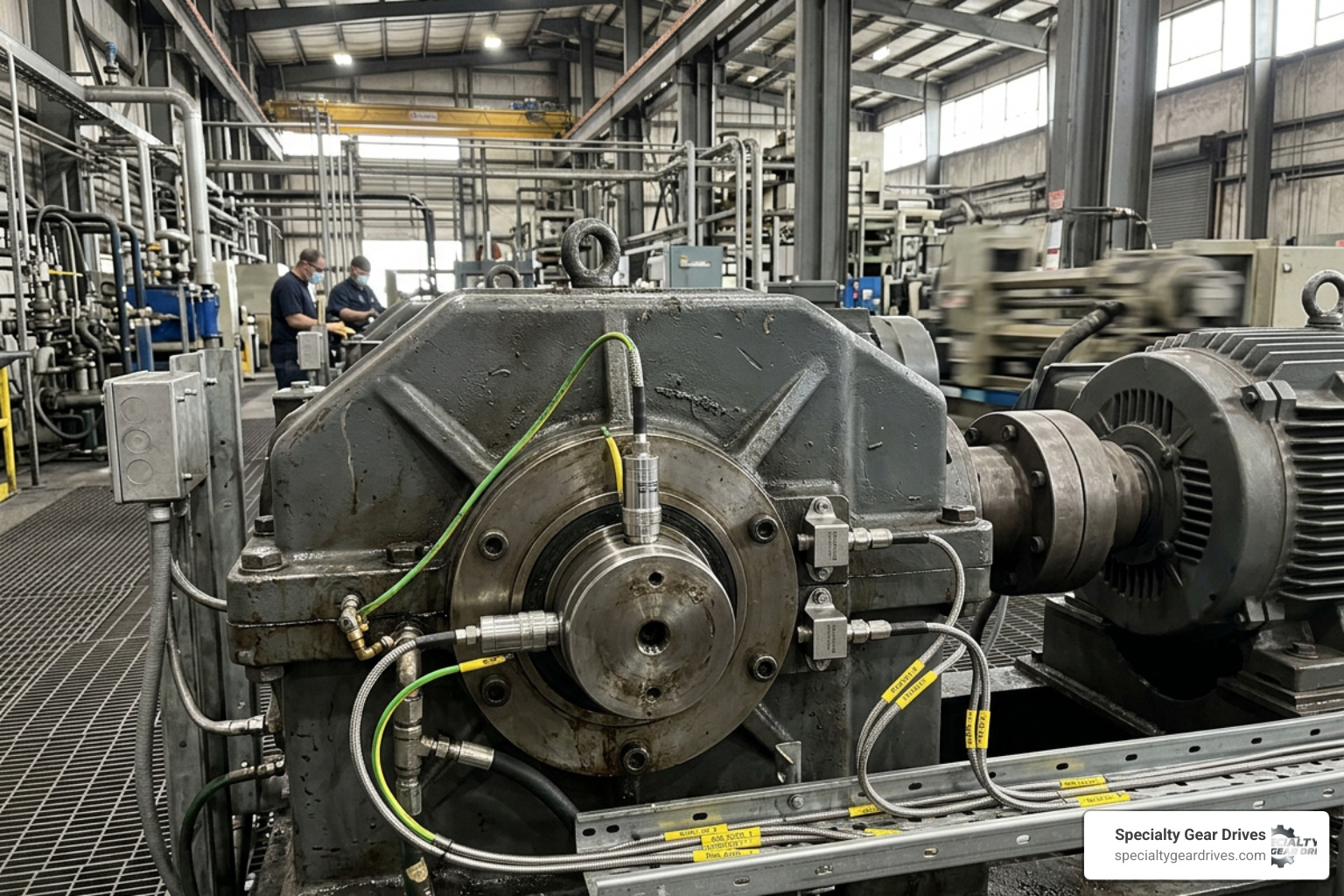
- High-Speed Gearboxes (with Journal Bearings): Because journal bearings rely on a pressurized film of oil rather than rolling elements, the shaft can move relative to the bearing housing. For these machines, we use non-contact proximity probes (displacement sensors) mounted through the bearing housing to measure actual shaft movement (orbits). We pair these with casing-mounted accelerometers and a keyphasor (a phase reference sensor) on each shaft to track exact rotational speed and phase.
- Low-Speed Gearboxes (with Rolling Element Bearings): In slower machinery, the shaft movement is directly transmitted through the rolling elements to the casing. Here, accelerometers and velocity sensors are the standard. For very slow-speed gearboxes (under 100 RPM), standard accelerometers can lose sensitivity. In these cases, we use specialized high-sensitivity, low-frequency accelerometers.
As a rule of thumb, we recommend placing at least one accelerometer per gear stage, along with at least one axial accelerometer to catch thrust-load issues.
Beyond Vibration: The Role of Oil and Temperature Monitoring
While vibration analysis is incredibly powerful, it is only one piece of the puzzle. A truly robust predictive maintenance strategy combines vibration data with oil analysis and temperature measurements. This is known as multi-sensor fusion.
For example, tracking oil temperature is an excellent way to monitor overall thermal health. You can read more about this in the study on the Condition Monitoring Method for the Gearboxes of Offshore Wind Turbines Based on Oil Temperature Prediction.
Integrating Oil-Particle Analysis and Thermal Metrics
More than 80% of all gear damage can be traced back to inadequate lubrication and progressive oil aging. By the time a bearing or gear starts vibrating heavily, physical wear has already occurred.
Online oil monitoring can detect potential gear failures months, or even a year, in advance. We look at several critical parameters:
- Oil-Particle Monitoring: These sensors count the number and size of metallic debris particles suspended in the lubricant. A sudden spike in large metallic particles is a direct warning of active gear or bearing wear.
- Oil-Quality Sensors: These measure relative moisture (humidity), electrical conductivity, relative permittivity, and turbidity. This helps detect water contamination, chemical breakdown, and oil aging before the lubricant loses its ability to protect the metal surfaces.
- Temperature Sensors: Monitoring oil and bearing temperatures provides a baseline of thermal performance. If a bearing starts to fail or the oil degrades, friction increases, leading to a steady rise in temperature.
By integrating vibration sensors with systems like the Innovative Gear Monitoring System for Maximised Uptime or solutions from Poseidon Systems | Real-Time Condition Monitoring Solutions, operators gain a complete, real-time view of both mechanical and chemical health. Other options like the Monitor – Schaeffler medias or Solutions for Condition Monitoring for Predictive Maintenance | NORD also offer excellent hardware integration for industrial environments.
Advanced Analytics: Machine Learning for Gearbox Condition Monitoring
With dozens of sensors streaming high-frequency data, human analysts can easily become overwhelmed. This is where machine learning comes in. AI algorithms can process massive datasets to find subtle patterns that indicate early-stage damage.
| Approach | Advantages | Limitations | Typical Use Case |
|---|---|---|---|
| Supervised Learning (SVM, Random Forest) | Highly accurate; can pinpoint the exact failure mode (e.g., “pinion tooth crack”). | Requires historical, labeled failure data to train the model. | High-value, standardized gearboxes with historical failure records. |
| Unsupervised Learning (Clustering, Autoencoders) | Does not need labeled failure data; learns what “normal” looks like and flags anomalies. | Cannot easily identify why a gearbox is behaving strangely, only that it is. | Unique, custom, or newly installed gearboxes with no failure history. |
Feature Extraction and Selection in Gearbox Condition Monitoring
Before we can feed vibration data into a machine learning model, we have to clean it up and extract meaningful “features.” Raw vibration signals are incredibly noisy. We use signal processing to pull out specific statistical indicators:
- Time-Domain Features: These look at the raw wave over time. Examples include Root Mean Square (RMS) for overall energy, Kurtosis for signal “spikiness” (great for catching early bearing impacts), and Crest Factor to measure the ratio of peak values to RMS.
- Frequency-Domain Features: These focus on specific frequencies, such as the amplitude of the GMF, its sidebands, and specialized gear-mesh metrics like FM4 (which detects localized tooth damage).
Because not all features are equally helpful, we use mathematical ranking techniques like monotonicity to select the features that show a steady, clear trend as the machine degrades. This prevents the model from getting confused by irrelevant data.
For a look at how adaptive models can build reliable health indicators under messy sampling conditions, see the research on Data-Resilient Condition Monitoring of Gearbox using Adaptive Bayesian Regression | Journal of Vibration Engineering & Technologies | Springer Nature Link.
Handling Unlabeled Field Data with Semi-Supervised Learning
In the real world, we rarely have perfectly labeled datasets. Most industrial gearboxes spend their entire lives running normally, meaning 99% of the historical data you collect is from a healthy machine.
To bridge this gap, advanced systems use semi-supervised learning and pseudolabeling techniques. One such method is the Reduced Lagrange Method (R-LM). This algorithm takes unlabeled field data, compares it against known physical models, and periodically assigns “pseudolabels” to the data. This allows us to train highly accurate supervised classifiers even when we don’t have a library of real-world failures to draw from.
For a technical breakdown of this process, you can read the study on Gearbox Condition Monitoring and Diagnosis of Unlabeled Vibration Signals Using a Supervised Learning Classifier.
Minimizing False Alarms and Validating System Performance
A condition monitoring system that cries wolf is worse than no system at all. If your alarm triggers every time the plant changes its production speed or increases the load, operators will quickly learn to ignore the alerts.
To minimize false alarms, modern systems use:
- Adaptive Thresholds: Instead of a fixed alarm limit, the system adjusts its expectations based on current operating conditions (speed, load, ambient temperature).
- Exponentially Weighted Moving Averages (EWMA): This smooths out temporary spikes or noise, requiring a trend to persist before triggering an alert.
When evaluating these systems, we measure success using metrics like precision (avoiding false alarms) and recall (making sure we don’t miss a real fault). For a deeper look at how spatiotemporal networks handle these dynamic operational shifts, refer to A Multivariate Spatiotemporal Feature Fusion Network for Wind Turbine Gearbox Condition Monitoring.
Implementing a Modern Edge-to-Cloud Monitoring Architecture
A complete monitoring setup requires a clear path from the physical machine to the person making maintenance decisions.
- Edge Data Acquisition: High-speed vibration and oil sensors are wired into an edge device mounted near the gearbox. This device handles the heavy lifting of high-frequency sampling and basic signal processing (like calculating RMS or FFTs) right on-site.
- Cloud Analytics: The processed edge data is sent to a secure cloud platform. Here, machine learning models analyze long-term trends, compare data across multiple machines, and predict the Remaining Useful Life (RUL) of the components.
- Expert Dashboards: The results are displayed on a simple, intuitive dashboard. Instead of showing confusing raw wave signals, the dashboard uses clear indicators (like green, yellow, and red status lights) and provides actionable recommendations (e.g., “Schedule pinion bearing replacement within the next 4 weeks”).
Frequently Asked Questions about Gearbox Health
What is the most common cause of industrial gearbox failure?
Inadequate lubrication and progressive oil aging account for over 80% of all gear and bearing damage. When oil loses its viscosity, gets contaminated with water, or runs low, metal-on-metal contact quickly leads to rapid wear and overheating. Keeping your oil clean, dry, and cool is the single best thing you can do for your gearbox. If the damage is already done, professional Industrial Gearbox Repair is required to restore the housing, shafts, and gears to their original specifications.
How early can condition monitoring detect a potential gearbox failure?
It depends on the technology you use. While vibration analysis can warn you of bearing and gear wear weeks or months in advance, online oil-particle monitoring can detect active wear up to a year before a catastrophic breakdown occurs. For highly critical setups, such as those requiring specialized Planetary Gearbox Repair, catching these signs early is the difference between a simple bearing swap and a complete rebuild.
Can condition monitoring prevent all gearbox failures?
No system can prevent 100% of failures, especially those caused by sudden, extreme overloads or manufacturing defects. However, continuous monitoring combined with regular visual inspections can prevent roughly 65% of all common failures. When gears are worn beyond repair, we combine advanced monitoring data with Custom Gear Manufacturing to produce replacement gears that are often stronger and more resilient than the originals.
Conclusion
Implementing a gearbox condition monitoring strategy is not just about keeping machines running; it is about taking control of your maintenance schedule, protecting your budget, and keeping your operations running smoothly.
At Specialty Gear Drives, we help industrial operations across Florida and the wider USA keep their critical machinery healthy. Based in Largo, Florida, we specialize in repairing and rebuilding industrial gearboxes for demanding industries like plastics, food processing, and pulp and paper.
When things do go wrong, we offer 24-to-48-hour emergency service, free pickup and delivery, and savings of up to 60% compared to the cost of buying a brand-new unit — all backed by our industry-leading 24-month warranty.
Ready to secure your machinery and your peace of mind? Contact us today at Specialty Gear Drives to discuss how we can support your predictive maintenance and gearbox repair needs.